


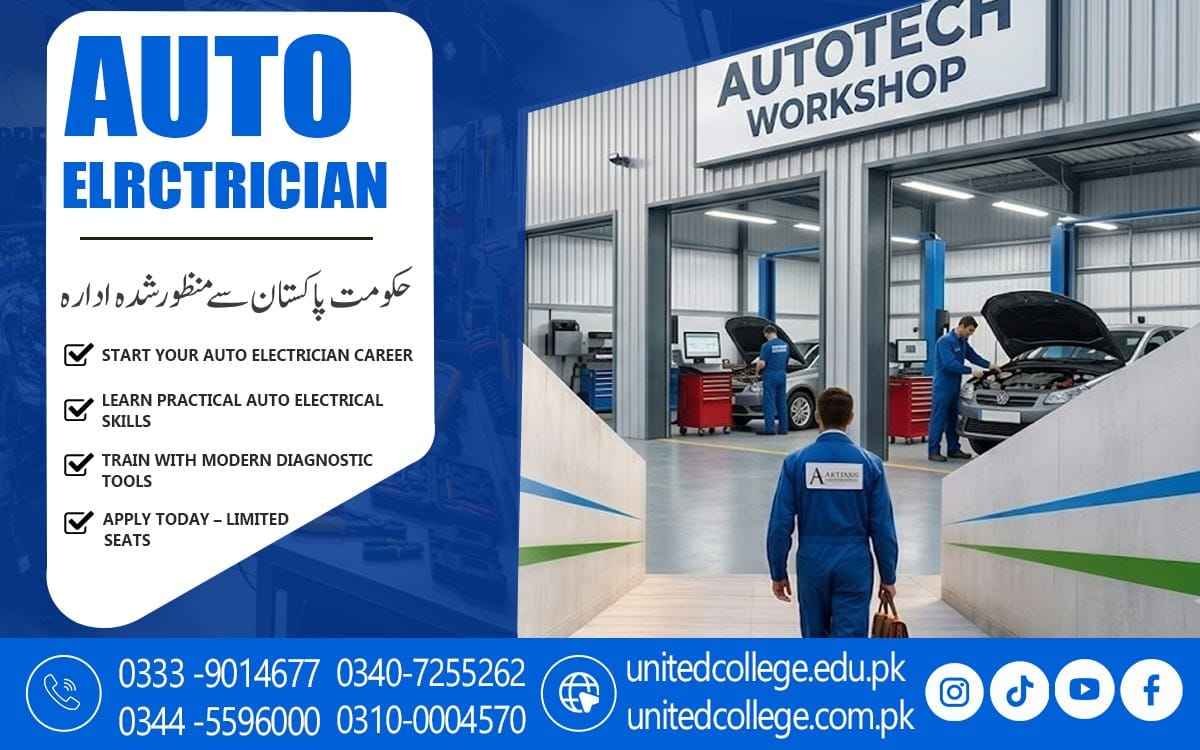

Auto Electrician Course in Gawadar for Practical Vehicle Skills
Master Modern Vehicle Electrical Systems with Practical Auto Electrician Training
Modern vehicles depend on electrical systems to start the engine, power lights, operate sensors, and support essential driving functions. When an electrical component stops working, identifying the actual fault requires technical knowledge, careful inspection, and the correct use of tools. This makes automotive electrical skills valuable for people interested in vehicle repair and maintenance.
The Auto Electrician Course in Gawadar provides a learning path for beginners who want to understand how vehicle electrical systems work and how technicians identify common electrical problems. Instead of relying only on theory, learners can focus on practical concepts related to wiring, batteries, ignition systems, starters, and alternators.
Develop Hands-On Automotive Knowledge Through Professional Training
Learning auto electrical work involves more than recognizing vehicle parts. A technician needs to understand how electrical power moves through different circuits and how individual components work together. The Auto Electrician Course in Gawadar, offered by United College of Technology, introduces learners to important concepts used in automotive electrical systems.
This type of Auto Electrical Training can help beginners develop a stronger understanding of automotive repair tasks. It also introduces the careful working methods needed when inspecting electrical components. Through Vehicle Electrical System Training, learners can become familiar with the relationship between batteries, charging systems, starting systems, lighting, and other electrical features found in vehicles.
Build Strong Skills in Vehicle Wiring, Batteries, and Starting Systems
Vehicle wiring is one of the important areas of automotive electrical work. Wires, connectors, fuses, and switches allow electrical power to reach different vehicle components. During Vehicle Wiring Training, learners can study basic wiring layouts, connection points, circuit protection, and methods for identifying damaged or loose connections.
Learners can study battery condition, terminal inspection, and basic voltage testing under suitable supervision. Starter and Alternator Repair concepts also help explain how the starting and charging systems operate. The starter helps turn the engine during startup, while the alternator supplies electrical power and charges the battery when the engine runs.
Understand Lighting Circuits, Ignition Systems, and Modern Vehicle Sensors
Automotive electrical systems include many components that support vehicle operation and driver safety. Headlights, indicators, brake lights, interior lights, and dashboard warning lamps depend on properly functioning circuits. A fault in these systems may result from damaged wiring, a faulty bulb, a poor connection, or another component problem. An Auto Electrician Course in Gawadar introduces learners to the basic operation of these circuits and the importance of checking them carefully.
Ignition systems are another key subject because they help control the process required to start and run an engine. Modern vehicles may also use sensors to monitor different operating conditions and send information to electronic control systems. Learning about these components helps students develop Automotive Repair Skills and understand why electrical diagnosis can require more than a simple visual inspection.
Learn Car Electrical Troubleshooting with Diagnostic Tools
Finding the cause of an electrical problem requires a logical, step-by-step process. Replacing parts without checking the fault can waste time and may fail to solve the actual issue. Through Car Electrical Troubleshooting, learners can study how to inspect symptoms, examine wiring connections, check fuses, and test electrical components. Automotive Diagnostic Tools, including a digital multimeter and suitable test equipment, can help technicians measure voltage, resistance, and continuity when used correctly.
Vehicle Electrical Fault Diagnosis also involves comparing test results with appropriate specifications instead of making assumptions about the problem. For example, a vehicle that fails to start may have a weak battery, a damaged connection, a starter issue, or another fault. Learning to check possible causes systematically helps beginners understand the importance of accurate testing and careful decision-making in automotive repair.
Strengthen Practical Auto Electrician Skills Through Workshop-Based Learning
Practical experience plays an important role in developing confidence with automotive electrical systems. Reading about a circuit can explain how it works, but inspecting real components and carrying out supervised tests can make the information easier to understand. Auto Electrician Course in Gawadar can help learners become familiar with common tools, electrical connections, wiring diagrams, and testing procedures.
Practical activities may include identifying vehicle components, examining battery terminals, checking lighting circuits, and learning basic fault-finding techniques, depending on the training arrangements. Learners should also understand electrical safety before handling tools or working near vehicle systems.
Prepare for Technical Learning in Automotive Repair Environments
The Auto Electrician Course in Gawadar can be considered by students, beginners, fresh learners, job seekers, and individuals interested in understanding vehicle electrical systems. It may also suit people who want to expand their knowledge of automotive repair or explore a technical trade. Prior experience can be helpful, but beginners can start by learning basic electrical concepts and gradually progress to more detailed systems.
Automotive Electrical Course topics can provide a foundation for understanding the work carried out in vehicle workshops, repair centers, and automotive service environments. With continued practice, learners may improve their ability to inspect electrical components, understand wiring problems, and assist with basic diagnostic tasks.
Turn Automotive Electrical Knowledge into a Practical Technical Skill
Understanding vehicle electrical systems can open a useful learning path for people who enjoy practical work and problem-solving. From testing a battery to understanding an alternator or tracing a wiring fault, each skill contributes to a better understanding of automotive repair. The Auto Electrician Course in Gawadar offers an opportunity to explore these technical areas through structured learning and practical skill development.
Learners should focus on understanding how components function, using diagnostic tools correctly, following safety procedures, and practising fault identification rather than memorising information alone. The training offered by United College of Technology can be a starting point for those interested in building automotive electrical knowledge.
Frequently Asked Questions (FAQs)
A wiring diagram uses symbols and lines to show electrical connections. Learning these symbols helps technicians trace circuits and understand how different vehicle components connect.
An electrical fault may involve damaged wires, weak connections, or faulty sensors. A mechanical fault usually affects physical parts such as belts, gears, or engine components. Correct inspection helps distinguish between them.
Dashboard warning lights alert drivers to possible problems in vehicle systems. An auto electrician can learn how to investigate electrical warnings, check related components, and use suitable diagnostic methods to identify potential faults.
Beginners can learn to use a digital multimeter, wire strippers, insulated screwdrivers, test lights, and appropriate circuit-testing equipment. Understanding each tool's purpose and safety requirements is essential before practical use.
Different vehicles may use different wiring layouts, electronic controls, and component designs. Strong electrical fundamentals help technicians understand unfamiliar systems and follow the correct technical information for each vehicle.
Yes. Electrical knowledge can help people understand additional lighting, accessory connections, and power requirements. However, modifications should follow vehicle specifications, circuit protection requirements, and applicable safety standards.
Admission Open: Start Your Professional Journey Today!
Join United College of Technology and build a career with practical training, recognized certifications, and Gulf job support. Seats are limited.
Apply Now via WhatsAppContact Information
- Address: Rawalpindi: F-272 Main New Katarian Stop, Old IJP Road | Lahore Campus: Lahore, Pakistan
- Phone/WhatsApp: 0340-7255262 / 0333-9014677 / 0301-5044340 / 0310-0004570 / 051-8770756
- Website: unitedcollege.edu.pk
















Leave a Comment