


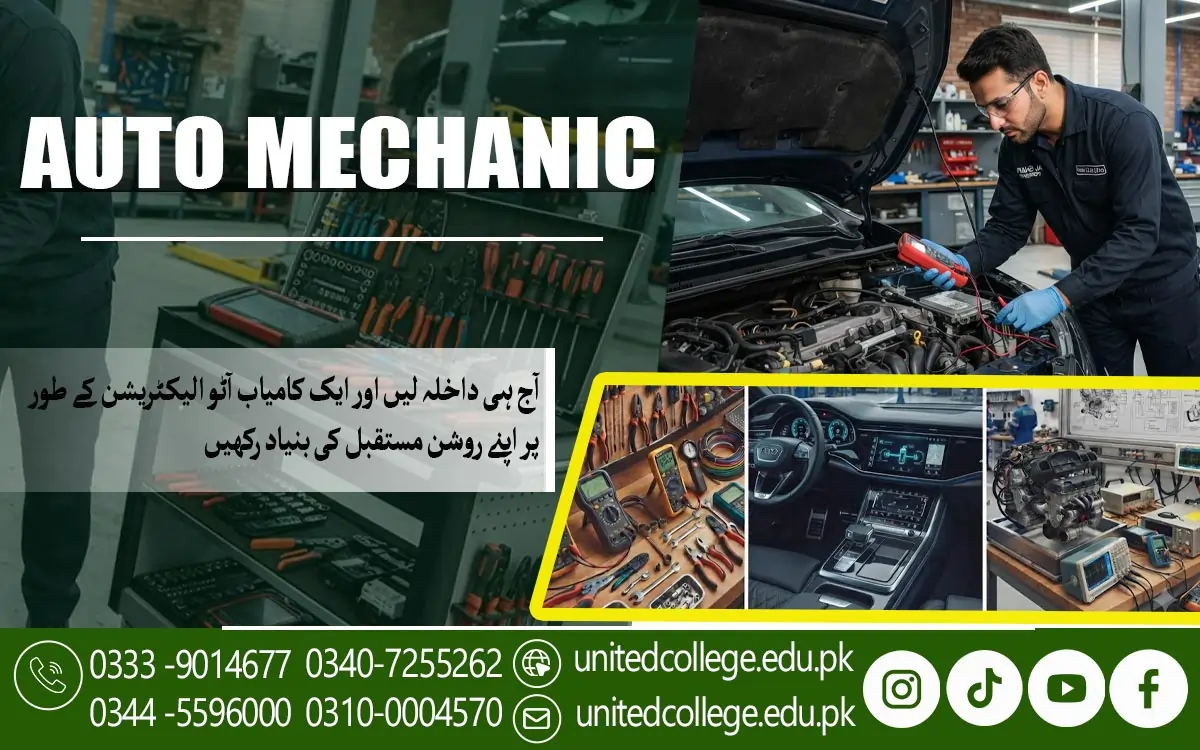

Auto Mechanic Course in Khanewal – Learn Practical Repair Skills
Auto Mechanic Course in Khanewal – Build Practical Automotive Skills
A car may look simple from the outside, but a lot is happening under its bonnet and inside its different systems. When an engine starts making an unusual sound, the brakes feel weak, the battery stops working, or a vehicle refuses to start, someone with the right skills is needed to understand the problem. This is where practical automobile mechanic training becomes valuable. For students, beginners, and job seekers who enjoy working with vehicles, an Auto Mechanic Course in Khanewal can be a useful way to turn an interest in cars into practical technical skills.
Instead of only learning through books, learners can become familiar with vehicle components, servicing procedures, workshop tools, inspection methods, and common repair tasks. United College of Technology offers technical education with a practical approach, helping learners understand important automotive workshop skills and develop a stronger foundation for a future in vehicle repair and maintenance.
Turn Your Interest in Cars Into a Practical Career Skill
Many people enjoy cars but do not know how to turn that interest into something useful. They may watch mechanics repairing engines, changing parts, checking electrical faults, or servicing vehicles, yet they may not know where to begin themselves. A structured Auto Mechanic Course in Khanewal can provide that starting point by introducing learners to automobile technology simply and practically. Students can gradually learn how different vehicle components work together and why regular maintenance is important. An automotive repair course is not only about learning how to replace a damaged part.
It is also about learning how to inspect a vehicle, understand symptoms, use tools correctly, and approach a repair problem carefully. This practical mechanic training can be especially useful for people who prefer learning by doing rather than studying only theory. With regular practice, learners can become more comfortable working around vehicles and begin developing mechanical repair skills that can be useful in workshops, garages, service centers, and other automotive workplaces.
Understand What Is Happening Inside the Engine
The engine is one of the most important parts of a vehicle, and understanding its basic operation is an important part of mechanic training. Beginners do not need to become experts immediately. They first need to understand the purpose of major engine components and how they work together to help a vehicle run. During an Auto Mechanic Course in Khanewal, learners can explore areas related to engine inspection, engine maintenance, common faults, and basic engine repair training. They can learn how to recognize signs that something may not be working correctly, such as unusual sounds, poor performance, starting difficulties, overheating, or other common symptoms.
Learning to observe these signs can help a beginner approach car engine troubleshooting more logically instead of simply guessing which part needs replacement. The training can also introduce learners to routine checks and maintenance practices that help keep an engine in better working condition. Understanding the engine in this practical way gives students a stronger foundation for dealing with real vehicles and prepares them for more advanced automotive technician skills as their experience grows.
Keep Vehicles Reliable With Regular Servicing and Maintenance
A mechanic's work is not limited to repairing a vehicle after something has already gone wrong. Regular servicing and preventive maintenance are equally important because small problems can sometimes become more serious when they are ignored. A good vehicle maintenance course can help learners understand common servicing tasks such as checking fluid levels, inspecting important components, performing oil changes, checking filters, examining belts and other visible parts, and carrying out basic vehicle inspections. Car service and maintenance require attention to detail because different vehicles can have different requirements.
Students can learn why maintenance schedules matter and how routine checks can help identify possible issues earlier. Practical training also helps learners understand how to organize workshop tasks and complete them carefully rather than rushing through the job. These skills can be useful when working with customers who depend on their vehicles for daily travel, business, family needs, or transportation. Developing good maintenance habits can therefore become an important part of becoming a responsible and professional auto mechanic.
Learn How Brakes, Clutch, Steering, and Suspension Work
When a driver presses the brake pedal, changes gears, turns the steering wheel, or drives over an uneven road, several vehicle systems are involved. A mechanic needs to understand these systems because problems in them can affect the safety, comfort, and performance of a vehicle. Practical automotive workshop training can introduce students to brake system repair, clutch-related maintenance, steering components, and suspension systems in an easy-to-understand manner. Learners can become familiar with the purpose of these parts, signs of common problems, inspection methods, and basic repair procedures.
For example, unusual braking sounds, a difficult clutch pedal, uneven steering, or excessive vehicle movement can indicate that a system needs attention. A car mechanic course can teach students how to approach these situations carefully and identify possible causes before carrying out repair work. The goal is not simply to memorize component names. It is to develop the ability to observe a vehicle, understand what the driver is experiencing, inspect the relevant area, and perform appropriate maintenance or repair work safely.
Discover the Electrical Problems Hidden in Modern Vehicles
Modern cars depend on electrical systems for many functions, so an auto mechanic needs at least a basic understanding of vehicle electrical systems. A vehicle may have problems with lights, battery connections, starting, charging, switches, sensors, or other electrical components. For a beginner, these problems can seem confusing because the fault may not always be visible. An Auto Mechanic Course in Khanewal can introduce learners to basic car electrical systems and common electrical faults in a practical manner. Students can learn how to inspect connections, identify obvious signs of electrical problems, use suitable testing tools, and follow a logical troubleshooting process.
This does not mean every learner becomes an advanced automotive electrician immediately. Instead, the aim is to give future mechanics enough knowledge to understand common electrical issues and work more confidently around modern vehicles. As vehicles continue to use more electronic features, developing basic automotive diagnostics and electrical troubleshooting skills can become an important part of a mechanic's long-term professional development.
Learn to Inspect Problems Instead of Guessing
Imagine a customer brings a car to a workshop because it is difficult to start. Simply replacing random parts may waste time and money. A skilled mechanic needs to inspect the vehicle, listen to the customer's description, check possible causes, and then decide what should be tested. This is why vehicle troubleshooting skills are such an important part of practical mechanic training. Students can learn how to approach a problem step by step instead of immediately assuming that one particular component is faulty.
Automotive diagnostics can involve visual inspection, basic testing, checking connections, listening for unusual sounds, and using appropriate diagnostic tools where required. During hands-on automotive training, repeated practice can help learners understand how different symptoms can point toward different problems. This type of thinking is useful across many repair situations, from engine issues to electrical faults and servicing concerns. Good troubleshooting also helps a mechanic communicate more clearly with customers because they can explain what they found and why a particular repair or maintenance task may be needed.
Build Confidence With Tools and Real Workshop Practice
Knowing the name of a tool is very different from knowing how to use it properly. Automobile workshop skills develop through repeated practical work, careful observation, and responsible tool handling. An Auto Mechanic Course in Khanewal can give learners an opportunity to become familiar with commonly used automotive tools and workshop equipment while learning how they are used for inspection, servicing, adjustment, and repair tasks. Practical experience can also teach students how to keep tools organized, maintain a clean working area, handle vehicle components carefully, and follow proper workshop procedures.
Safety should remain part of every task. Learners need to understand why protective equipment, careful lifting, correct tool selection, cleanliness, and attention to moving or heated vehicle parts matter. United College of Technology can provide a learning environment where students focus on developing useful technical abilities rather than depending only on theoretical knowledge. The more responsibly learners practice, the more comfortable they can become with workshop situations. Confidence should come from repeated correct practice, not from rushing into complex repair work without proper understanding.
Prepare for Real Automotive Work in Khanewal and Beyond
After developing practical skills, learners can explore different areas of the automotive field. A person with suitable training and experience may work as an Auto Mechanic, Automotive Technician, Car Service Technician, Vehicle Maintenance Technician, Workshop Assistant, Automobile Repair Technician, Engine Service Technician, or Automotive Electrical Assistant. Local workshops, garages, automobile service centers, dealerships, maintenance teams, and related businesses can provide different types of work depending on their requirements. For people living in Khanewal and surrounding communities, learning a practical automobile skill can provide a way to build experience while staying connected to the local automotive market.
With time, a mechanic who develops strong technical ability may also consider working in another city or exploring opportunities abroad where their skills and experience are suitable. Some experienced mechanics may eventually decide to establish their own automobile repair workshop or service business. However, career growth does not come from a course alone. Practical ability, workplace experience, responsible work, customer dealing, communication, and continued learning all play an important role in becoming a dependable professional auto mechanic.
Keep Learning as Vehicles Continue to Change
The automotive industry does not stay the same. New vehicle models can bring different systems, improved electronics, new diagnostic methods, and changing maintenance requirements. This means completing an Auto Mechanic Course in Khanewal should be viewed as the beginning of a learning journey rather than the final step. Beginners can continue improving by working under experienced mechanics, practicing regularly, observing different repair situations, and learning about newer vehicle technologies.
Customers want someone who can listen to their concerns, explain a problem clearly, and treat their vehicle responsibly. Over time, technical knowledge combined with practical experience can create a stronger professional foundation. Whether a learner wants to work in a local garage, join a service center, develop a long-term mechanic career in Pakistan, or eventually operate an independent workshop, consistent practice and a willingness to learn can make a significant difference. The real value of automotive training is not simply knowing how a vehicle works—it is developing the ability to work on vehicles carefully, responsibly, and professionally.
Frequently Asked Questions (FAQs)
An Auto Mechanic Course in Khanewal is practical training designed to help learners understand vehicle maintenance, servicing, inspection, troubleshooting, and common automobile repair tasks.
Students, beginners, school or college graduates, job seekers, and people interested in building practical automotive skills can join an auto mechanic course.
Students can learn about engine maintenance, car servicing, oil changes, brake systems, clutch, steering, suspension, vehicle electrical systems, troubleshooting, and automotive workshop practices.
Yes. Hands-on practice helps learners become familiar with automotive tools, vehicle components, inspection methods, servicing tasks, and safe repair procedures.
Depending on your skills and experience, you may work as an Auto Mechanic, Automotive Technician, Car Service Technician, Vehicle Maintenance Technician, Workshop Assistant, or Automobile Repair Technician.
Admission Open: Start Your Professional Journey Today!
Join United College of Technology and build a career with practical training, recognized certifications, and Gulf job support. Seats are limited.
Apply Now via WhatsAppContact Information
- Address: Rawalpindi: F-272 Main New Katarian Stop, Old IJP Road | Lahore Campus: Lahore, Pakistan
- Phone/WhatsApp: 0340-7255262 / 0333-9014677 / 0301-5044340 / 0310-0004570 / 051-8770756
- Website: unitedcollege.edu.pk
















Leave a Comment