


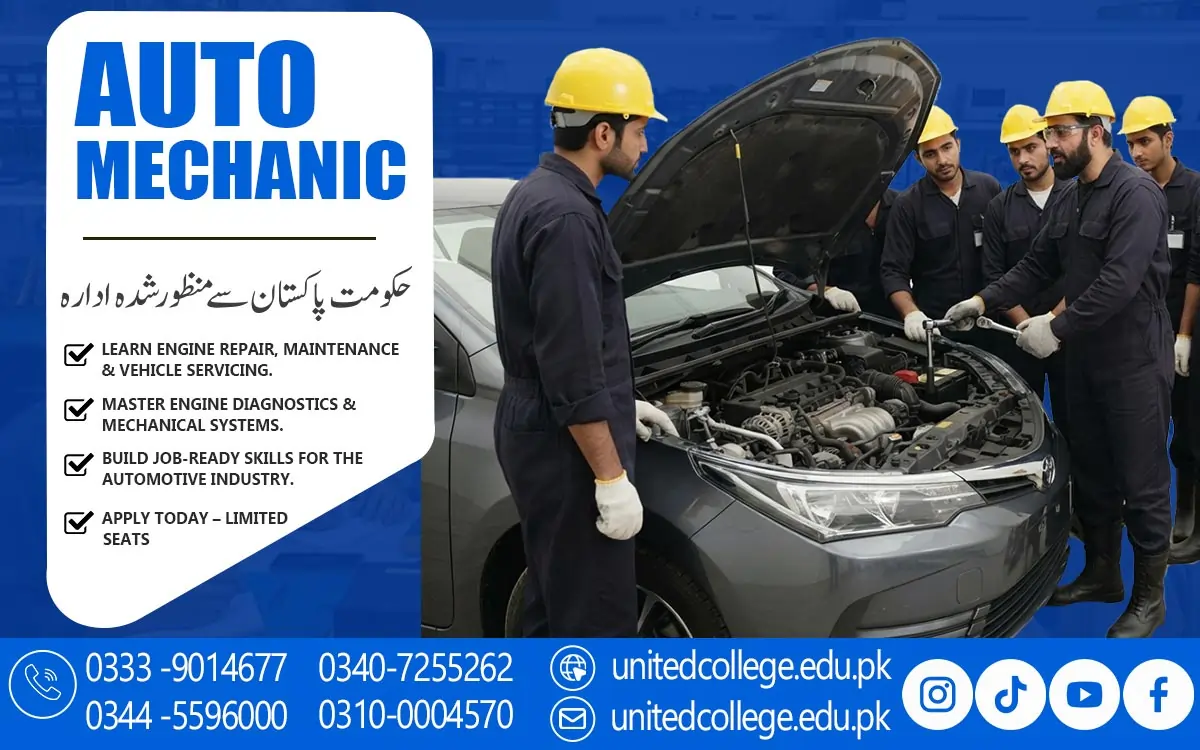

Auto Mechanic Course in Khushab – Develop Practical Mechanic Skills
Build the Skills to Understand, Service, and Repair Vehicles
A vehicle may look simple from the outside, but hundreds of mechanical and electrical parts work together every time it starts, moves, turns, and stops. When something goes wrong, finding the real problem requires more than changing a part and hoping for the best. It requires practical knowledge and careful inspection. The Auto Mechanic Course in Khushab offered by United College of Technology gives beginners a structured way to enter this practical field.
Students can learn how common vehicle systems work, how routine servicing is performed, and how mechanics approach different repair situations. For people who enjoy working with machines, this type of training can turn an everyday interest in automobiles into useful technical knowledge that can continue developing through workshop experience.
Start With the Engine and Learn What Happens Under the Hood
The engine is one of the first areas learners usually want to understand. It changes fuel and air into the power that moves the vehicle, but many supporting components are needed for this process to work correctly. An Auto Mechanic Course in Khushab can introduce students to basic engine parts and their functions in simple language. Learners may study lubrication, cooling, filters, belts, and other components involved in engine operation and maintenance.
Practical activities can help them understand how inspection and routine servicing are performed. Car engine repair is not only about fixing a damaged part; it also involves recognizing signs of wear and understanding how regular care affects performance. Building this foundation can make more advanced mechanical topics easier to understand later.
Turn Routine Servicing Into a Habit of Careful Inspection
Good vehicle maintenance starts before a major breakdown happens. Simple checks can reveal conditions that deserve attention. Students can learn why oil levels, filters, fluid conditions, belts, hoses, and other visible components should be inspected during appropriate servicing procedures. A car servicing course can help learners understand the difference between preventive maintenance and emergency repair.
For example, replacing a worn component at the right time may prevent a larger problem from developing. Learners can also discover how service records and regular inspection support better vehicle care. These lessons are useful because a mechanic's work is not limited to repairing faults after they appear. A skilled technician also helps keep vehicles in better working condition through proper maintenance practices.
Follow the Clues Instead of Guessing the Problem
One of the most useful abilities in automotive work is knowing how to approach an unknown fault. A vehicle that is difficult to start may have several possible causes. Likewise, unusual noise, overheating, weak performance, or warning lights can point toward different areas that need checking. Through automotive diagnostics, learners can understand a step-by-step approach to fault identification.
They can learn to observe symptoms, inspect relevant parts, and consider possible causes before deciding what should be tested next. Vehicle troubleshooting develops patience and logical thinking because the first visible symptom is not always the actual cause. This approach can help beginners become more confident when dealing with vehicle problems and reduce the habit of making unsupported assumptions during repair work.
Explore the Systems That Control Stopping, Turning, and Movement
A vehicle's performance depends on much more than its engine. Students enrolled in an Auto Mechanic Course in Khushab can explore the braking system, clutch, transmission, steering, and suspension system to understand how these areas affect vehicle control and movement. Brake system repair can introduce learners to the importance of inspecting braking components and recognizing conditions that may require attention.
Clutch and transmission lessons can explain how engine power is managed and delivered to the wheels. Steering and suspension topics can help students understand how a vehicle responds to road conditions and driver input. These areas expand a learner's mechanical skills and show why different vehicle complaints require different inspection methods. Such knowledge is an important part of practical auto repair training in Khushab.
Bring Electrical Knowledge Into Traditional Mechanical Work
Today's mechanic also needs a basic understanding of vehicle electricity. Batteries, starters, alternators, fuses, wiring, ignition components, and other electrical parts all contribute to vehicle operation. Students can learn the basic role of these components and understand how electrical problems can affect starting, charging, lighting, and other functions. Automotive repair skills become broader when mechanical and electrical knowledge are learned together.
For instance, a vehicle that does not start may not necessarily have an engine problem. The issue could involve the battery, starter, wiring, or another part of the starting system. Learning to consider these possibilities can improve diagnostic thinking. As vehicles continue to include more electronic features, developing basic electrical awareness can also encourage learners to continue improving their technical knowledge after training.
Make Workshop Practice the Point Where Knowledge Becomes Skill
Technical information becomes more useful when learners have opportunities to apply it. Practical mechanic training can introduce students to common automotive tools, equipment, inspection procedures, and guided servicing tasks. Learners can become familiar with selecting suitable tools and using them responsibly instead of treating every task as the same.
United College of Technology can provide a structured environment where technical lessons are connected with practical exposure. This approach can help beginners become more comfortable around vehicles and develop useful workshop habits. Alongside repair techniques, learners can develop patience, accuracy, organization, and respect for proper procedures.
Give Your New Skills a Direction Beyond the Training Room
An Auto Mechanic Course in Khushab can be a starting point for people who want to build a technical career around automobiles. After completing training, learners can continue developing their abilities through real workshop experience and may explore roles such as automobile technician, workshop assistant, vehicle maintenance worker, service technician, or professional auto mechanic.
Some experienced mechanics may eventually consider independent work, but this usually requires additional technical experience as well as knowledge of tools, customers, costs, and business management. United College of Technology helps learners take an initial step toward this field through structured technical education and practical exposure. For beginners, the most important goal is not to become an expert overnight, but to build a strong foundation and keep improving.
Frequently Asked Questions (FAQs)
It can be a useful option for someone looking to enter a practical technical field. Learners can begin with basic automotive concepts and gradually develop skills through structured training and continued practice.
Some vehicle problems cannot be identified immediately. A mechanic may need to check several possibilities before finding the actual cause. Patience helps prevent rushed decisions and supports more careful repair work.
Basic automotive knowledge can help a person better understand maintenance needs, recognize unusual vehicle behavior, and communicate more clearly with technicians when professional repair is required.
No. Vehicles differ in design and technology, so mechanics continue learning as they encounter new models. A strong understanding of basic automotive principles can make it easier to adapt to unfamiliar vehicles.
Beginners can build good habits by keeping tools organized, following instructions carefully, checking their work, respecting safety procedures, and asking for guidance when they encounter a task they do not understand.
Seeing a vehicle problem become understandable through your own knowledge can make the learning process satisfying. Regular practice also allows students to notice their progress as unfamiliar tasks become easier over time.
Admission Open: Start Your Professional Journey Today!
Join United College of Technology and build a career with practical training, recognized certifications, and Gulf job support. Seats are limited.
Apply Now via WhatsAppContact Information
- Address: Rawalpindi: F-272 Main New Katarian Stop, Old IJP Road | Lahore Campus: Lahore, Pakistan
- Phone/WhatsApp: 0333-9014677 / 0344-5596000 / 0310-0004570 / 0301-5044340 / 0340-7255262
- Website: unitedcollege.edu.pk
















Leave a Comment