


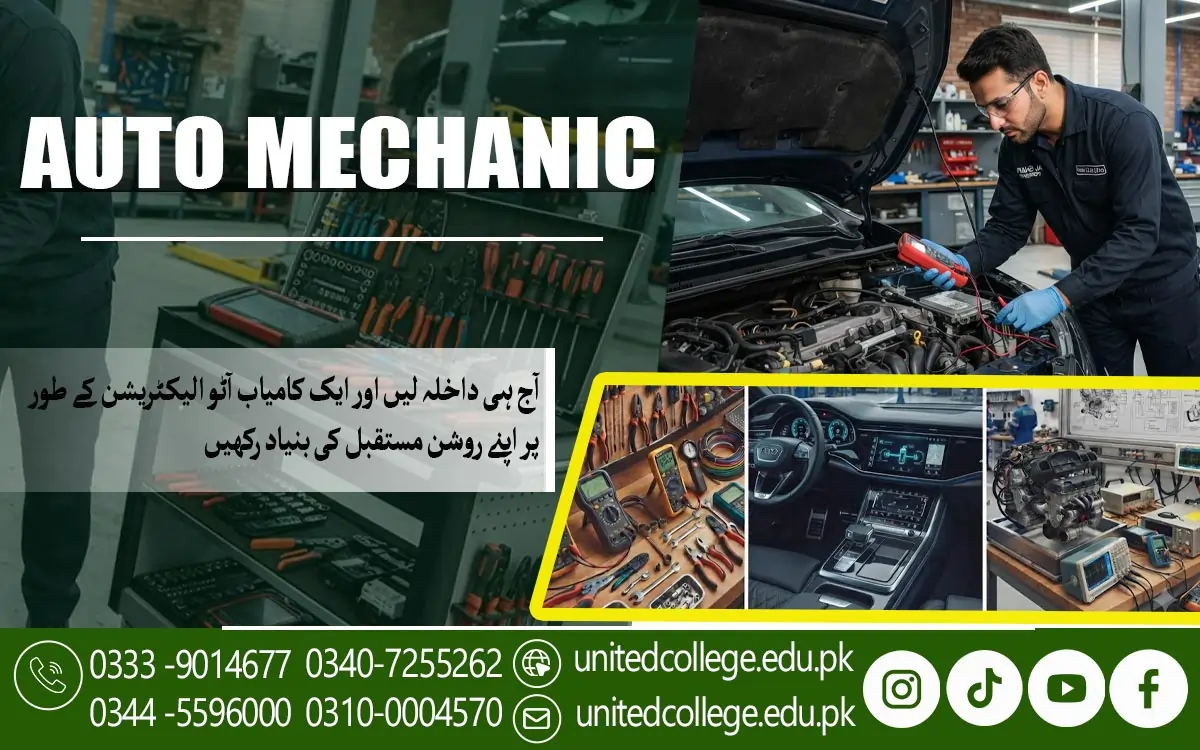

Auto Mechanic Course in Sadiqabad – Train for a Better Career
Auto Mechanic Course in Sadiqabad: Build Practical Automotive Skills
A car can develop a problem when you least expect it. It may refuse to start in the morning, make an unusual engine sound, lose braking performance, or suddenly develop an electrical fault while you are on the road. Finding the real cause of such problems requires proper inspection, basic technical knowledge, and practical repair skills. These situations show why trained mechanics are needed to understand vehicle problems and carry out the right maintenance or repair work.
For students, beginners, job seekers, and car enthusiasts in Sadiqabad, learning automotive skills can be a practical way to develop a useful technical career. The Auto Mechanic Course in Sadiqabad offered by United College of Technology allows learners to understand vehicle systems, engine servicing, maintenance, repair, diagnostics, and troubleshooting through structured automotive training and practical learning.
Turn Your Interest in Cars into a Practical Career Skill
Many young people in Sadiqabad have an interest in cars and enjoy learning how engines, brakes, electrical systems, and other vehicle parts work. However, interest alone is not enough to perform professional repair work. A structured auto mechanic course can help learners turn that interest into practical knowledge by teaching them how to inspect vehicles, understand common faults, use workshop tools, and approach repair tasks carefully.
Learners can start with basic concepts and gradually move toward more practical work as their understanding improves. This type of learning can be especially useful for beginners who want a skill-based career rather than relying only on academic education. At United College of Technology, the Auto Mechanic Course in Sadiqabad is designed to help learners develop useful automotive skills that they can continue improving through workshop experience and regular practice.
Learn Automotive Skills Through Hands-On Workshop Training
Reading about a vehicle system is useful, but practical experience helps learners understand how that knowledge applies to real vehicles. Hands-on automotive training allows students to become familiar with mechanic tools, vehicle components, inspection procedures, servicing tasks, and workshop practices. Instead of simply memorizing the names of parts, learners can understand what those parts do and what may happen when a component develops a fault. Instructor guidance can also help beginners learn how to approach practical tasks safely and systematically.
At United College of Technology, students can develop their skills through practical mechanic training while learning how to handle common automotive tasks. This approach can help build confidence and prepare learners for the type of work they may encounter in automobile workshops, garages, service centers, and other vehicle maintenance environments.
Build a Strong Foundation in Engine Maintenance and Servicing
The engine is one of the most important areas of automobile learning, so beginners need a clear understanding of basic engine operation and maintenance. During an automobile mechanic course, learners can explore engine inspection, routine servicing, maintenance practices, and common signs that may indicate a problem. They can learn why regular checks are necessary and how different engine components contribute to the vehicle's performance.
Basic engine repair training can also introduce learners to the correct way of examining problems rather than immediately replacing parts. Along with engine work, students can develop an understanding of car servicing routines and general vehicle maintenance. These skills provide a useful foundation for anyone who wants to work as a professional auto mechanic and later develop more advanced repair abilities through workplace experience.
Learn How to Find Vehicle Problems Step by Step
A vehicle problem does not always have an obvious cause. If a car fails to start, for example, the issue could be related to the battery, starter, wiring, fuel system, or another important component. Proper vehicle troubleshooting involves checking the symptoms, examining different components, and finding the actual source of the problem instead of simply replacing parts without proper inspection. Learning these basic diagnostic skills through an auto mechanic course can help students understand how mechanics approach different vehicle faults and develop greater confidence during practical repair work.
Engine troubleshooting and vehicle fault identification are therefore important parts of an auto mechanic course. Learners can develop a habit of checking symptoms, examining relevant components, and narrowing down possible causes instead of guessing. Basic car diagnostics and vehicle troubleshooting skills can become increasingly valuable as students gain practical experience. Learning this step-by-step approach can help a beginner become more confident when dealing with different vehicle problems.
Understand Brakes, Clutch, Suspension and Steering Systems
A vehicle has many systems that must work properly for safe and smooth operation. Brakes help the driver control the vehicle, the clutch plays an important role in manual transmission vehicles, suspension components support ride quality and handling, while the steering system allows the driver to control direction. A car mechanic course can introduce learners to these important systems and help them understand common maintenance and repair requirements.
Students can learn the basic purpose of different components and how problems may affect vehicle performance. Brake system repair, suspension system training, clutch inspection, and steering-related maintenance can give learners a broader understanding of automobile repair. Developing knowledge across several vehicle systems can be useful for beginners who want to become versatile mechanics rather than focusing on only one part of a car.
Explore Automotive Electrical Systems and Common Faults
Mechanical knowledge is important, but modern vehicles also depend heavily on electrical systems. Problems involving batteries, wiring, lights, charging systems, starting systems, and other electrical components can affect the way a vehicle operates. An auto mechanic training program can introduce learners to basic automotive electrical systems so they understand how common electrical faults can be identified and inspected.
Beginners can learn why careful checking is necessary when dealing with electrical problems and how different components may be connected. This knowledge can complement mechanical repair skills and make a learner more capable of understanding complete vehicle systems. United College of Technology can help students develop a basic understanding of automotive electrical work as part of their broader practical automotive training.
Develop Safe Workshop Habits and Proper Tool Handling
Every mechanic needs to know how to use tools properly. Wrenches, screwdrivers, inspection equipment, lifting equipment, and other workshop tools are used for different tasks, and incorrect handling can damage components or create safety risks. Practical training gives learners an opportunity to become familiar with tools while understanding when and how they should be used. Workshop safety is equally important because automotive repair involves vehicles, moving components, electrical systems, fluids, and heavy equipment.
At United College of Technology, learners can receive guidance on safe working practices, proper tool handling, organized workshop behavior, and careful inspection. Developing these habits during training can help students become more disciplined and responsible when they eventually enter a professional automotive workplace.
Explore Realistic Career Opportunities After Training
After completing an Auto Mechanic Course in Sadiqabad, learners can explore different entry-level and developing career paths depending on their practical ability and experience. Possible roles may include Auto Mechanic, Automotive Technician, Car Service Technician, Vehicle Maintenance Assistant, Workshop Technician, Automobile Repair Technician, Diagnostic Assistant, or Garage Technician. Students may look for opportunities in automobile workshops, garages, service centers, dealerships, and vehicle maintenance businesses.
Some learners may eventually choose to work independently or provide freelance repair services after gaining enough practical experience. Career development does not happen from a certificate alone; strong technical skills, reliability, customer service, workplace discipline, and continuous learning all matter. As vehicles and automotive technology continue to develop, mechanics who keep improving their knowledge and practical abilities can create more opportunities for themselves.
Keep Improving Your Automotive Skills After the Course
Completing an auto mechanic course should be viewed as the beginning of a learning journey rather than the final step. Vehicles can differ by model, manufacturer, design, and technology, so a mechanic needs to keep learning through practical experience. After training, learners can improve by working alongside experienced mechanics, practicing servicing procedures, studying new vehicle systems, and becoming better at diagnosing faults. Good customer service and professional behavior can also make a difference because mechanics often need to explain vehicle problems and repair requirements clearly.
For learners in Sadiqabad, developing a strong foundation through the Auto Mechanic Course at United College of Technology can provide a starting point for continued growth. With regular practice, patience, and real workshop experience, an interest in cars can gradually develop into valuable professional automotive skills and a practical career path.
Frequently Asked Questions (FAQs)
An Auto Mechanic Course in Sadiqabad is practical training that teaches learners about vehicle maintenance, engine servicing, car repair, troubleshooting, brakes, suspension, steering, and basic automotive electrical systems.
Students, beginners, job seekers, car enthusiasts, and anyone interested in developing practical automotive skills can consider joining an auto mechanic course.
Learners can develop skills related to engine maintenance, car servicing, vehicle troubleshooting, brake system repair, clutch and suspension work, basic electrical systems, diagnostics, and proper tool handling.
Practical training is an important part of learning automotive work. Students can gain hands-on experience with vehicle components, mechanic tools, inspection procedures, and common servicing tasks.
Depending on practical skills and experience, learners can explore roles such as Auto Mechanic, Automotive Technician, Car Service Technician, Workshop Technician, Garage Technician, or Vehicle Maintenance Assistant.
Admission Open: Start Your Professional Journey Today!
Join United College of Technology and build a career with practical training, recognized certifications, and Gulf job support. Seats are limited.
Apply Now via WhatsAppContact Information
- Address: Rawalpindi: F-272 Main New Katarian Stop, Old IJP Road | Lahore Campus: Lahore, Pakistan
- Phone/WhatsApp: 0340-7255262 / 0333-9014677 / 0301-5044340 / 0310-0004570 / 051-8770756
- Website: unitedcollege.edu.pk
















Leave a Comment