


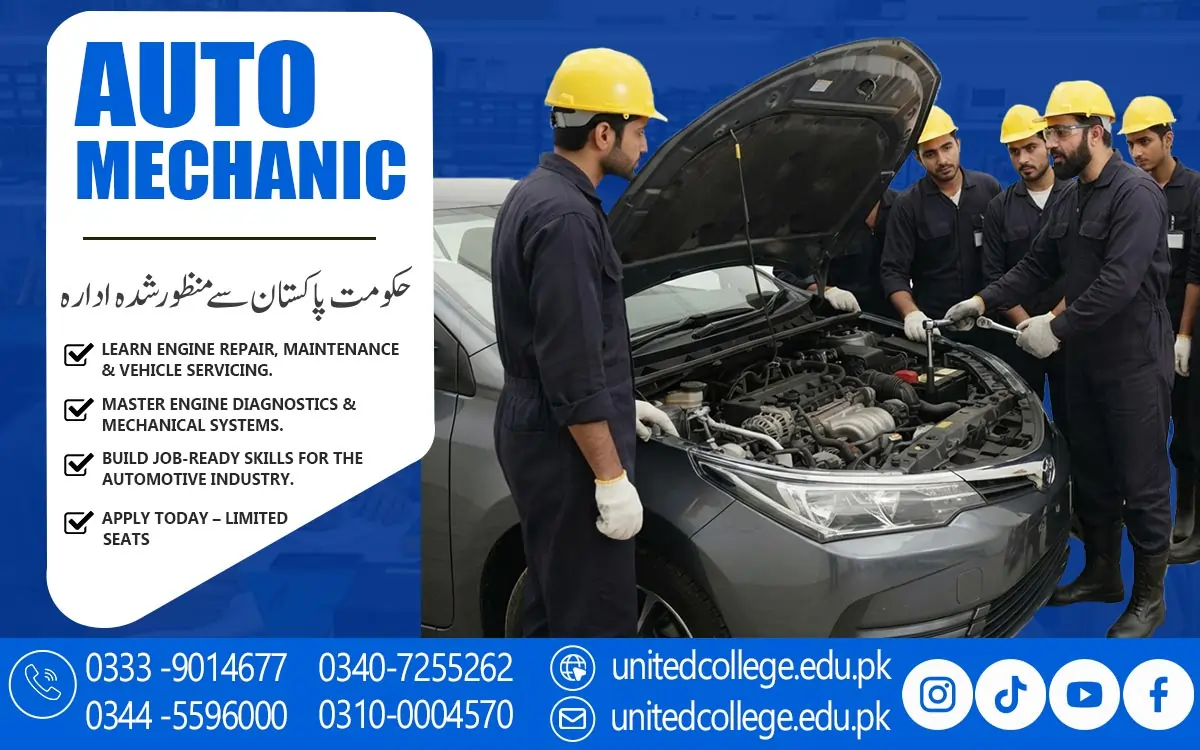

Auto Mechanic Course in Sukkur – Your Path to Automotive Skills
Auto Mechanic Course in Sukkur – Practical Automotive Training
A car can stop working without warning, leaving the owner wondering what went wrong. Sometimes the problem is a weak battery, while in other cases it may be an engine fault, brake issue, electrical problem, or something much smaller that is difficult to notice without proper inspection. Learning how to identify and repair such problems requires practical knowledge rather than simply knowing the names of vehicle parts.
For students, beginners, school and college graduates, and job seekers in Sukkur, automotive training can provide a practical direction for developing a technical career. The Auto Mechanic Course in Sukkur offered by United College of Technology helps learners build a foundation in vehicle maintenance, repair, troubleshooting, diagnostics, and workshop practices.
Skilled Mechanics Help Keep Everyday Vehicles Safe and Reliable
Vehicles are an important part of daily life, and they need regular maintenance to continue operating properly. Cars, motorcycles, commercial vehicles, and other automobiles can experience problems because of regular use, worn components, poor maintenance, or unexpected faults. A skilled mechanic can inspect a vehicle, identify the likely source of a problem, and perform suitable maintenance or repair work.
This makes automotive skills useful for people who want to enter a practical technical profession. Learners in Sukkur can benefit from understanding how vehicles operate and how common problems are handled in a workshop. An auto mechanic course can provide beginners with structured learning so they can gradually understand automobile repair, servicing, maintenance, and troubleshooting instead of trying to learn everything through guesswork.
Learn the Vehicle Systems Behind Everyday Car Problems
A vehicle contains many connected systems, and a mechanic needs a basic understanding of each one. During an Auto Mechanic Course in Sukkur, learners can study areas such as engine maintenance, oil and filter service, brake systems, steering, suspension, transmission, cooling systems, and basic automotive electrical components. Students can learn what these systems do, how they contribute to vehicle operation, and what kinds of problems may occur when a component does not work properly.
Understanding these areas can make it easier for a beginner to approach automobile repair in an organized way. Instead of focusing only on engine work, learners can develop broader vehicle maintenance skills that may be useful when dealing with different servicing and repair requirements. This foundation can also make it easier to develop more advanced automotive skills through continued practice and workplace experience.
Learn How to Identify the Actual Cause of a Vehicle Fault
One of the most useful skills for a mechanic is knowing how to investigate a problem before attempting a repair. A car that does not start, for example, may have a battery issue, starter problem, wiring fault, fuel-related problem, or another cause. An engine that overheats may also have several possible reasons, so simply replacing one component without inspection may not solve the actual problem. Vehicle troubleshooting teaches learners to look at symptoms, inspect relevant components, and gradually narrow down possible causes.
Through car diagnostic skills, students can learn how to approach a vehicle fault step by step instead of making assumptions. This method is especially useful for beginners because it develops logical thinking alongside technical knowledge. With repeated practice, learners can become more confident in identifying problems and deciding which areas need further inspection or repair.
Hands-On Mechanic Training Builds Real Workshop Confidence
Automotive repair is not a field that can be fully learned through classroom theory alone. Students need to become familiar with actual vehicle components, mechanic tools, workshop procedures, servicing tasks, and repair methods. An Auto Mechanic Course allows beginners to connect technical knowledge with practical automotive work and understand how different tasks are performed in a workshop. Hands-on mechanic training allows learners to see how technical information is applied during real work.
Practical training can also introduce them to inspection routines, maintenance procedures, component handling, and basic repair work. At United College of Technology, practical automotive learning is used to help students develop confidence while building their understanding of vehicle systems. This type of automotive workshop training can give learners a clearer idea of what to expect when they begin working in garages, workshops, service centers, or other automotive environments.
Develop Useful Engine Repair and Vehicle Maintenance Skills
Engine maintenance is an important part of automotive learning because many vehicle owners depend on regular servicing to keep their cars working properly. Students can learn about routine engine inspections, oil and filter changes, basic servicing, starting problems, overheating, unusual sounds, and other common engine concerns. Engine repair training can help learners understand that a particular symptom does not always have one obvious cause.
They can learn to inspect the engine carefully and understand the importance of proper maintenance before attempting more complicated repair work. Along with engine skills, students can develop knowledge of general car maintenance, including checking important components and recognizing signs that a vehicle may require attention. These skills can help create a strong foundation for learners who want to work as an automobile technician or develop their abilities further through practical experience.
Build Safety Habits Before You Enter a Professional Workshop
Technical ability is only one part of becoming a good mechanic. Safe working habits are equally important because automotive workshops involve heavy components, tools, electrical systems, fluids, lifting equipment, and moving vehicle parts. Students need to learn how to handle tools correctly, keep their workspace organized, inspect equipment, and follow safe procedures during repair and maintenance tasks. Using suitable protective equipment where required and avoiding careless working methods can also help reduce unnecessary risks.
Workshop safety should become a normal part of every practical task rather than something remembered only when a problem occurs. Through practical mechanic training, learners can develop greater awareness of safe vehicle inspection and repair practices. These habits can later help them work more responsibly when they enter an automobile workshop or service environment.
United College of Technology Connects Learning with Practical Skills
For a beginner, the right learning environment can make automotive education easier to understand. United College of Technology offers the Auto Mechanic Course in Sukkur with an emphasis on practical automotive learning, skill development, instructor guidance, and workshop-based experience. Learners can build their understanding of vehicle systems while becoming familiar with maintenance procedures, mechanic tools, troubleshooting methods, and common repair tasks.
The purpose of this training is to give students a useful technical foundation rather than suggesting that a short course alone can replace years of professional experience. Students can use the knowledge and practical skills they develop during training as a starting point for further workplace learning. With continued practice and exposure to different vehicles, they can gradually improve their confidence and ability.
Explore Automotive Career Opportunities After Your Training
After developing basic automotive skills and gaining practical experience, learners can explore different career paths within the automobile repair and maintenance field. Depending on their abilities and experience, they may consider roles such as Auto Mechanic, Automobile Technician, Workshop Assistant, Vehicle Maintenance Technician, Service Center Worker, Garage Technician, or related positions. Automobile workshops, garages, service centers, dealerships, and vehicle maintenance businesses can provide different types of work environments.
Some experienced mechanics may also decide to work independently after developing sufficient technical ability, customer-dealing skills, and practical confidence. Career development is usually a gradual process, and a certificate does not automatically guarantee a job or a particular income. Strong practical performance, reliability, communication, problem-solving ability, and willingness to continue learning can all influence a mechanic's progress over time.
Keep Developing Your Skills for a Long-Term Automotive Career
Completing an Auto Mechanic Course in Sukkur should be seen as the beginning of a practical learning journey rather than the end of it. Every vehicle can present different challenges, and mechanics often become better at their work by dealing with real problems repeatedly. After completing training, learners can improve by working alongside experienced mechanics, practicing servicing procedures, learning about newer vehicle systems, and developing stronger diagnostic and troubleshooting skills.
Customer dealing is another useful area because a mechanic needs to explain vehicle problems, repair requirements, and maintenance work in a clear and respectful way. For learners in Sukkur, starting with practical training at United College of Technology can provide a foundation for building these abilities step by step. With regular practice, workplace experience, professional habits, and a willingness to keep learning, a simple interest in cars can develop into valuable automotive skills and a long-term career path.
Frequently Asked Questions (FAQs)
The Auto Mechanic Course in Sukkur is practical training designed to teach learners about vehicle repair, maintenance, engine servicing, troubleshooting, brakes, suspension, steering, transmission, and basic automotive electrical systems.
Students, beginners, school or college graduates, job seekers, and people interested in cars can join an auto mechanic course to develop practical automotive skills.
Students can learn engine maintenance, car servicing, vehicle troubleshooting, brake repair, suspension systems, steering, transmission, basic electrical systems, diagnostics, and safe workshop practices.
Yes, practical learning is an important part of automotive training. Learners can become familiar with vehicle components, mechanic tools, inspection procedures, servicing tasks, and basic repair methods.
After gaining suitable practical experience, learners can explore roles such as Auto Mechanic, Automobile Technician, Workshop Assistant, Vehicle Maintenance Technician, Service Center Worker, or Garage Technician.
Admission Open: Start Your Professional Journey Today!
Join United College of Technology and build a career with practical training, recognized certifications, and Gulf job support. Seats are limited.
Apply Now via WhatsAppContact Information
- Address: Rawalpindi: F-272 Main New Katarian Stop, Old IJP Road | Lahore Campus: Lahore, Pakistan
- Phone/WhatsApp: 0340-7255262 / 0333-9014677 / 0301-5044340 / 0310-0004570 / 051-8770756
- Website: unitedcollege.edu.pk
















Leave a Comment