


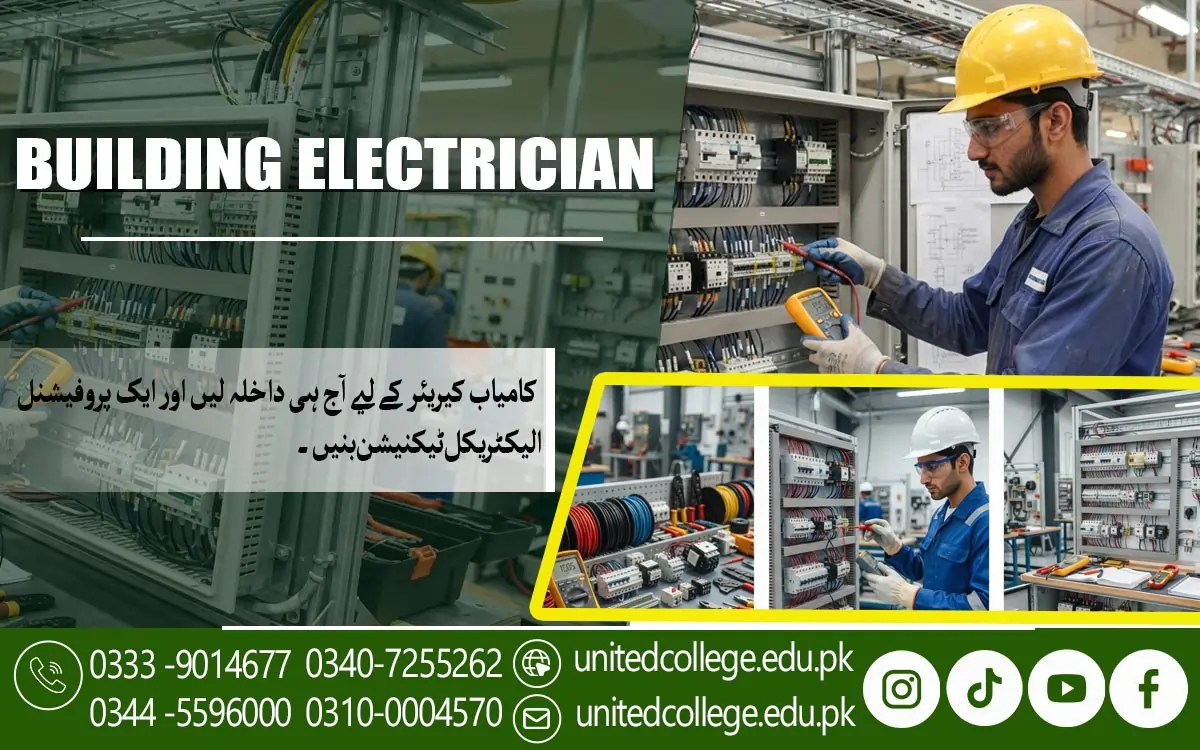

Building Electrician Course in Chiniot: Gain Practical Expertise
Put Practical Skills to Work
Walk into any newly built house, shop, office, or workshop, and electricity is one of the first systems that makes the space useful. Lights need to work, sockets need reliable connections, and electrical equipment must receive power through a properly arranged system. This work requires more than simply knowing how to join two wires. A building electrician needs practical knowledge, careful working habits, and an understanding of how different electrical parts function together.
For people in Chiniot who want to enter a hands-on technical field, learning these skills can provide a useful starting point. The Building Electrician Course in Chiniot is aimed at beginners, students, job seekers, and fresh learners who want to understand practical electrical work from the ground up. Through structured learning, students can become familiar with building wiring, installation, electrical tools, basic troubleshooting, and workplace safety.
Behind the Walls, Every Connection Has a Purpose
Electrical work becomes easier to understand when learners stop seeing wiring as a collection of loose cables and begin seeing it as a complete system. A Building Electrician Course in Chiniot may cover lighting points, switches, sockets, circuits, distribution boards, fans, and other electrical connections. Each part has a role, and an electrician needs to understand how those parts work together.
For example, a switch controls a circuit or electrical point, while a distribution board helps organize and protect circuits supplying different areas. This knowledge gives learners a better picture of what happens behind the walls of a building. For someone searching for an electrician course in Chiniot, understanding the complete system can be more valuable than learning isolated connections.
House Wiring Gives Beginners a Place to Start
Most learners find technical subjects easier when they begin with familiar examples. House wiring training can provide that starting point because students can relate electrical points to places they already use every day. A typical home may contain lights, fans, sockets, switches, and several circuits designed to supply different areas. During an electrical wiring course, learners can explore how these points are arranged and how wiring connects them to the electrical supply.
They can also become familiar with basic wiring techniques and learn how diagrams can represent actual connections. As their understanding improves, students can move from simple arrangements toward more detailed building wiring concepts. The goal is not to make beginners memorize complicated diagrams but to help them understand what a diagram is showing and how electrical components relate to one another.
The Right Tool Can Change the Way You Approach a Task
Electrical tools are an important part of practical learning because an electrician depends on them for many different jobs. Students need to become familiar with commonly used electrical tools, their purposes, and the correct way to handle them. A training environment can allow beginners to practice suitable tasks while learning how equipment supports wiring, installation, checking, and maintenance work.
When learners handle equipment themselves, they can better understand why one tool is suitable for a particular task while another may not be. They can also learn the importance of keeping tools organized and using them responsibly. A practical electrician course should therefore give learners opportunities to connect classroom explanations with supervised activities. Repeated practice can gradually improve hand coordination, accuracy, and confidence.
Commercial Work Shows How Electrical Needs Change With the Building
Not every electrical installation follows the same pattern. A small house has different requirements from a shop, office, workshop, or larger commercial property. Residential wiring usually focuses on everyday electrical needs, while commercial environments may contain more lighting points, equipment, circuits, and maintenance requirements. Understanding this difference can help students see how building electrical work adapts to the purpose and size of a property.
They can also learn how building wiring needs to be organized so that different areas and electrical loads can be managed appropriately. This broader understanding can be useful for anyone planning to work in construction electrical work, maintenance, or installation services. The Building Electrician Course in Chiniot can give learners a foundation that is not limited to one type of property. As they gain more experience, they can continue developing their technical abilities for different environments and increasingly demanding electrical tasks.
When Something Stops Working, Your Method Matters
Installation is only one side of an electrician's work. Existing electrical systems also need checking and maintenance when a problem appears. A light that stops working, a socket that does not operate, or a circuit that develops a fault can require careful examination before any repair is attempted. Electrical troubleshooting teaches learners to approach such situations logically rather than simply guessing what has gone wrong.
Students can learn the basic idea of identifying symptoms, checking relevant parts, and understanding possible causes within the limits of their training. This can introduce them to electrical maintenance and basic repair skills while showing why patience is important in technical work. Beginners should also understand that complicated electrical faults may require experienced professionals and proper procedures. The purpose of introductory training is to build a foundation for safe fault identification and responsible working practices.
Good Electrical Work Always Starts With Safe Habits
A technically correct connection is not enough if the work is performed without proper safety precautions. Electricity can cause serious injury or damage when handled incorrectly, so safety needs to remain part of every stage of learning. Electrical safety training can teach students why power should be properly isolated before suitable work, why tools need responsible handling, and why electrical installations should be checked carefully.
These lessons are important because building electricians may work in environments where other workers and residents are also present. Safe working procedures help reduce unnecessary risks and encourage a professional attitude toward electrical tasks. At United College of Technology, practical and technical learning can help students develop their knowledge alongside the working habits needed in a vocational environment.
Training Becomes Valuable When It Prepares You for the Next Step
Learning a trade is a process that continues beyond the classroom. A student may begin by understanding simple circuits and wiring arrangements, then gradually develop stronger installation, maintenance, troubleshooting, and tool-handling abilities. The Building Electrician Course in Chiniot can provide a structured starting point for this development, particularly for people who want to gain a practical skill without already having extensive electrical knowledge.
United College of Technology can support learners through skill-focused technical education and practical learning opportunities that help connect concepts with actual tasks. Once students develop a basic foundation, they may explore different directions according to their abilities and experience. Some may look for apprenticeship opportunities, construction-related work, residential installation projects, maintenance roles, or suitable independent work.
A Technical Future Can Begin With One Skill Learned Properly
The strongest electrical careers are built gradually through knowledge, practice, discipline, and real-world experience. A learner does not need to understand every electrical system on the first day. What matters is developing the basics correctly and then continuing to improve. The Building Electrician Course in Chiniot can introduce students to the practical side of building electrical work while giving them a clearer understanding of wiring, installation, tools, circuits, maintenance, troubleshooting, and safety.
For beginners in Chiniot, the course can be a first step toward discovering whether electrical work matches their interests and long-term goals. With regular practice, responsible working habits, and a willingness to learn beyond the initial course, students can continue strengthening their abilities over time. A practical trade becomes more valuable as experience grows, and building electrician training can provide the starting structure needed to take that journey with greater confidence and direction.
Frequently Asked Questions (FAQs)
Yes. A beginner can enter the field by learning fundamental concepts first and gradually developing practical abilities through guided training and regular practice.
It can be useful because electrical installation is an important part of many construction projects, giving learners technical knowledge relevant to building environments.
Yes. Initial training can create a foundation for advanced courses, specialized electrical work, greater field exposure, and continued professional development.
Training may introduce learners to basic electrical diagrams and layouts so they can better understand how wiring arrangements are represented before practical work begins.
Working with electrical systems can encourage learners to observe carefully, follow logical steps, and think through technical problems instead of relying on guesswork.
Yes. People who enjoy practical activities, working with tools, and learning through doing may find building electrical training an interesting technical career direction.
Admission Open: Start Your Professional Journey Today!
Join United College of Technology and build a career with practical training, recognized certifications, and Gulf job support. Seats are limited.
Apply Now via WhatsAppContact Information
- Address: Rawalpindi: F-272 Main New Katarian Stop, Old IJP Road | Lahore Campus: Lahore, Pakistan
- Phone/WhatsApp: 0340-7255262 / 0333-9014677 / 0301-5044340 / 0310-0004570 / 051-8770756
- Website: unitedcollege.edu.pk
















Leave a Comment