


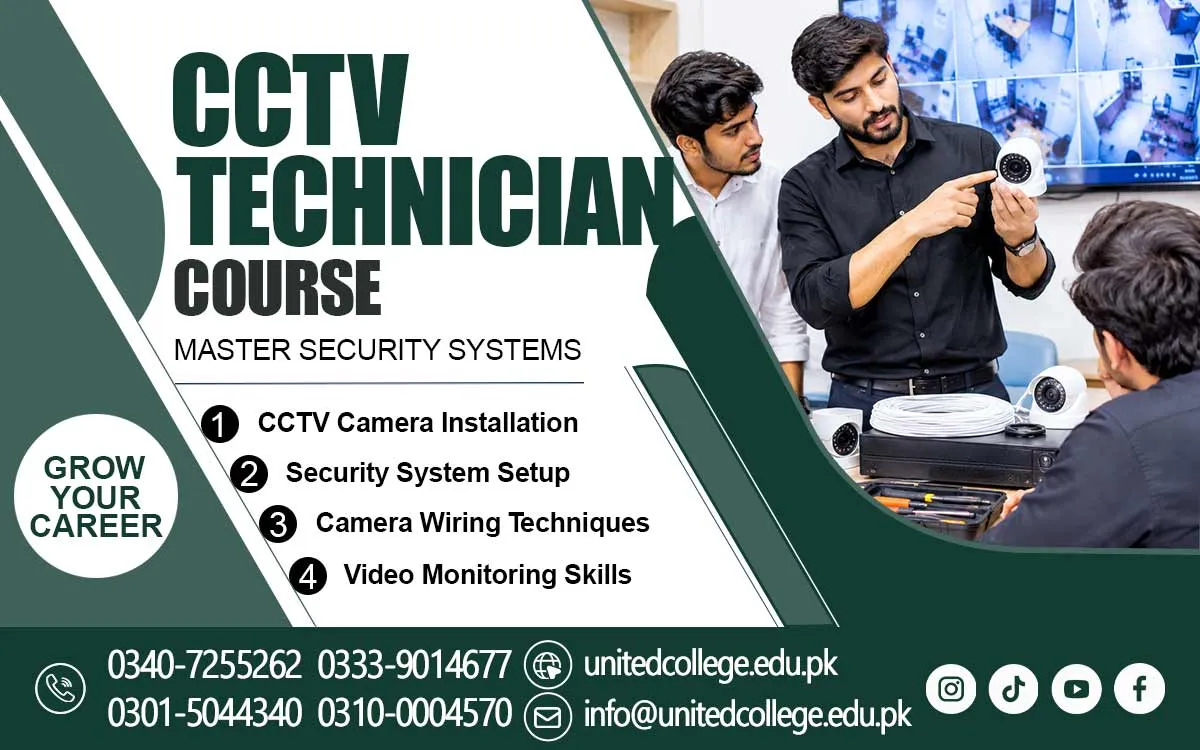

CCTV Technician Course in Balakot – Learn CCTV Installation
The Growing Need for Reliable CCTV Security Systems
Imagine a shop owner in Balakot checking the security cameras after closing time, only to discover that one camera has stopped recording. Important footage may be missing because of a loose cable, a power supply issue, or an incorrect system setting. Situations like this show the importance of properly installed and maintained CCTV systems. Today, security cameras are commonly used in homes, shops, offices, schools, hospitals, warehouses, factories, and commercial buildings. They help property owners monitor activities, review recorded footage, and improve security arrangements.
A reliable surveillance system requires correct camera positioning, suitable wiring, proper power connections, and accurate recording settings. This is where trained CCTV technicians play an important role. The CCTV Technician Course in Balakot introduces learners to the technical knowledge and practical skills needed to understand modern security camera systems. Students can explore different camera types, installation methods, recording devices, and basic troubleshooting techniques. As security technology continues to develop, learning CCTV installation and maintenance can be a useful step for individuals interested in technical education and electronic security systems.
CCTV Applications in Homes, Businesses, and Commercial Buildings
Security cameras have become an important part of everyday security arrangements. Homeowners may install CCTV cameras near entrances, parking areas, gates, and outdoor spaces to monitor their properties. Shopkeepers often use cameras to observe customer areas, cash counters, storage rooms, and entrances. Similarly, offices use surveillance systems to monitor common areas, reception desks, and important working spaces. Schools, colleges, hospitals, factories, and warehouses also use CCTV monitoring for different security and operational purposes. Each location has different installation requirements. For example, an outdoor camera needs suitable weather protection, while an indoor camera may be selected according to room size, lighting conditions, and viewing angle.
A CCTV technician must understand these requirements before recommending or installing equipment. The CCTV Technician Course in Balakot helps beginners understand the practical applications of surveillance technology and the importance of selecting suitable equipment for different environments. Learners can become familiar with camera coverage, monitoring arrangements, and basic security system planning. They can also understand the importance of privacy when installing cameras, including avoiding areas where people expect personal privacy. This knowledge helps learners develop a responsible approach to CCTV installation and maintenance in residential and commercial settings.
Practical CCTV Installation Skills and Technical Equipment
Successful CCTV installation requires careful planning and attention to detail. A technician must understand the basic tools, cables, connectors, and equipment used during installation. Training generally introduces learners to common tools such as screwdrivers, wire strippers, pliers, drilling equipment, crimping tools, and digital multimeters. These tools help with mounting cameras, preparing cables, checking electrical connections, and performing basic testing. Another important skill is CCTV camera wiring. Students learn about cable types, connectors, cable routing, and the importance of making secure connections. For example, if a camera uses a wired connection, an incorrectly attached connector may interrupt the video signal or prevent the camera from working properly.
Camera positioning is equally important because an unsuitable angle may leave important areas outside the camera's view. Learners also explore power supply connections and basic system testing. The CCTV Technician Course in Balakot focuses on developing an understanding of these practical tasks so beginners can become familiar with the installation process. Students should also learn to follow electrical safety precautions, use tools correctly, and avoid damaging equipment during installation. With regular practice, learners can improve their understanding of surveillance equipment and develop the confidence needed to handle basic CCTV installation tasks.
Different CCTV Camera Types and Modern Surveillance Technology
CCTV technology includes several camera types designed for different security requirements. Analog cameras are commonly connected to a Digital Video Recorder (DVR) through suitable coaxial cables. They are used in many traditional surveillance systems and can be suitable for basic monitoring needs. HD analog cameras provide improved image quality compared with older standard-definition systems. IP cameras work through network connections and transmit digital video, often using an Ethernet cable. These cameras can offer features such as higher image resolution, remote access, motion detection, and flexible system integration, depending on the model. Wireless security cameras use wireless networks to transmit video, although many still require a separate power source.
Some models also support battery operation. Each camera type has different installation requirements, advantages, and limitations. For example, a small shop may use a few cameras connected to a DVR, while a larger office may require an IP camera system connected to an NVR. During the CCTV Technician Course, learners can develop an understanding of these technologies and their common applications. The CCTV Technician Course in Balakot introduces important concepts related to IP camera installation, analog systems, wireless cameras, and video surveillance technology. Understanding these differences helps beginners recognise suitable equipment for different locations and technical requirements.
DVR, NVR Configuration and Remote Camera Monitoring
Recording devices are an essential part of many CCTV security systems because they allow users to save and review camera footage. A Digital Video Recorder, commonly called a DVR, is generally used with analog CCTV cameras. It receives video signals through connected cables and records the footage on a storage drive. A Network Video Recorder, known as an NVR, works with IP cameras and records digital video received through a network. Both devices allow users to manage camera channels, recording schedules, playback settings, and storage options. During training, learners can understand the basic connection process and the role of each device in a surveillance system.
For example, a shop owner may want to record footage throughout the day and review a particular time when needed. A correctly configured recording system makes this possible. Remote CCTV monitoring is another useful feature of modern security systems. Depending on the equipment and network configuration, users may access live camera footage through a mobile application or computer. This usually requires an internet connection, suitable device settings, and secure login details. The CCTV Technician Course in Balakot helps learners become familiar with DVR and NVR configuration, camera connections, recording functions, and basic network requirements.
CCTV Troubleshooting, Repairing, and Regular Maintenance
Even a properly installed CCTV system may develop technical problems over time. A camera may stop displaying video, recorded footage may become unclear, or a monitoring application may fail to connect. These problems can occur because of damaged cables, loose connectors, power supply faults, incorrect settings, storage problems, or network interruptions. A CCTV technician needs a systematic approach to identify the possible cause instead of replacing equipment without checking it. For example, if a camera shows no picture, the technician can begin by checking its power connection, cable condition, connector, and recording device input. If the footage appears blurry, the camera lens may need cleaning, or the focus and positioning may require adjustment.
Recording problems may involve storage settings, hard drive condition, or incorrect recording schedules. Regular maintenance also helps keep surveillance systems working properly. Cleaning camera lenses, checking cable connections, inspecting power supplies, and reviewing recording functions are common maintenance activities. The CCTV Technician Course in Balakot introduces beginners to CCTV troubleshooting and basic maintenance techniques. Learners can understand common faults and develop problem-solving skills through practice. It is also important to recognise when a problem requires advanced electrical, networking, or equipment repair expertise. This practical knowledge helps technicians work more carefully and avoid unnecessary changes to functioning systems.
Practical Technical Education at United College of Technology
Learning CCTV technology becomes easier when theoretical knowledge is supported by practical activities. Reading about camera connections and recording devices provides useful information, but understanding their actual working process requires hands-on experience. Students need opportunities to become familiar with cameras, cables, connectors, power supplies, DVRs, NVRs, and installation tools. Practical learning helps beginners understand how different components work together to create a complete surveillance system. For example, learners can study the process of connecting a camera, checking its video signal, and understanding the role of a recording device. They can also explore camera positioning, cable management, and basic configuration procedures.
United College of Technology (UCT) offers technical training opportunities for individuals interested in developing CCTV installation and maintenance knowledge. Through the CCTV Technician Course in Balakot, interested learners can explore the essential concepts of security camera systems and technical equipment. The training is relevant to beginners who want to build their understanding of electronic security technology without assuming they already have professional experience. A useful learning approach includes understanding equipment specifications, following installation instructions, practising safe working methods, and reviewing common technical faults. Consistent practice is important because technical confidence develops gradually.
Career Applications of CCTV Installation and Maintenance Skills
CCTV installation and maintenance knowledge can be useful in several technical and service-related fields. Security companies, electronic equipment shops, surveillance installation businesses, offices, residential projects, and commercial buildings may require people who understand basic camera installation and maintenance. Some individuals may choose to work with experienced technicians before handling independent projects. Others may use their knowledge to support small installation or maintenance services after developing sufficient practical experience. CCTV technicians may be involved in tasks such as mounting cameras, preparing cables, connecting recording devices, checking video signals, configuring basic settings, and inspecting existing systems.
However, professional work requires more than completing a training course. Technicians need practical experience, knowledge of equipment, communication skills, problem-solving abilities, and an understanding of safe installation practices. The CCTV Technician Course in Balakot can help beginners establish a foundation in this technical field. Individuals interested in electronics, networking, and security equipment may find these skills useful for further technical development. With continued learning and supervised practical experience, students can gradually explore different areas of CCTV installation, surveillance system maintenance, and electronic security services without relying on unrealistic employment or income expectations.
Technical Learning Opportunities for Beginners in Balakot
For beginners in Balakot, learning CCTV installation can be a practical way to explore the field of electronic security systems. Students do not necessarily need advanced technical knowledge to begin understanding basic camera equipment and installation methods. A genuine interest in electronics, patience, and willingness to practise can provide a helpful starting point. During the learning process, beginners should first become familiar with camera types, cables, connectors, power supplies, and recording devices. After understanding these components, they can gradually explore installation planning, camera positioning, DVR and NVR connections, and basic troubleshooting. Learning the difference between wired, wireless, analog, and IP camera systems can also improve their technical understanding.
United College of Technology provides a training opportunity for individuals interested in developing these skills through its CCTV Technician Course. The course topic is particularly relevant to students, fresh learners, and individuals who want to understand modern surveillance technology and its practical applications. Beginners should focus on building strong technical foundations rather than rushing towards advanced installation work. Regular practice, careful equipment handling, and learning from experienced professionals can help improve their abilities over time. As CCTV systems continue to be used in residential, commercial, and industrial environments, technical knowledge of installation and maintenance can remain a useful area of further learning and professional development.
Frequently Asked Questions (FAQs)
The CCTV Technician Course in Balakot teaches students how to install, configure, maintain, and troubleshoot different types of CCTV security camera systems.
Students, beginners, fresh learners, and job seekers interested in CCTV installation and electronic security systems can consider this course.
Students learn camera installation, CCTV wiring, cable connections, DVR and NVR configuration, IP camera installation, and basic troubleshooting.
No advanced technical experience is necessary to start learning. Beginners can develop their knowledge gradually through basic concepts and practical training.
DVR is generally used with analog CCTV cameras, while NVR works with IP cameras and records digital video through a network.
Admission Open: Start Your Professional Journey Today!
Join United College of Technology and build a career with practical training, recognized certifications, and Gulf job support. Seats are limited.
Apply Now via WhatsAppContact Information
- Address: Rawalpindi: F-272 Main New Katarian Stop, Old IJP Road | Lahore Campus: Lahore, Pakistan
- Phone/WhatsApp: 0340-7255262 / 0333-9014677 / 0301-5044340 / 0310-0004570 / 051-8770756
- Website: unitedcollege.edu.pk
















Leave a Comment