


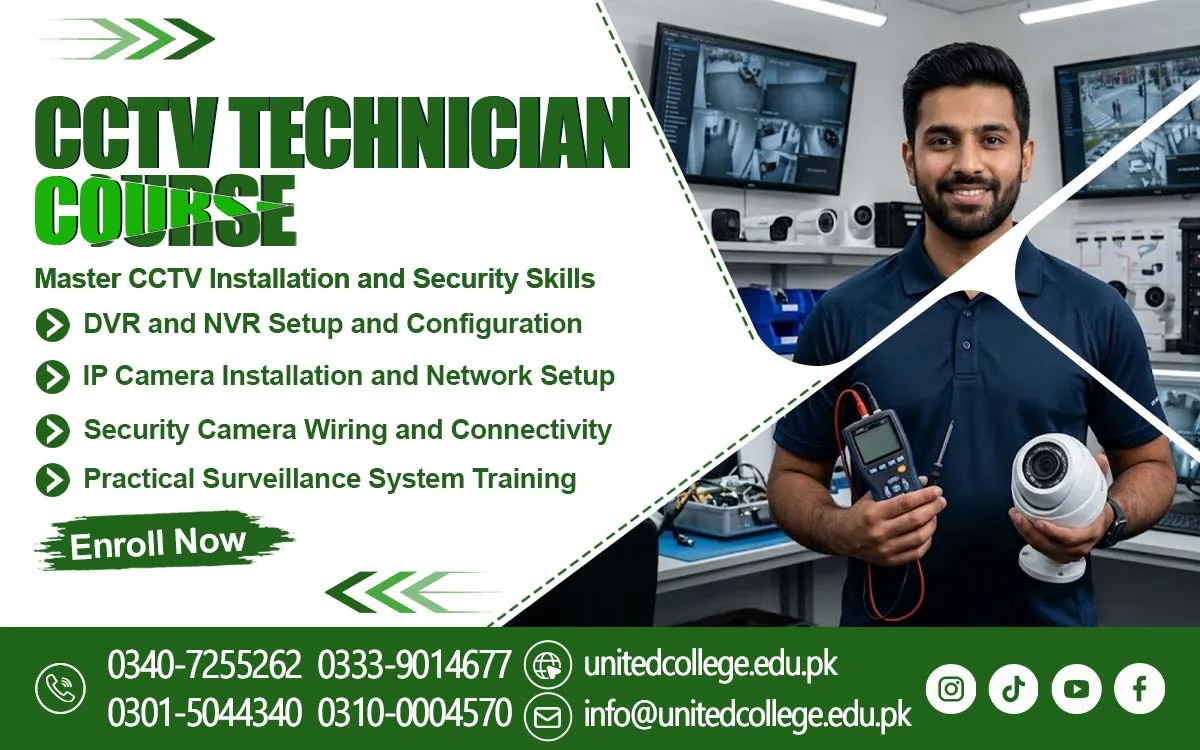

CCTV Technician Course in Charsadda Visual Security for New Learners
Security Cameras Are Becoming an Essential Part of Everyday Protection
CCTV cameras have become an important part of modern security in homes, shops, offices, schools, markets, and commercial buildings. They help property owners monitor important areas, observe daily activities, and review recorded footage when necessary. From watching shop entrances to monitoring office spaces, surveillance systems provide useful support for keeping different environments under observation. As more people become familiar with digital security equipment, understanding how these systems work has become a valuable area of technical learning.
The CCTV Technician Course in Charsadda offers an interesting learning direction for beginners who want to understand security camera technology. Installing a CCTV system involves more than fixing a camera to a wall. It requires knowledge of equipment, wiring, connections, recording devices, and proper camera positioning. Learning these technical concepts can help students, fresh learners, and job seekers understand how surveillance systems operate.
Modern Surveillance Technology and the Equipment Behind Clear Monitoring
A CCTV system contains different devices that work together to capture and record video. Cameras collect visual information from selected areas, while recording devices receive and store the footage. Monitors allow users to view live camera feeds, and suitable cables and power supplies help the equipment operate correctly. Every component has a specific purpose, so understanding how these devices connect is an important part of learning CCTV technology.
The CCTV Technician Course in Charsadda is a relevant subject for people interested in exploring these systems from a technical perspective. Beginners can learn about camera resolution, recording quality, storage capacity, and the basic differences between analogue and digital systems. They can also understand how individual components communicate with one another.
Camera Types and Installation Methods That Shape Reliable Security Coverage
Different CCTV cameras are designed for different locations and monitoring requirements. Dome cameras are commonly used indoors and have a rounded protective design. Bullet cameras have a longer shape and are often selected for outdoor monitoring. PTZ cameras can move in different directions and zoom in on selected areas, while IP cameras use network technology to transmit video.
Proper installation is equally important for achieving useful camera coverage. A technician needs to consider camera height, viewing direction, lighting, mounting surfaces, and possible obstacles before fixing the equipment. For example, a camera installed near a shop entrance should provide a suitable view of the entry area without unnecessary obstruction.
Wiring Connections and Recording Equipment That Keep CCTV Systems Running
CCTV installation involves several components that must work together correctly. Video cables, Ethernet cables, connectors, power adapters, and mounting accessories all have important functions. BNC connectors are commonly associated with traditional analogue camera connections, while Ethernet cables are widely used with network-based systems. Understanding these components helps beginners become familiar with the materials used during CCTV Camera Installation Course learning activities and general equipment setup.
Recording devices are another important part of surveillance technology. DVR stands for Digital Video Recorder and is generally used with compatible analogue cameras. NVR means Network Video Recorder and works with network-based cameras. Both systems allow users to save and review recorded footage, although their connection methods differ. Understanding DVR and NVR Configuration also involves learning about storage settings, recording schedules, camera connections, and basic playback options.
Practical Technical Education That Connects Learning with Real Equipment
Learning technical subjects becomes easier when beginners understand the purpose of each device and how it is used. CCTV-related learning can introduce students to installation tools, camera connections, cable arrangements, and basic equipment testing. Common tools include screwdrivers, drills, measuring tapes, cable cutters, crimping tools, and multimeters.
The CCTV Technician Course offered by United College of Technology is relevant to individuals interested in exploring this technical field through education. Understanding CCTV equipment, installation methods, and system maintenance can help beginners develop a clearer picture of electronic security technology. Learners should focus on building basic knowledge, understanding equipment functions, and becoming familiar with practical procedures.
Network-Based Cameras and Remote Monitoring in the Digital Age
Modern CCTV systems increasingly use internet and network connections to provide flexible monitoring options. IP cameras can transmit video through Ethernet cables or supported wireless connections. A router helps connect devices within a network, while compatible applications may allow authorized users to view camera footage through smartphones or computers. Remote monitoring can be useful for people who want to observe their properties when they are away, provided the system supports this feature and has been configured properly.
Understanding networking basics is an important part of modern CCTV Technician Training. Beginners can explore IP addresses, routers, internet connections, network cables, and camera compatibility. They can also learn why secure passwords and correct access permissions matter when connecting cameras to online systems. Network problems can affect live viewing and recording, so understanding basic connectivity can help learners recognize possible faults.
System Testing and Maintenance Practices That Improve Equipment Performance
A CCTV system needs regular inspection to help keep its components working properly. Camera lenses may collect dust, cables can become loose, and connectors may develop problems over time. Recording devices also need checking to confirm that footage is being saved correctly. Testing cameras after installation helps identify issues such as unclear images, incorrect viewing angles, missing video signals, or recording difficulties.
The CCTV Technician Training in Charsadda is a useful learning topic for beginners interested in CCTV Maintenance and basic repair knowledge. CCTV Repairing Skills involve identifying possible faults, examining connections, checking power supplies, and understanding equipment settings. Safe working practices are equally important during these tasks. Electrical connections should be handled carefully, power should be disconnected when required, and tools should be used according to their instructions.
Local Security Applications and the Technical Abilities Needed for CCTV Work
Charsadda has residential areas, markets, shops, offices, educational institutions, and other workplaces where surveillance equipment may be used for monitoring purposes. Each location has different security requirements. A small shop may need cameras covering its entrance and counter, while an office may require monitoring of hallways and selected working areas. Understanding these differences helps beginners recognize why camera selection, positioning, and system configuration should depend on the actual environment.
People interested in this field can gradually develop important personal and technical abilities. Attention to detail helps identify installation mistakes, while patience makes it easier to examine equipment and understand technical problems. Problem-solving skills are useful when dealing with connection failures or recording issues. Communication is also important because technicians may need to understand what property owners expect from their surveillance arrangements.
Turning Technical Curiosity into Knowledge of Modern Security Solutions
CCTV technology continues to develop through improved cameras, digital recording, network connectivity, and remote monitoring features. Understanding these developments can help beginners become familiar with the equipment used in different security environments. Learning about camera types, installation procedures, wiring arrangements, recording systems, and maintenance methods creates a broader understanding of how surveillance technology operates.
The CCTV Technician Course in Charsadda represents a starting point for individuals who want to explore the technical side of security camera systems. Building knowledge requires regular practice, careful observation, and an interest in understanding how different devices work together. Beginners can strengthen their technical understanding by exploring equipment functions, learning safe installation procedures, and becoming familiar with common system problems.
Frequently Asked Questions (FAQs)
Infrared technology helps cameras capture images in low-light or dark environments, making nighttime monitoring possible with suitable equipment.
Yes, a compatible recording system can support several cameras positioned in different areas, depending on its channel capacity and technical specifications.
Certain cameras include microphones to capture audio along with video, provided local privacy rules and system settings allow audio recording.
Field of view describes how much area a camera can capture. A wider view covers more space, while a narrower view focuses on a smaller area.
Video compression reduces the size of recorded files, helping systems use storage space more efficiently while maintaining suitable video quality.
Equipment manuals explain installation requirements, compatible connections, operating instructions, and troubleshooting procedures for specific devices.
Admission Open: Start Your Professional Journey Today!
Join United College of Technology and build a career with practical training, recognized certifications, and Gulf job support. Seats are limited.
Apply Now via WhatsAppContact Information
- Address: Rawalpindi: F-272 Main New Katarian Stop, Old IJP Road | Lahore Campus: Lahore, Pakistan
- Phone/WhatsApp: 0340-7255262 / 0333-9014677 / 0301-5044340 / 0310-0004570 / 051-8770756
- Website: unitedcollege.edu.pk
















Leave a Comment