


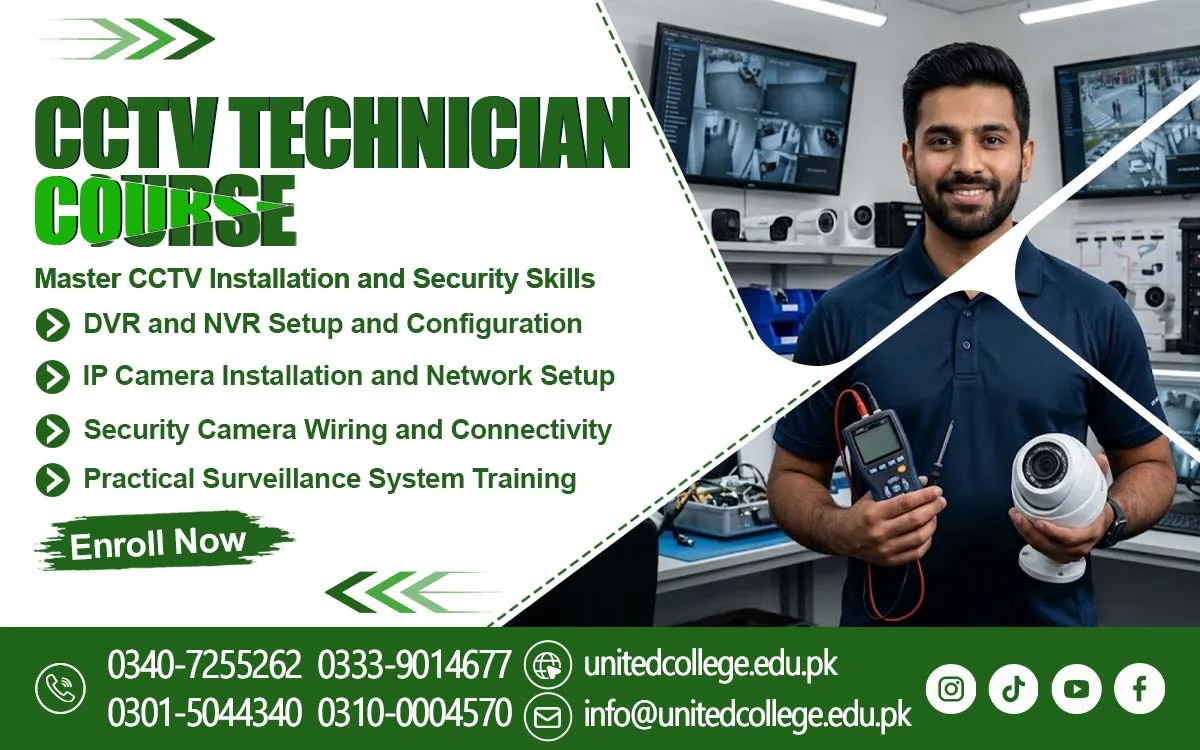

CCTV Technician Course in Gilgit Baltistan for Security Solutions
Introduction to CCTV Technician Course in Gilgit Baltistan
Advanced surveillance technology has become an essential part of modern security management. Businesses, offices, schools, hotels, and residential properties use CCTV systems to monitor activities and protect their surroundings. With improvements in digital cameras and network-based monitoring, the demand for technicians with updated technical knowledge continues to grow.
The CCTV Technician Course in Gilgit Baltistan introduces students to advanced surveillance technology, camera specifications, system components, multi-camera installation, network video transmission, and digital recording. Learners explore how different devices work together to create an effective security monitoring system.
United College of Technology provides technical education for individuals interested in electronic security services. This course helps beginners understand modern CCTV equipment and develop foundational knowledge that can support their future technical careers.
Fundamentals of Advanced Surveillance Technology
Advanced surveillance technology includes digital cameras, network-based monitoring devices, recording systems, and software used to observe different locations. These technologies help property owners and organizations monitor important areas and maintain security records.
During the CCTV Technician Course in Gilgit-Baltistan, students explore the basic working principles of modern surveillance systems. They learn how cameras capture video, how signals are transferred, and how monitoring equipment displays recorded and live footage.
Learners also understand the role of surveillance technology in different environments. From commercial buildings to residential properties, these systems can be designed according to specific security requirements. Understanding these fundamentals prepares students for more detailed technical topics.
Understanding Security Camera Specifications
Security camera specifications help determine the performance and suitability of a camera for a particular installation. Important features include resolution, lens type, viewing angle, frame rate, night vision, and environmental protection. Students learn what these specifications mean and how they affect camera performance.
The course introduces learners to different camera categories and their technical features. They explore how image resolution influences video clarity and how viewing angles determine the area covered by a camera. This knowledge helps students understand the differences between various surveillance products.
Students also examine how lighting conditions and installation environments influence camera selection. For example, outdoor locations may require weather-resistant cameras, while areas with limited lighting may benefit from infrared night vision. Understanding specifications helps learners make informed equipment choices.
Exploring CCTV System Components and Functions
A complete CCTV system consists of several components that work together to capture, transmit, record, and display video footage. These may include security cameras, recording devices, monitors, power supplies, connectors, cables, and network equipment.
Students learn about the purpose of each component and how it contributes to system operation. They explore the relationship between cameras and recording devices, as well as the role of monitors in displaying surveillance footage. Understanding these connections provides a clearer picture of a complete installation.
The CCTV Technician Course also introduces basic equipment compatibility and system requirements. Learners understand why selecting suitable components is important for reliable performance. This knowledge prepares them to understand installation procedures and identify possible equipment-related problems.
Learning Multi-Camera Installation Procedures
Multi-camera installation involves setting up several cameras to monitor different areas of a property. This type of arrangement is commonly used in offices, shopping centres, factories, hotels, and large residential buildings. Students learn why proper planning is necessary before installing multiple cameras.
Learners explore camera positioning, mounting methods, cable arrangements, and connection requirements. They understand how to divide a property into monitoring zones and select suitable positions for individual cameras. Proper placement helps reduce blind spots and improve overall coverage.
Students also become familiar with connecting multiple cameras to compatible recording equipment. They learn the importance of checking every camera feed and confirming that the complete system is operating correctly. These concepts provide a foundation for handling larger surveillance installations.
Understanding Network Video Transmission
Network video transmission allows digital cameras to send video data through connected networks. IP cameras commonly use Ethernet connections or supported wireless arrangements to communicate with recording and monitoring devices. Students learn the basic principles behind this technology.
The course introduces important networking concepts, including IP addresses, routers, switches, bandwidth, and network connectivity. Learners explore how video information moves between cameras and other devices. They also understand why network stability can affect video quality and monitoring performance.
Students further examine common factors that influence video transmission, such as network congestion, cable problems, and incorrect configuration. This knowledge helps them understand the requirements of modern IP-based surveillance systems.
Configuring Digital Recording and Monitoring Systems
Digital recording systems manage CCTV footage and allow users to monitor live video or review previously recorded events. DVRs and NVRs are commonly used for this purpose, depending on the camera technology and system arrangement.
Students explore basic recording configurations, including camera channels, recording schedules, storage settings, and playback options. They learn how monitoring screens display footage from multiple cameras and how recording devices organize video information.
The course also introduces important system settings, such as date and time configuration, user access, and basic recording management. Understanding these functions helps learners become familiar with the daily operation of digital surveillance equipment.
Identifying Technical Issues in Surveillance Equipment
Surveillance equipment can develop different technical problems during installation or regular operation. These may include unclear video, disconnected cameras, recording failures, power interruptions, and network communication issues. Students learn how to recognize common symptoms and understand their possible causes.
During the CCTV Technician Course in Gilgit-Baltistan, learners explore basic inspection and troubleshooting methods. They study how to check cable connections, examine power supplies, review network settings, and inspect camera configurations. These procedures help identify faults systematically.
Students also learn why testing is important after making adjustments. Checking live footage, recording functions, and camera connectivity helps confirm that the system is working as expected. Troubleshooting knowledge is valuable for technicians responsible for maintaining surveillance equipment.
Exploring Professional Development in CCTV Technology
The electronic security industry provides opportunities for individuals who understand modern surveillance equipment. Organizations, security companies, commercial properties, and residential projects may need technicians to install, configure, and maintain CCTV systems.
After completing the CCTV Technician Course in Gilgit-Baltistan, learners can explore roles such as CCTV Installation Technician, IP Camera Technician, Surveillance System Assistant, and Security Equipment Maintenance Worker. Some individuals may also consider providing independent installation and maintenance services after gaining practical experience.
Professional development requires continuous learning because surveillance technology regularly introduces new cameras, recording devices, and network features. Improving knowledge of installation, configuration, and troubleshooting can help learners build confidence and prepare for changing industry requirements.
Frequently Asked Questions (FAQs)
Advanced surveillance technology includes digital cameras, IP-based monitoring, recording devices, and software that help users observe and manage security footage.
Important specifications include resolution, lens type, viewing angle, frame rate, night vision, and weather protection. These features help determine the suitability of a camera.
A typical system includes cameras, recording equipment, monitors, power supplies, cables, connectors, and, where required, networking devices.
Multiple cameras provide coverage of different areas. They are useful for monitoring entrances, corridors, parking spaces, workplaces, and other important locations.
It is the process of transferring digital video from IP cameras to recording or monitoring devices through a network connection.
Admission Open: Start Your Professional Journey Today!
Join United College of Technology and build a career with practical training, recognized certifications, and Gulf job support. Seats are limited.
Apply Now via WhatsAppContact Information
- Address: Rawalpindi: F-272 Main New Katarian Stop, Old IJP Road | Lahore Campus: Lahore, Pakistan
- Phone/WhatsApp: 0340-7255262 / 0333-9014677 / 0301-5044340 / 0310-0004570 / 051-8770756
- Website: unitedcollege.edu.pk
















Leave a Comment