


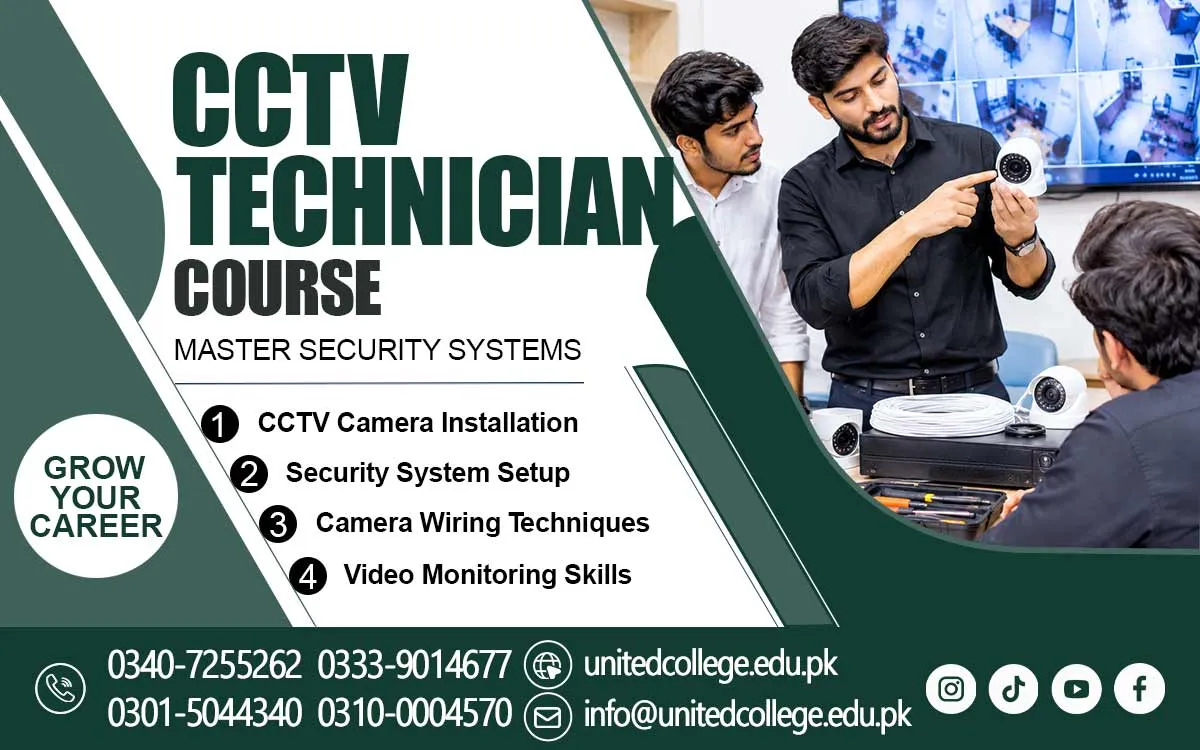

CCTV Technician Course in Hangu Exploring Tools for Clearer Footage
Modern Security Begins with Understanding How CCTV Works
Security cameras have become an important part of everyday life. Homes, shops, offices, schools, hospitals, and workplaces use CCTV systems to monitor activities and keep a record of important events. These systems help people observe different areas, review recorded footage, and improve security arrangements. As surveillance technology continues to develop, understanding how cameras and recording devices work has become a useful technical skill.
The CCTV Technician Course in Hangu introduces beginners to the basic knowledge behind these systems and helps them understand the technology used in modern security setups. A CCTV system captures video through cameras and sends the footage to a recording or monitoring device. Depending on the system, it may use a Digital Video Recorder (DVR), Network Video Recorder (NVR), or another storage solution. Users can watch live footage on a monitor or access recordings when needed.
The Essential Components That Bring a Surveillance System Together
Every CCTV setup contains several components that work together to capture, transfer, display, and store video. Cameras record activity, while DVRs and NVRs manage video recording. Monitors display live or recorded footage, and cables carry signals or data between connected devices. Connectors help create secure connections, while power supplies provide the electricity required for equipment to operate. Understanding the purpose of each component makes it easier to recognize how a complete security system works.
The CCTV Technician Course in Hangu can help learners explore these components as general areas of technical study. Beginners can develop an understanding of different connectors, cable types, recording devices, and power arrangements. They can also learn why compatibility matters when connecting equipment. A clear understanding of these parts provides a useful starting point for people interested in CCTV Installation Training and basic security system work.
Different Camera Designs for Different Security Requirements
CCTV cameras come in several designs, and each type serves different monitoring needs. Dome cameras have a rounded shape and are commonly used inside shops, offices, and public buildings. Bullet cameras have a longer body and are often installed where a particular direction needs monitoring. IP cameras use network connections to transmit digital video, while wireless cameras can send footage without a traditional video cable connection. Their actual requirements still depend on power arrangements and network access.
Understanding camera types helps beginners recognize which designs may suit different locations. Camera selection can depend on the area, installation position, lighting conditions, and monitoring requirements. Some systems are designed for indoor use, while others have protective features for outdoor environments. Learning about these differences also introduces students to IP Camera Installation and the basic features of modern Security Camera Systems. It helps them understand why one camera design may be more suitable than another.
Installation Planning That Turns Camera Placement into Clear Coverage
Installing a camera involves more than attaching it to a wall or ceiling. The technician needs to consider the area that requires monitoring, the direction of movement, possible obstructions, and the camera's viewing angle. A poorly positioned camera may leave important spaces outside its field of view. Doors, entrances, parking areas, corridors, and reception points may require different camera positions according to their security needs.
Lighting also affects the quality of recorded footage. Bright sunlight, dark corners, reflections, and strong artificial lights can influence what a camera captures. Learners can explore how to select suitable positions and avoid unnecessary blind spots. The CCTV Technician Course in Hangu provides a useful learning direction for understanding these installation considerations. Such knowledge can help beginners recognize why careful planning is important before any camera is fixed in place.
From Cable Connections to System Configuration and Fault Checking
A CCTV installation depends on correct connections between cameras, recording devices, monitors, and power sources. Different systems may use coaxial cables, network cables, or wireless connections. Beginners can study how connectors fit into a setup and how incorrect wiring may affect video transmission. They can also explore basic configuration concepts, including camera settings, recording options, date and time adjustments, and network access where supported.
System problems can appear in different ways. A camera may show no picture, footage may become unclear, or a recording device may fail to detect a connected camera. These issues can relate to loose connections, power interruptions, damaged cables, or incorrect settings. Basic troubleshooting involves checking the problem carefully and identifying its possible cause.
Learning Through Technical Guidance and Practical Understanding
Building technical knowledge requires clear explanations and an opportunity to understand how different parts of a system relate to one another. Learners need to become familiar with camera functions, installation principles, cable connections, recording methods, and common maintenance concerns. They should also understand that different CCTV systems may use different technologies and connection methods. Studying these general areas can help beginners develop a stronger foundation before exploring more advanced equipment.
The CCTV Technician Training in Hangu, offered by United College of Technology, is relevant to people who want to explore surveillance technology and develop an understanding of its basic technical requirements. United College of Technology can be considered by learners interested in this field as they explore available educational options. The main focus when choosing a learning path should be understanding the subject, developing careful working habits, and gaining knowledge that can be applied to different types of security systems.
CCTV Knowledge Across Homes, Businesses, and Public Facilities
Surveillance systems are used in many environments, but their requirements can vary. A house may need cameras near entrances, gates, or outdoor spaces. A shop may use cameras to monitor customer areas, cash counters, and storage sections. Offices may require monitoring around reception desks, corridors, and selected work areas. Educational institutions can use security cameras to observe entrances and shared spaces, while industrial settings may monitor access points and specific operational areas.
These different uses show why CCTV knowledge involves more than understanding camera installation alone. A technician needs to consider the purpose of the system, the location, privacy requirements, and the type of monitoring needed. People exploring this field can also learn about responsible camera use, including placing cameras appropriately and respecting private spaces. This broader understanding helps beginners recognize how surveillance technology supports security arrangements in different settings.
Personal Qualities That Support Progress in CCTV Technology
People interested in CCTV work can benefit from patience, observation, and attention to detail. Installation tasks often require careful measurements, organized cable routing, and accurate camera positioning. Problem-solving is also important because technical faults do not always have the same cause. A learner who enjoys understanding how devices connect and communicate may find this subject interesting. Basic computer knowledge can also be helpful when exploring digital recording devices and network-connected cameras.
The CCTV Technician Course in Hangu can be a starting point for beginners who want to understand the responsibilities involved in surveillance system installation and maintenance. As learners explore CCTV Technician Training, they can gradually become more familiar with equipment, connections, system settings, and routine checks. Continued learning and careful practice can strengthen their technical confidence. With a responsible approach and interest in modern security technology, beginners can build a useful foundation for understanding the changing world of surveillance systems.
Frequently Asked Questions (FAQs)
Default passwords may be easy to guess. Changing them helps prevent unauthorized people from accessing camera settings or recorded footage.
Firmware is the built-in software that controls a camera's basic functions. Updates may improve performance, fix errors, or address security weaknesses.
Accurate date and time settings make it easier to identify when an event occurred and locate the relevant footage during a review.
Yes. Some systems allow administrators to give users different permissions, such as viewing live footage, checking recordings, or changing system settings.
An event log records selected system activities, such as login attempts, configuration changes, or device errors. It can help users review system activity.
A sudden increase in electrical voltage can damage sensitive electronic components. Suitable surge protection can help reduce this risk.
Admission Open: Start Your Professional Journey Today!
Join United College of Technology and build a career with practical training, recognized certifications, and Gulf job support. Seats are limited.
Apply Now via WhatsAppContact Information
- Address: Rawalpindi: F-272 Main New Katarian Stop, Old IJP Road | Lahore Campus: Lahore, Pakistan
- Phone/WhatsApp: 0340-7255262 / 0333-9014677 / 0301-5044340 / 0310-0004570 / 051-8770756
- Website: unitedcollege.edu.pk
















Leave a Comment