


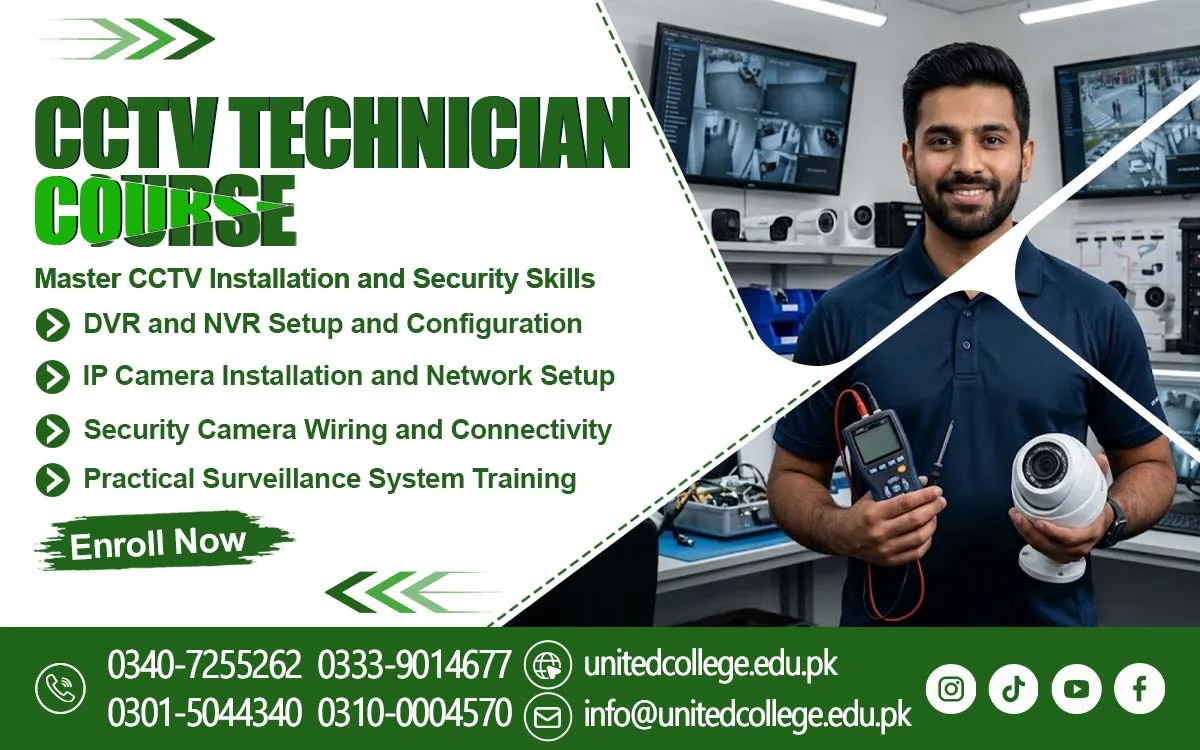

CCTV Technician Course in Mardan for Modern Security Systems
Introduction to Modern CCTV Surveillance Systems
Closed-Circuit Television (CCTV) systems are widely used for monitoring and recording activities in different locations. Students begin by understanding the basic working principles of surveillance systems and their importance in modern security arrangements. They explore how cameras capture video footage and transmit information to recording or monitoring devices.
The course introduces learners to different components of a CCTV system, including cameras, monitors, cables, power supplies, and recording equipment. Students understand how these components work together to provide continuous or scheduled surveillance according to system requirements.
This foundational knowledge helps learners recognize the importance of CCTV technology in residential, commercial, and industrial environments. It also prepares them to study camera installation and system configuration in greater detail.
Understanding Different Types of Security Cameras
Security cameras are available in different designs and technologies according to monitoring requirements. Students learn about common camera types, including dome cameras, bullet cameras, PTZ cameras, and IP cameras. They explore the basic features and applications of each type.
Learners also understand the differences between analog and digital surveillance technologies. They examine how camera resolution, viewing angles, night vision, and weather resistance influence the selection of suitable equipment for different locations.
Knowledge of camera types helps students identify appropriate surveillance solutions for various environments. It also develops their understanding of the equipment commonly used in professional CCTV installations.
Exploring Camera Installation Tools and Equipment
CCTV installation requires different tools and equipment to complete mounting, wiring, and connection tasks. Students become familiar with commonly used tools such as screwdrivers, drills, measuring tapes, cable cutters, crimping tools, and testing devices.
The CCTV Technician course explains how installation equipment is selected and used during different stages of a project. Learners understand the importance of preparing mounting surfaces, measuring cable routes, and checking connections before activating a surveillance system.
Understanding these tools helps students become familiar with the practical requirements of CCTV installation. It also encourages careful working practices and organized equipment handling.
Learning Proper Camera Positioning Techniques
Camera positioning plays an important role in achieving effective surveillance coverage. Students learn how to identify suitable installation points according to the layout of a building, monitoring requirements, and potential areas that need observation.
The course introduces learners to important positioning considerations, including camera height, viewing direction, lighting conditions, blind spots, and coverage angles. They understand how incorrect placement can reduce image quality and leave important areas outside the camera's view.
These concepts help students develop an understanding of effective surveillance planning. They also learn why cameras should be positioned to respect privacy and applicable security requirements.
Understanding CCTV Wiring and Cable Connections
Wiring and cable connections are essential parts of CCTV installation. Students learn about commonly used cables, including coaxial cables, Ethernet cables, and power connections. They explore how different cable types support video transmission and electrical supply.
The CCTV Technician course also introduces learners to basic connection procedures, cable routing, connector preparation, and connection testing. They understand the importance of secure wiring arrangements to prevent signal interruptions and other technical problems.
Knowledge of CCTV wiring helps students understand how surveillance components communicate with each other. These skills are useful for individuals interested in installation, maintenance, and troubleshooting activities.
Working with Digital Video Recording Devices
Digital video recording devices are used to store and manage surveillance footage. Students learn about common recording equipment, including Digital Video Recorders (DVRs) and Network Video Recorders (NVRs). They understand the basic differences between these devices and their applications in surveillance systems.
Learners explore important functions such as camera connectivity, recording schedules, playback options, storage management, and video monitoring. They also understand how recording devices help users review previously captured footage when required.
This knowledge helps students become familiar with the recording and monitoring side of CCTV technology. It also provides a foundation for understanding modern surveillance system management.
Identifying Common Camera and System Faults
CCTV systems may experience different technical problems that affect their performance. Students learn to identify common faults such as unclear images, disconnected cameras, power supply issues, damaged cables, recording failures, and network connectivity problems.
The course introduces learners to basic troubleshooting methods. They understand how to inspect connections, check power sources, review camera settings, and examine recording equipment to identify possible causes of system failures.
Developing troubleshooting knowledge helps students understand the importance of regular maintenance. It also prepares them to recognize common installation problems and take appropriate steps to resolve basic technical issues.
Exploring Career Opportunities in CCTV Technology
The increasing use of surveillance systems in residential, commercial, and industrial environments creates different opportunities for individuals with CCTV installation and maintenance knowledge. Students completing the CCTV Technician Course in Mardan can explore entry-level roles with security companies, installation service providers, and technical maintenance organizations.
Possible career options include CCTV installation technician, surveillance system assistant, security equipment technician, CCTV maintenance worker, and technical support assistant. These roles may involve installing cameras, connecting cables, configuring recording devices, inspecting equipment, and helping customers maintain their security systems.
With practical experience and further technical development, learners can improve their abilities and explore additional responsibilities in electronic security services. Knowledge of camera technologies, wiring procedures, recording systems, and troubleshooting can provide a useful foundation for entering the CCTV technology field.
Frequently Asked Questions (FAQs)
It is a technical training program that introduces students to surveillance cameras, CCTV installation, wiring, recording devices, and basic system maintenance.
Students learn about dome cameras, bullet cameras, PTZ cameras, IP cameras, and basic analog surveillance systems.
Common tools include drills, screwdrivers, measuring tapes, cable cutters, crimping tools, and electrical testing equipment.
DVR systems commonly process video from analog cameras, while NVR systems record video transmitted through network-connected IP cameras.
Yes, students explore coaxial cables, Ethernet connections, power wiring, connectors, and basic cable testing procedures.
Admission Open: Start Your Professional Journey Today!
Join United College of Technology and build a career with practical training, recognized certifications, and Gulf job support. Seats are limited.
Apply Now via WhatsAppContact Information
- Address: Rawalpindi: F-272 Main New Katarian Stop, Old IJP Road | Lahore Campus: Lahore, Pakistan
- Phone/WhatsApp: 0340-7255262 / 0333-9014677 / 0301-5044340 / 0310-0004570 / 051-8770756
- Website: unitedcollege.edu.pk
















Leave a Comment