


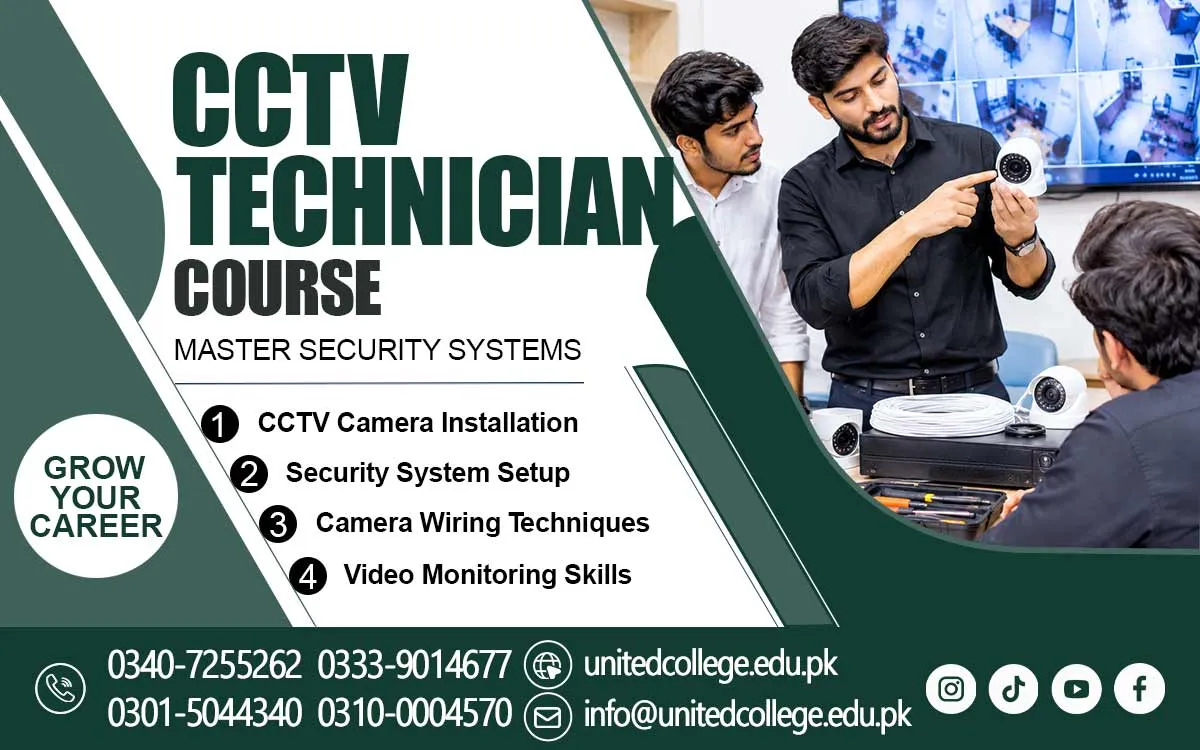

CCTV Technician Course in Upper Dir for Network Security Cameras
Introduction to CCTV Technician Course in Upper Dir
Electronic monitoring equipment has become an important part of modern security arrangements. Residential buildings, offices, shops, schools, and commercial properties use CCTV systems to observe activities and protect valuable assets. As surveillance technology develops, trained technicians are needed to install, manage, and troubleshoot different security devices.
The CCTV Technician Course in Upper Dir introduces students to electronic monitoring equipment, camera installation standards, surveillance networks, DVR and NVR management, remote monitoring, and power protection systems. Learners explore the technical requirements of CCTV installations and understand how different components work together.
United College of Technology provides technical education for individuals interested in developing knowledge of electronic security systems. This course is a useful starting point for beginners who want to understand CCTV technology and explore professional opportunities in the installation and maintenance field.
Introduction to Electronic Monitoring Equipment
Electronic monitoring equipment includes cameras, recording devices, monitors, power supplies, and other accessories used to observe and record activities. These devices are commonly installed in residential, commercial, and industrial locations to support security management.
During the CCTV Technician Course in Upper Dir, students learn about different types of monitoring equipment and their basic functions. They explore how cameras capture video, how recording devices store footage, and how display screens allow users to view live recordings.
Learners also understand how different devices are selected according to the requirements of a property. Familiarity with monitoring equipment helps students recognize the purpose of each component before moving towards installation and configuration procedures.
Understanding CCTV Camera Installation Standards
CCTV camera installation requires proper planning and attention to technical requirements. Camera positions, mounting arrangements, cable connections, and power supplies all influence the performance of a surveillance system. Students learn why installation standards are important for reliable operation.
The course introduces learners to camera placement, mounting height, viewing direction, and coverage planning. They understand how to position cameras near entrances, corridors, parking spaces, and other important areas while reducing unnecessary blind spots.
Students also explore basic installation safety and equipment protection. They learn about secure mounting, suitable cable management, and the importance of following manufacturer instructions. These concepts help prepare learners for organized and responsible installation work.
Exploring Surveillance Network Components
Modern CCTV installations often use network-based devices to transfer video and support remote monitoring. A surveillance network may include IP cameras, routers, switches, Ethernet cables, and network video recorders. Students learn about the purpose of these components.
Learners explore how network equipment connects different devices within a surveillance system. They become familiar with basic IP camera connections, network ports, and the role of routers and switches in communication. This knowledge helps them understand how digital video systems operate.
The section also introduces common network requirements, including stable connectivity and compatible equipment. Students learn why incorrect network settings or damaged connections can interrupt video transmission. Understanding these components provides a foundation for working with IP-based surveillance technology.
Learning DVR and NVR System Management
DVR and NVR devices are used to manage and store video recordings from connected cameras. A Digital Video Recorder generally works with compatible analog camera systems, while a Network Video Recorder is commonly used with IP cameras.
Students learn about the basic functions of these recording devices, including camera channel management, recording schedules, playback, and storage settings. They explore how video footage is organized and accessed through the recording system.
The CCTV Technician course also introduces routine management procedures, such as checking camera connections, adjusting recording settings, and reviewing stored footage. These concepts help learners understand the responsibilities involved in operating a CCTV recording system.
Configuring Camera Access and Remote Monitoring
Remote monitoring allows authorized users to view CCTV footage through smartphones, computers, and other compatible devices. This feature is useful for property owners who want to observe their premises without being physically present.
During this section, students explore the basic requirements for configuring remote camera access. They learn about compatible applications, device registration, network connectivity, and user account settings. These procedures introduce learners to the practical side of remote surveillance.
Security is also an important part of remote monitoring. Students understand the importance of strong passwords, authorized user permissions, and secure network configurations. These practices help protect camera feeds and recording systems from unauthorized access.
Understanding Power Backup and Protection Systems
CCTV equipment depends on a reliable power supply to maintain continuous monitoring and recording. Power interruptions can affect cameras, recording devices, and network equipment. Students learn why suitable power arrangements are necessary for surveillance installations.
The course introduces different power backup options, including Uninterruptible Power Supply (UPS) units and compatible backup batteries. Learners understand how these devices can provide temporary power during electrical interruptions and support continued system operation.
Students also explore basic power protection measures, including suitable adapters, surge protection, and proper electrical connections. They learn why checking power requirements and protecting equipment from electrical fluctuations are important for maintaining CCTV performance.
Diagnosing Common Surveillance System Issues
CCTV systems may develop technical faults that affect camera performance, video recording, or remote access. Common problems include unclear images, disconnected cameras, damaged cables, power failures, and network interruptions. Students learn how to recognize these issues.
The CCTV Technician Course in Upper Dir introduces basic troubleshooting procedures. Learners explore how to inspect power connections, check cable conditions, review recording settings, and examine network configurations. These steps help identify possible causes before making technical adjustments.
Students also understand the importance of testing equipment after troubleshooting. Checking live video, playback functions, and camera connectivity helps confirm whether the system is operating properly. These diagnostic skills are useful for technicians responsible for maintaining security installations.
Exploring Future Opportunities in CCTV Installation
CCTV installation and maintenance offer different professional possibilities in the electronic security industry. Businesses, schools, offices, factories, hotels, and residential projects may need technicians who understand surveillance equipment and system management.
After completing the CCTV Technician Course in Upper Dir, learners can explore roles such as CCTV Installation Technician, Security Equipment Assistant, Surveillance System Technician, and CCTV Maintenance Worker. With suitable experience, they may also consider providing independent installation and repair services.
Professional growth in this field requires practical experience and continuous learning. Developing knowledge of network cameras, recording devices, remote monitoring, and power protection can help individuals improve their technical abilities and prepare for new industry requirements.
Frequently Asked Questions (FAQs)
Common equipment includes security cameras, DVRs, NVRs, monitors, power adapters, cables, network switches, and backup power devices.
Proper installation helps achieve suitable camera coverage, secure mounting, reliable connections, and better overall system performance.
A router connects networks and manages network traffic, while a switch connects multiple devices within the same local network.
Yes. Both systems can manage multiple compatible cameras, depending on their available channels and technical specifications.
Remote access generally requires compatible cameras or recording equipment, suitable network connectivity, an authorized account, and a supported monitoring application.
Admission Open: Start Your Professional Journey Today!
Join United College of Technology and build a career with practical training, recognized certifications, and Gulf job support. Seats are limited.
Apply Now via WhatsAppContact Information
- Address: Rawalpindi: F-272 Main New Katarian Stop, Old IJP Road | Lahore Campus: Lahore, Pakistan
- Phone/WhatsApp: 0340-7255262 / 0333-9014677 / 0301-5044340 / 0310-0004570 / 051-8770756
- Website: unitedcollege.edu.pk
















Leave a Comment