


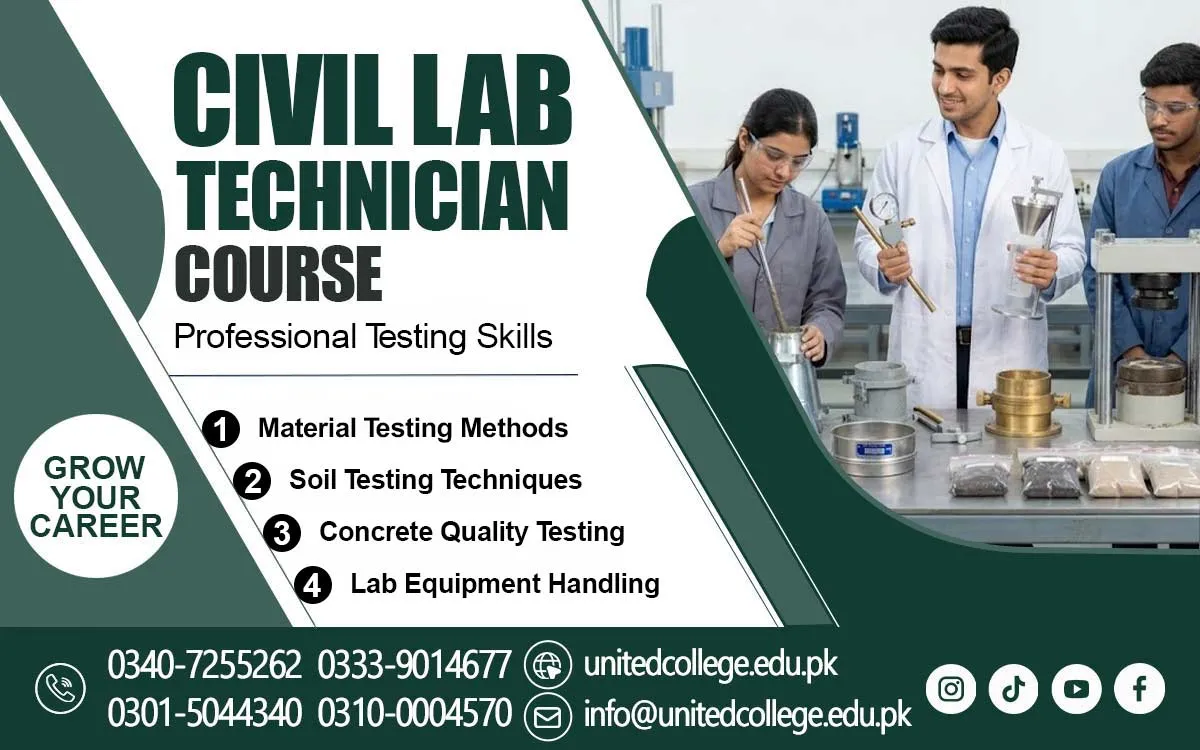

Civil Lab Technician Course in Skardu for Concrete Testing Procedures
Introduction to Concrete Laboratory Operations
Concrete laboratory operations play an important role in civil engineering because they help evaluate the quality, strength, and performance of concrete used in construction projects. Students enrolling in the Civil Lab Technician Course in Skardu learn about the basic activities performed in concrete testing laboratories. They become familiar with the main ingredients of concrete, including cement, water, sand, and coarse aggregates, and understand how these materials contribute to construction quality.
During this section, learners explore different laboratory procedures used to examine fresh and hardened concrete. They understand how concrete samples are collected, prepared, mixed, and tested under suitable conditions. Students also become familiar with the importance of following proper testing instructions and maintaining accurate measurements.
Practical knowledge of concrete laboratory operations helps students understand how testing supports construction activities. They learn about the responsibilities of laboratory technicians and how their work contributes to material inspection and quality assessment. This foundation prepares them for further learning in concrete testing procedures.
Understanding Cement Composition and Properties
Cement is one of the most important materials used in concrete production and other construction activities. Students learn about the basic composition of cement and understand how its ingredients contribute to binding and strength development. They also explore different types of cement and their common applications in civil engineering projects.
The Civil Lab Technician course introduces learners to important cement properties, including fineness, consistency, setting time, and specific gravity. They understand how these characteristics influence cement performance and why laboratory examination is necessary before using cement in construction. Students also become familiar with basic testing procedures and the equipment used during cement analysis.
Understanding cement properties helps learners recognize the importance of material selection and quality control. They explore how testing results are compared with relevant technical requirements to evaluate cement suitability. This knowledge develops their understanding of construction material inspection.
Exploring Slump Test Procedures
The slump test is a common laboratory and field procedure used to examine the workability and consistency of fresh concrete. Students learn about the purpose of this test and understand how concrete consistency can influence placement, compaction, and finishing activities. They become familiar with the basic principles behind evaluating fresh concrete before it is used in construction.
During this section, learners explore the equipment required for slump testing, including the slump cone, tamping rod, and measuring tools. They understand how fresh concrete is placed into the cone in layers, compacted, and carefully lifted to observe the resulting slump. Students also learn how measurements are recorded to determine the consistency of the concrete mixture.
Proper slump testing helps technicians identify whether fresh concrete has suitable workability for particular construction requirements. Students understand the importance of following a consistent testing procedure and recording accurate results. This practical knowledge helps them develop an understanding of fresh concrete quality assessment.
Learning Compressive Strength Testing
Compressive strength is an important property used to determine how much load concrete can withstand before failure. Students learn about the factors that influence concrete strength, including cement quality, water content, aggregate properties, and mixing proportions. They understand why strength testing is necessary for evaluating the performance of concrete structures.
The Civil Lab Technician Course in Skardu introduces learners to the basic procedures of compressive strength testing. They become familiar with preparing concrete specimens, filling moulds, compacting mixtures, and curing samples before examination. Students also learn how compression testing machines are used to apply pressure to concrete specimens and measure their strength.
Learners understand how compressive strength results help engineers assess concrete quality and suitability for construction projects. They explore the importance of accurate measurements, proper specimen preparation, and organized testing records. This knowledge helps them understand concrete quality control procedures.
Examining Aggregate Quality and Texture
Aggregates are essential components of concrete and other construction materials. Their quality, particle size, shape, and surface texture can influence the strength, workability, and durability of concrete mixtures. Students learn about fine aggregates such as sand and coarse aggregates such as gravel and crushed stone.
During this section, learners explore different methods used to examine aggregate characteristics. They become familiar with sieve analysis, particle-size distribution, and basic visual inspection techniques. Students also understand how aggregate cleanliness, grading, and texture influence the preparation of suitable concrete mixtures.
Proper aggregate examination helps determine whether materials meet construction requirements. Students learn why suitable aggregate selection is important for producing reliable concrete and maintaining construction quality. These concepts provide useful knowledge for material testing activities.
Understanding Soil Density Measurements
Soil density is an important property in civil engineering because it influences the stability and performance of foundations, roads, and other construction structures. Students learn about the relationship between soil particles, air spaces, and moisture content. They understand why density measurements are necessary when evaluating soil conditions for different construction activities.
The course introduces learners to basic soil density testing procedures used in laboratories and construction projects. They become familiar with sample preparation, weighing methods, volume determination, and moisture content examination. Students also learn how laboratory instruments are used to obtain accurate measurements.
Understanding soil density helps learners recognize its importance in foundation preparation, road construction, and earthwork compaction. They explore how testing results provide useful information about soil conditions and construction suitability. This knowledge helps develop their understanding of geotechnical laboratory work.
Following Laboratory Quality Control Practices
Quality control is an essential part of civil engineering laboratory work because it helps maintain the reliability and accuracy of testing results. Students learn about the basic procedures followed to examine construction materials and ensure that laboratory activities meet relevant technical requirements. They understand why consistency and accuracy are important during material testing.
During this section, learners explore different quality control practices, including proper sample identification, equipment inspection, accurate measurements, and organized testing procedures. They also learn about maintaining laboratory cleanliness, following safety instructions, and recording observations correctly. These activities help students understand how testing errors can be reduced.
Students also develop an understanding of laboratory documentation and result verification. They learn why testing records should be maintained properly and how quality control supports construction projects. This knowledge prepares them to contribute to organized and reliable laboratory operations.
Professional Opportunities in Civil Material Testing
Civil material testing offers different employment opportunities in the construction, engineering, and infrastructure development sectors. Individuals completing the Civil Lab Technician Course in Skardu can explore professional positions according to their technical knowledge, practical abilities, and experience. These opportunities may be available in construction companies, concrete testing laboratories, engineering consultancies, and material inspection organizations.
Some possible career positions include Civil Lab Technician, Concrete Testing Technician, Material Testing Assistant, Soil Testing Assistant, Quality Control Assistant, and Laboratory Assistant. A Civil Lab Technician performs basic examinations of construction materials, while a Concrete Testing Technician assists with slump and compressive strength testing. Material Testing Assistants help collect and examine construction samples, whereas Soil Testing Assistants support soil density and classification procedures. Quality Control Assistants help monitor material standards and maintain laboratory records.
With practical experience and further technical education, individuals can improve their knowledge of civil engineering laboratory procedures. Developing concrete testing techniques, equipment-handling abilities, measurement accuracy, and quality control knowledge can help learners explore additional professional opportunities in the construction industry.
Frequently Asked Questions (FAQs)
The Civil Lab Technician Course in Skardu provides knowledge of concrete laboratory operations, cement properties, slump testing, compressive strength examination, and construction material testing.
Students learn concrete sample preparation, slump test procedures, aggregate examination, soil density measurements, laboratory equipment handling, and quality control practices.
A slump test measures the workability and consistency of fresh concrete to determine whether it is suitable for particular construction requirements.
Concrete compressive strength is evaluated by applying pressure to prepared concrete specimens using a compression testing machine and recording the maximum load they withstand.
Common cement properties include fineness, consistency, setting time, and specific gravity, which help evaluate its physical characteristics and quality.
Admission Open: Start Your Professional Journey Today!
Join United College of Technology and build a career with practical training, recognized certifications, and Gulf job support. Seats are limited.
Apply Now via WhatsAppContact Information
- Address: Rawalpindi: F-272 Main New Katarian Stop, Old IJP Road | Lahore Campus: Lahore, Pakistan
- Phone/WhatsApp: 0340-7255262 / 0333-9014677 / 0301-5044340 / 0310-0004570 / 051-8770756
- Website: unitedcollege.edu.pk
















Leave a Comment