


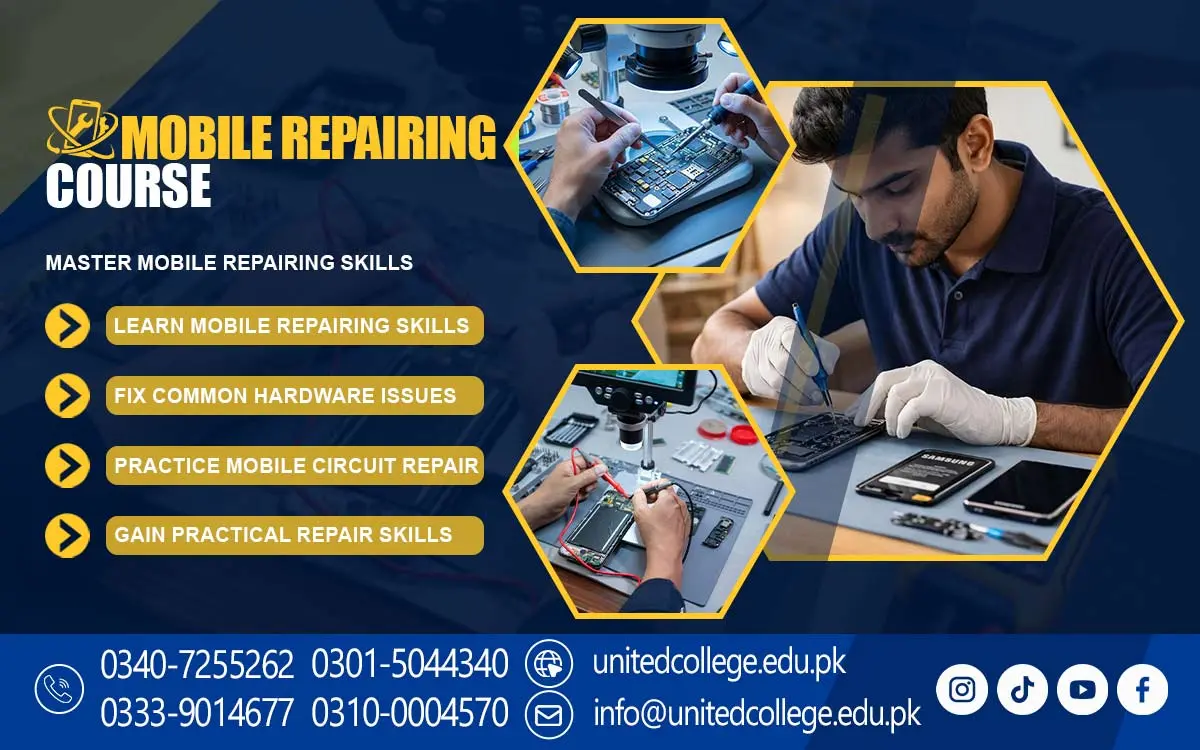

Mobile Repairing Course in Malakand – Master Smartphone Repair Skills
Everyday Mobile Phone Problems That Need Skilled Repairers
Imagine your mobile phone suddenly stops charging just when you need to make an important call. You change the charger, try another cable, and restart the phone, but nothing works. In another situation, a phone may fall on the floor, leaving its screen cracked or its display completely black. These problems are common, and they explain why skilled mobile repair technicians are needed. Modern smartphones are used for communication, education, online payments, business, and entertainment, so even a small fault can cause inconvenience. Common mobile phone problems include weak batteries, damaged charging ports, faulty speakers, microphone failures, broken screens, camera issues, and phones that refuse to switch on.
However, not every problem requires replacing a part. Sometimes, dust inside a charging port, a loose connector, an unsuitable charger, or a software issue may be responsible. This is why mobile phone fault diagnosis is an important part of repair work. A technician must carefully examine the device, identify the possible cause, and select a suitable repair method. For students interested in technical work, a Mobile Repairing Course in Malakand can provide a starting point for understanding these everyday problems. Learning how mobile phones work helps beginners move beyond guessing and develop a more systematic approach to troubleshooting.
How Mobile Repairing Skills Help Beginners Enter Technical Work
Have you ever wondered what happens inside a mobile phone when you press the power button? Although a smartphone looks simple from the outside, it contains several electronic components that work together to perform different functions. A Mobile Repairing Course helps learners understand how these devices work by teaching them to identify faults, open devices safely, test components, replace damaged parts when appropriate, and check whether the phone works correctly after repair. Beginners do not need to understand every technical detail on their first day. They can start by learning the names of common components, recognizing basic tools, and understanding simple faults such as charging problems or damaged screens.
Gradually, they can develop more advanced mobile repairing skills through practice and guidance. Patience is particularly important because a small mistake, such as pulling a delicate cable too hard, can cause additional damage. Observation also matters because two phones with similar symptoms may have different underlying problems. For example, a phone that does not turn on might have a discharged battery, a faulty charging circuit, a damaged power button, or another internal fault. A repairer must investigate rather than assume. Smartphone repair training can help beginners build a foundation in careful handling, logical thinking, and technical problem-solving.
What Students Can Learn in a Mobile Repairing Course in Malakand
Learning from a structured training programme can make a technical subject easier to understand, especially for someone who has never opened a mobile phone. The Mobile Repairing Course in Malakand, offered by United College of Technology (UCT), is a relevant course topic for students and beginners interested in understanding mobile phone repair. A useful mobile phone repair course introduces learners to smartphone hardware components, common faults, appropriate tools, and basic troubleshooting methods. Students can explore how batteries supply power, how charging ports connect devices to power sources, and how displays, speakers, cameras, and buttons perform their functions.
Under suitable supervision, beginners can practise identifying components, organizing small parts, following disassembly procedures, and recognizing common warning signs of damage. They can gradually develop an understanding of mobile hardware repair and learn when software troubleshooting may be relevant. A structured learning environment can also help students understand the difference between simple repairs and complicated electronic faults. Before enrolling, interested learners should confirm the current course syllabus, duration, fees, practical facilities, and certificate details directly with the institution rather than relying on assumptions.
Recognizing Mobile Phone Components and Their Functions
Opening a smartphone for the first time can be confusing because many small parts are connected inside a limited space. In a Mobile Repairing Course, understanding what each component does makes the repair process easier to follow. The display presents images, text, and other information, while the touchscreen detects finger movements and allows users to interact with the phone. The battery stores electrical energy and supplies power to the device. A charging port provides a connection for charging and, depending on the device, data transfer. Inside the phone, the motherboard is the main circuit board that connects and supports many important electronic components.
The camera captures photographs and videos, while the microphone records sound and the speaker produces audio. Small buttons allow users to control power and volume, and flexible cables connect different components to the motherboard. Connectors provide the electrical contact needed for these parts to communicate with the rest of the device. Learning about these smartphone hardware components helps students understand how one faulty part can affect another function. For example, a damaged speaker may cause sound problems even when the display and other features work normally.
Using Mobile Repairing Tools for Safe and Accurate Repairs
The result could be a scratched casing, a broken connector, or damage to the delicate components inside. Using appropriate mobile repairing tools is therefore an essential part of technical training. Precision screwdrivers help remove small screws, while plastic opening tools can help separate device covers without scratching surfaces as easily as metal objects might. Tweezers are useful for handling small screws and components, and suction tools may help lift certain screens or covers when used with the correct procedure. A multimeter is an electronic testing instrument that can measure values such as voltage, resistance, and continuity, helping a trained user investigate electrical problems.
Soldering equipment is used for particular repairs involving electronic connections, but it requires additional training and careful handling. Other useful supplies may include a parts tray, cleaning materials suitable for electronics, and an anti-static wrist strap or mat. Static electricity can damage sensitive electronic components, so appropriate precautions are important when working with exposed circuits. Before opening a phone, a technician should identify the correct procedure for that model, switch off the device, and disconnect the battery when the design and repair procedure permit it. Lithium-ion batteries must never be punctured, bent, or exposed to excessive heat because they can become dangerous.
Diagnosing Charging, Battery, Display, and Power Problems
When a phone refuses to charge, many people immediately assume that its battery has failed. However, the real cause could be a faulty cable, a damaged adapter, a blocked charging port, a loose connector, or a problem in the charging circuit. Effective mobile charging problem repair begins with checking the simplest possibilities before investigating internal components. A technician may inspect the phone and charging accessories for visible damage, test suitable known-working accessories, and follow the manufacturer's guidance for safe troubleshooting. If the phone becomes unusually hot, the battery looks swollen, or there is a burning smell, charging should stop and the device should be handled by a qualified professional.
Battery replacement should only be considered after the condition of the battery and other possible causes have been assessed. Display faults also require careful diagnosis. A cracked screen may still show an image, while a black display can sometimes occur even when the phone is receiving power. Checking the device's response, examining visible damage, and testing appropriate connections can help identify the next step. A phone that will not switch on may have a depleted battery, a damaged power button, liquid damage, or a more serious electronic fault. In a Mobile Repairing Course in Malakand, learning a systematic approach to these problems can help students understand why testing is more reliable than guessing.
Learning Circuit Repair, Soldering, and Advanced Fault Detection
Some mobile phone problems cannot be solved by replacing an external accessory or fitting a new screen. A device may have damaged motherboard connections, corroded components, a faulty power circuit, or a problem caused by liquid entering the phone. The motherboard contains many small electronic components, including resistors, capacitors, integrated circuits, and connectors. Each component has a specific role, and a fault in one area can affect several phone functions. Mobile circuit repair involves examining these components and connections to identify possible electrical problems.
Excessive heat can damage nearby components, lift circuit-board pads, or destroy delicate connections. Beginners should therefore learn the purpose of soldering tools, basic electronic safety, and proper handling before attempting board-level repairs. Advanced fault detection may involve using a multimeter, a suitable microscope, circuit diagrams, or other specialized equipment, depending on the device and the fault. Software troubleshooting is another area of mobile repair, but it should be approached carefully because some procedures can erase personal data or create additional problems if performed incorrectly.
Practising Repair Skills and Building Professional Work Habits
Knowing the names of mobile phone components is useful, but practical experience is what helps learners understand how repairs work in real situations. A beginner might successfully remove a phone's back cover during one practice session but struggle with a different model that uses adhesive, delicate cables, or a different screw arrangement. This is why regular practice and following model-specific repair instructions are important. Students should begin with manageable tasks, learn to organize screws and small components, and keep track of each step during disassembly. Before starting work, they should understand the phone's condition and ask about the reported problem.
For example, replacing a display may require checking touch response, brightness, and other functions supported by the device. Customer privacy is equally important. Repair technicians may encounter personal photographs, messages, accounts, and other private information while handling a phone. They should avoid accessing personal content unnecessarily, obtain permission before any procedure that may affect data, and explain possible risks in advance. Honesty also matters when a device cannot be repaired or when the exact fault remains uncertain. Rather than promising a result without sufficient evidence, a responsible technician explains the problem, the proposed work, and any relevant limitations.
Exploring Mobile Repairing Work and Future Skill Development in Malakand
A person who learns mobile repairing may discover several ways to use those skills, but progress usually depends on practice, experience, and the quality of work they can perform. After developing a foundation, a learner might seek an opportunity to assist an experienced technician, observe repair procedures in a mobile repair shop, or practise suitable tasks under supervision. With further experience, some technicians may consider offering basic repair services or eventually developing a small repair business, provided they have the necessary tools, knowledge, and resources. However, completing training alone does not guarantee employment or business success.
Simple maintenance and accessory-related issues may be easier starting points than complicated motherboard repairs, which require more advanced knowledge and equipment. Learners should also understand that mobile software troubleshooting, data-related procedures, and hardware repairs can involve different risks and responsibilities. Continued practice, guidance from experienced professionals, and careful study of new phone models can help technicians improve over time. The Mobile Repairing Course in Malakand offered by United College of Technology (UCT) is one training option that interested students can investigate when considering their next educational step.
Frequently Asked Questions (FAQs)
Beginners can learn about smartphone components, mobile repairing tools, charging problems, battery faults, screen replacement, and basic hardware troubleshooting. Advanced topics may include circuit testing and motherboard repair, depending on the training provided.
Yes, beginners can start by learning the names and functions of mobile phone components, understanding basic electronics, and practising simple repair procedures under proper guidance. No previous repair experience is necessary to begin learning the fundamentals.
Technicians examine the phone's symptoms, inspect visible damage, test suitable accessories, and check relevant components using appropriate tools. This systematic process helps them identify possible causes before replacing parts.
Common mobile repairing tools include precision screwdrivers, plastic opening tools, tweezers, multimeters, suction tools, and soldering equipment. The tools required depend on the phone model and the type of repair being performed.
Yes. Hardware repair involves physical components such as batteries, displays, charging ports, and circuit boards. Software troubleshooting focuses on problems involving the operating system, applications, or device settings. Each requires different methods and precautions.
Admission Open: Start Your Professional Journey Today!
Join United College of Technology and build a career with practical training, recognized certifications, and Gulf job support. Seats are limited.
Apply Now via WhatsAppContact Information
- Address: Rawalpindi: F-272 Main New Katarian Stop, Old IJP Road | Lahore Campus: Lahore, Pakistan
- Phone/WhatsApp: 0340-7255262 / 0333-9014677 / 0301-5044340 / 0310-0004570 / 051-8770756
- Website: unitedcollege.edu.pk
















Leave a Comment