


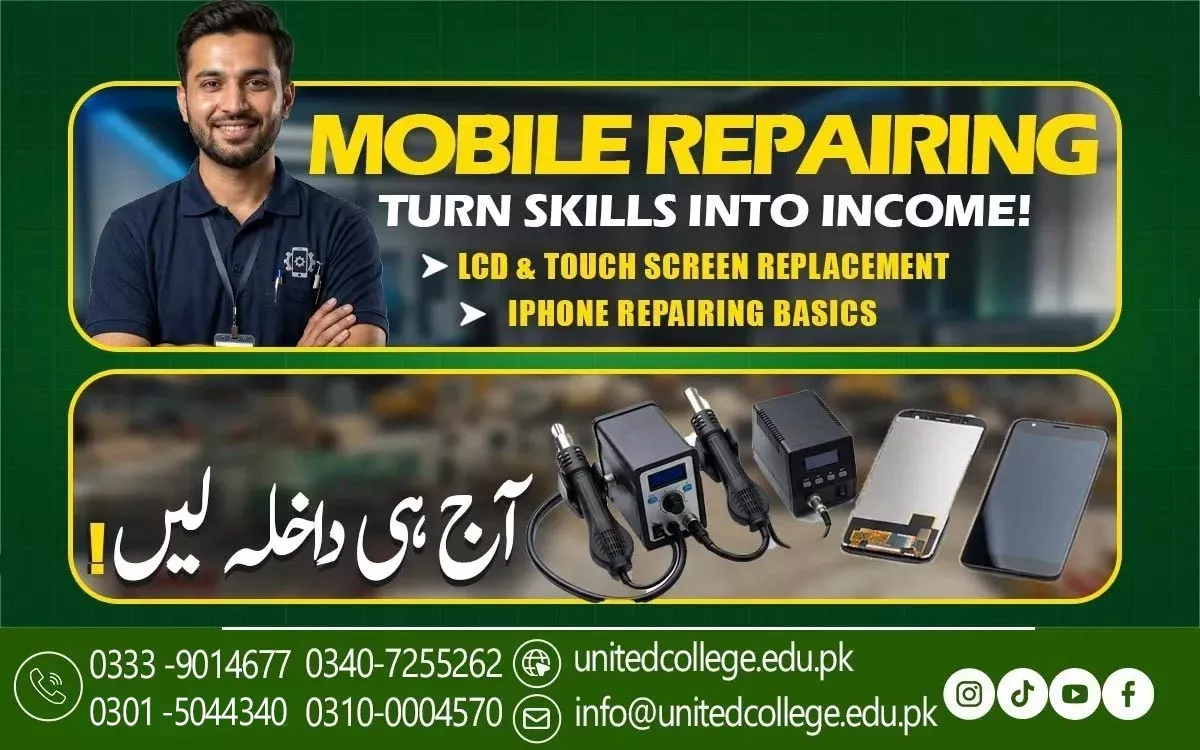

Mobile Repairing Course in Noshehra – Build Practical Repair Skills
When a Mobile Phone Stops Working, Repair Skills Become Valuable
You try another cable, change the charger, and restart the device, yet nothing seems to work. For someone who depends on a phone for calls, online classes, banking, and daily communication, even a small fault can become a major problem. Similar situations happen when a screen breaks, a battery drains too quickly, or a phone becomes unusually slow. These common issues create a need for people who understand how to identify and repair mobile phone problems. The Mobile Repairing Course in Noshehra offers an opportunity for beginners to explore this practical technical field through United College of Technology (UCT).
Instead of guessing what might be wrong with a device, learners can begin developing the knowledge needed to recognize common faults and understand possible solutions. Mobile repairing involves more than opening a phone and replacing a part. It requires patience, careful observation, basic technical knowledge, and the ability to follow safe repair procedures. People interested in hands-on learning can start by understanding how smartphones work and why different problems occur. As they develop their skills, they can learn to distinguish between simple faults and issues that require advanced technical support.
How Mobile Repairing Training in Noshehra Introduces Practical Technical Skills
Have you ever wondered how a technician identifies a mobile phone fault within a few minutes while an ordinary user struggles to understand the problem? The difference often comes from technical knowledge, systematic testing, and practical experience. A mobile phone repair course introduces learners to the methods technicians use to examine devices, identify possible faults, and decide which repair steps are appropriate. Through the Mobile Repairing Course in Noshehra offered by United College of Technology, interested learners can explore the field and understand the importance of developing practical mobile repair skills. Beginners should first become familiar with common mobile phone problems before attempting complicated repairs.
For example, a phone that does not turn on may have a discharged battery, a faulty charging connection, damaged internal components, or a software issue. Each possibility requires careful checking rather than guesswork. Mobile repairing training can help learners understand this process and develop a more organized approach to troubleshooting. Students can also learn why different phone models may require different procedures and why following manufacturer-supported guidance is important. A practical mobile repairing course in Pakistan can be a starting point for people who prefer hands-on technical learning instead of studying only theoretical information. However, the amount of practical experience available depends on the actual training arrangements.
Understanding Smartphone Components Before Attempting a Repair
Opening a smartphone without knowing what is inside can turn a minor problem into an expensive repair. A small connector may become damaged, a flexible cable may tear, or an incorrect tool may scratch an internal component. That is why understanding phone components is an important part of mobile hardware repair. A smartphone contains several connected parts, including a display, battery, charging port, cameras, speakers, microphones, buttons, circuit board, and flexible connectors. Each component performs a particular function, and a problem in one area can sometimes affect another. For example, a faulty speaker may cause unclear sound during calls, while a damaged charging port may prevent a device from receiving power correctly.
Learners interested in mobile phone technician training should understand the purpose of these parts before attempting to remove or replace them. They should also become familiar with basic electronics for mobile repair, including simple ideas about voltage, current, electrical connections, and short circuits. These concepts help explain why technicians use testing equipment rather than replacing components without evidence. Mobile phone fault diagnosis begins with observing the problem, checking the device's condition, and identifying possible causes. It does not always require immediate disassembly. Sometimes, an external inspection or a simple functional test can provide useful information.
Diagnosing Charging Faults, Battery Problems, and Broken Screens
A customer arrives at a repair shop because a phone only charges when the cable is held at a certain angle. Should the technician replace the charging port immediately? Not necessarily. The cable, adapter, charging connection, battery condition, or internal circuitry may be responsible. Effective mobile phone fault diagnosis requires checking possible causes before deciding which component needs attention. Charging problems are common examples of why careful testing matters. Learners can study how to inspect charging accessories, recognize signs of port damage, and understand when a fault requires professional examination. Battery-related symptoms also need proper attention.
A phone that shuts down unexpectedly, becomes unusually warm, or loses charge rapidly may have a battery problem, but software activity or other internal faults can create similar symptoms. Battery replacement should therefore follow suitable diagnostic procedures and safe handling practices. Damaged screens present another common challenge. A phone may have cracked glass, an unresponsive touch screen, display lines, or a completely black display. These symptoms do not always indicate the same fault, so technicians must distinguish between visible damage and possible internal problems. Mobile screen replacement also requires model-specific procedures because adhesives, connectors, and internal layouts can vary.
Learning Mobile Software Troubleshooting Without Losing Important Data
Not every mobile phone problem comes from a damaged physical component. Sometimes, a phone becomes slow, applications repeatedly crash, an update fails, or the device struggles to start properly. In such situations, mobile software troubleshooting may be more appropriate than opening the phone. Through a Mobile Repairing Course, learners can understand how to identify software-related problems and choose suitable troubleshooting methods. Software refers to the operating system and applications that control how a device works. Hardware, by comparison, includes its physical components. Understanding the difference helps a technician avoid unnecessary repairs. For example, a phone that freezes because its storage is almost full may need storage management rather than a new display or battery.
More advanced tasks, such as firmware installation or operating system recovery, require additional care because incorrect procedures may cause data loss or prevent the phone from starting correctly. Android phone repair may involve understanding different software versions and manufacturer-specific recovery methods, while basic iPhone repair concepts include learning about supported update and recovery options. Before carrying out any procedure that could erase information, a technician should explain the possible consequences and obtain the customer's permission. Backups should be considered whenever practical and supported. Mobile software troubleshooting must also respect privacy.
Using Mobile Repair Tools and Equipment Safely
Imagine trying to open a smartphone with an ordinary kitchen knife because a proper opening tool is unavailable. The attempt might scratch the casing, damage the display, or cause injury. This example shows why selecting the correct mobile repair tools and equipment is an important technical skill. A basic repair toolkit may include precision screwdrivers, plastic opening tools, tweezers, suction tools, a multimeter, and suitable protective equipment. Each tool has a specific purpose. Precision screwdrivers help remove small screws, while plastic opening tools can reduce the risk of scratching a phone's casing during disassembly. Tweezers are useful for handling small parts, but delicate connectors should never be pulled or bent carelessly.
A multimeter measures electrical values such as voltage and resistance, helping trained users investigate certain electrical faults. Beginners need instruction before using it on electronic devices because incorrect settings or testing methods can damage components. Static electricity is another concern. An electrostatic discharge can harm sensitive electronic parts even when the damage is not immediately visible. Using appropriate antistatic precautions and keeping the work area organized can reduce this risk. Learners should also understand that a tool suitable for one phone model may not be appropriate for another. During mobile repair training, students should become familiar with the purpose, limitations, and safe handling of common equipment.
Building Confidence Through Careful Disassembly and Practical Repair Exercises
The first time a learner opens a mobile phone, even a simple task can feel difficult. Small screws may look similar, adhesive can resist removal, and internal connectors may be harder to handle than expected. This is why practical learning should begin with suitable exercises under experienced supervision rather than attempting complicated repairs on valuable customer devices. Learners can start by identifying external components, examining damaged devices, recognizing screws and connectors, and practicing basic disassembly procedures on appropriate training equipment. They can then study how components are removed, inspected, and reassembled according to the relevant device instructions.
During a Mobile Repairing Course, learners can develop these skills by practising basic repair procedures and understanding how different phone components work. However, not every repair should be attempted by a beginner. Board-level repairs, micro-soldering, complex power faults, and repairs involving damaged circuit boards require specialized equipment and further training. Learners should understand their limits and ask for help when a task exceeds their experience. They should also practice checking basic functions after a repair, such as charging, display response, sound, buttons, and connectivity, whenever appropriate. The goal is not simply to open and close a device but to understand the repair process and work carefully.
Handling Customer Devices Responsibly in a Mobile Repair Workshop
Technical knowledge is only one part of successful mobile repair. Imagine a customer leaves a phone for a charging problem, but the technician returns it with missing screws, an unexplained delay, or personal information exposed. Even if the original fault is repaired, the customer may lose confidence in the service. Responsible workshop practices are therefore essential for anyone learning this trade. A technician should listen carefully to the customer's description, ask relevant questions, and record the reported problem before starting work. It is also helpful to explain the proposed inspection and obtain permission before opening the device or carrying out repairs that may affect its condition.
Data privacy deserves particular attention because smartphones contain photographs, messages, contacts, documents, and account information. Repair workers should access only the information genuinely needed for the authorized task and avoid copying, sharing, or inspecting private content without permission. Customer passwords and verification codes should not be requested unless a specific, legitimate procedure requires access, and safer alternatives should be considered wherever possible. A mobile repair workshop should also maintain an organized workspace, keep customer devices clearly identified, and store removed components securely.
Developing Mobile Repair Skills and Exploring Realistic Work Opportunities
After learning to identify common faults and practice basic repair procedures, students may begin considering how to use their skills in real working environments. Career opportunities in mobile repairing can include assisting an experienced technician, working in a mobile phone service shop, supporting basic device maintenance, or gradually developing the experience needed to explore a small repair business. However, completing training alone does not guarantee employment or business success. Employers and customers may expect practical ability, careful workmanship, honest communication, and an understanding of different smartphone models.
Beginners can strengthen their readiness by continuing to practice on suitable devices, studying manufacturer-supported repair information, and learning how to diagnose faults systematically. They should also keep up with changes in smartphone technology because newer devices may use different components, adhesives, software systems, and repair procedures. The Mobile Repairing Course in Noshehra offered by United College of Technology (UCT) can serve as a starting point for learners interested in exploring this technical field. Before enrolling, prospective students should ask about practical training arrangements, the equipment available, the topics covered, and the level of supervision provided.
Frequently Asked Questions (FAQs)
The Mobile Repairing Course in Noshehra is a technical training option offered by United College of Technology (UCT) for learners interested in understanding mobile phone hardware, software troubleshooting, and common smartphone repair techniques.
Students, beginners, job seekers, and individuals interested in learning practical mobile repair skills can explore this course. Previous technical experience may not be necessary for basic-level learning, but applicants should confirm the admission requirements with UCT.
Learners can develop an understanding of mobile phone components, common hardware faults, charging problems, battery issues, screen damage, basic software troubleshooting, and the safe use of repair tools.
Hardware repairing focuses on physical components, while software repairing involves operating systems, updates, and supported recovery procedures. The topics covered together depend on the course curriculum offered by the training institute.
Common tools include precision screwdrivers, tweezers, plastic opening tools, suction tools, and multimeters. Specialized repairs may require additional equipment and technical training.
Admission Open: Start Your Professional Journey Today!
Join United College of Technology and build a career with practical training, recognized certifications, and Gulf job support. Seats are limited.
Apply Now via WhatsAppContact Information
- Address: Rawalpindi: F-272 Main New Katarian Stop, Old IJP Road | Lahore Campus: Lahore, Pakistan
- Phone/WhatsApp: 0340-7255262 / 0333-9014677 / 0301-5044340 / 0310-0004570 / 051-8770756
- Website: unitedcollege.edu.pk
















Leave a Comment