


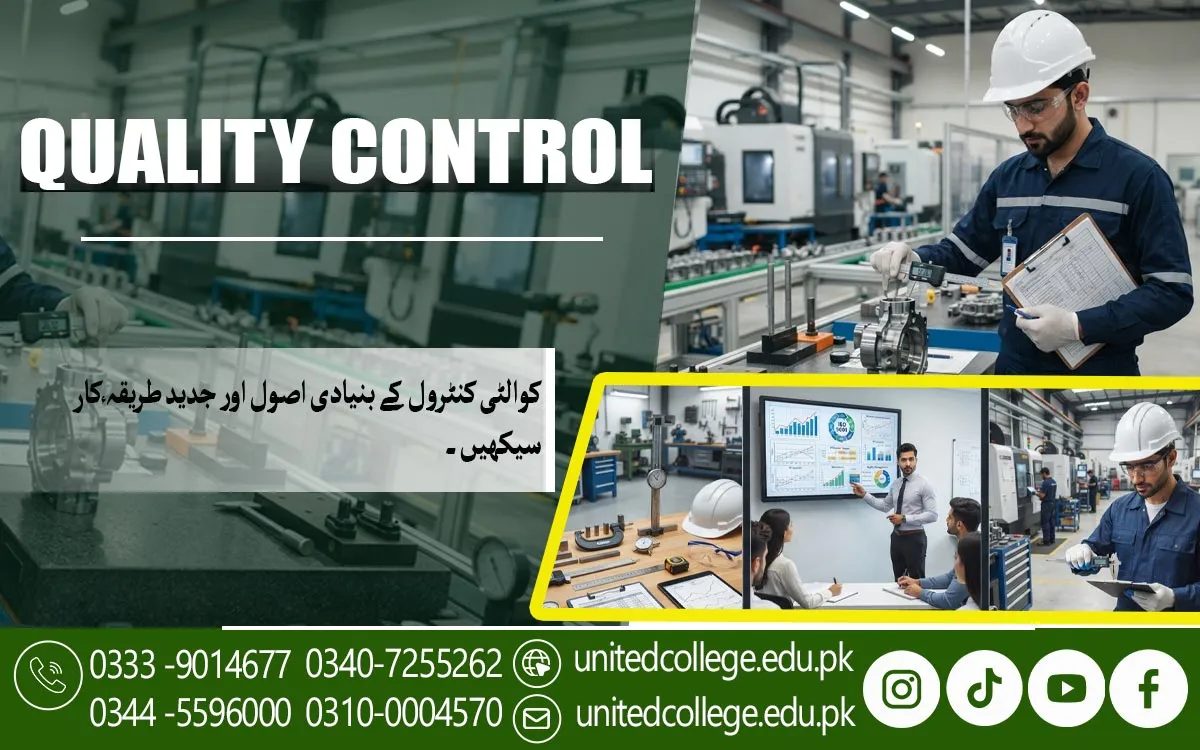

Quality Control Course in Chiniot for Modern Inspection Careers
Turns Careful Work Into Real Technical Value
A product can look perfect and still have a hidden problem. A small mistake in material, measurement, fitting, or production can affect the final result. That is why quality has become an important part of manufacturing, construction, production, and many other industrial activities. Quality control helps organizations find problems before they become bigger. Trained workers check materials, products, processes, and results against required standards.
They also record findings and help teams understand where improvements are needed. For students, beginners, fresh learners, and job seekers in Chiniot, learning these skills can be a practical way to understand the quality side of technical work. The Quality Control Course in Chiniot offered by United College of Technology can help learners develop basic knowledge of inspection, testing, documentation, standards, and workplace quality practices.
One Small Defect Can Change the Final Result
Quality control is mainly about making sure that work meets the required level of quality. It does not only mean looking at a finished product. It can involve checking materials, monitoring processes, measuring results, and identifying problems at different stages. A Quality Control Course in Chiniot can help learners understand these essential practices and how they support accurate and consistent production. For example, imagine a production unit making hundreds of similar items.
If a measurement is incorrect during production, the same mistake may appear in many products. Early inspection can help identify the issue before more material, time, and effort are wasted. This is why quality control is closely connected with consistency. Through a Quality Control Course in Chiniot, learners can develop an understanding of how proper quality processes help businesses produce results that follow the same expected requirements.
Learn to Spot Problems Before They Become Costly
Defect identification is an important part of quality inspection. A defect is simply a problem that makes a product, material, or process different from the required condition. Learners can become familiar with different inspection techniques used to find visible and measurable problems. They may learn how to compare actual results with given specifications and recognize irregularities that require attention.
This skill requires patience and observation. A quality worker should not rush through an inspection. Instead, each check should follow a clear procedure so that important details are not missed.
Quality Assurance and Quality Control Work Together
Quality assurance and quality control are related, but they are not the same. Quality assurance focuses more on creating processes that support consistent quality. Quality control focuses more on checking actual work, products, or results.
A simple example can make the difference clear. If a company creates a proper process for handling production work, that process supports quality assurance. When workers inspect the resulting products to find defects, that activity is quality control. Understanding both areas gives learners a broader view of workplace quality. It shows them that good results depend on both proper processes and careful checking.
Good Records Turn Inspection Into Useful Information
Finding a problem is only one part of quality work. The next step is making sure that the finding is properly recorded. Workplace documentation can include inspection results, measurements, observations, test findings, and details about quality issues. Clear records help teams understand what happened and when it happened.
Inspection reports also make communication easier. Instead of explaining a problem only through conversation, workers can provide written information that others can review. For beginners, learning basic documentation practices can build an important professional habit. Accurate records show that quality work depends not only on technical knowledge but also on responsibility.
Practical Training Helps Turn Knowledge Into Working Skills
Reading about quality control is useful, but practical learning can make the concepts easier to understand. When learners work through examples and inspection situations, they can see how quality procedures operate in real tasks. The Quality Control Course in Chiniot at United College of Technology is designed around developing a practical understanding of quality-related work.
With guidance from instructors, learners can become more familiar with inspection methods, quality requirements, documentation, and careful workplace practices. Practical training can also help students become more comfortable with technical tasks. They can learn how to approach an inspection step by step instead of trying to solve every problem at once. The goal is to build useful habits that learners can carry into future technical environments.
Quality Skills Have a Place Across Different Industries
Quality control is not limited to one type of workplace. Many industries need people who understand how to check work, identify problems, follow requirements, and maintain consistency. Manufacturing units may use quality checks to examine raw materials and finished products. Construction-related work may involve checking materials, measurements, and completed tasks.
Food production, engineering-related workplaces, warehousing, and other industrial operations can also depend on quality practices. In each setting, the exact inspection process may differ, but the basic purpose remains similar: identify issues and support reliable results. This wide application makes quality control knowledge useful for learners who have not yet decided which technical field they want to enter.
Corrective and Preventive Actions Move Quality Forward
When an inspection identifies a problem, simply recording it may not be enough. The workplace may need to take corrective action to fix the existing issue. Preventive action has a different purpose. It focuses on reducing the chance of a similar problem happening again.
For example, if repeated errors appear during a production process, a team may review the procedure, identify what needs improvement, and change the way the task is handled. Learners can become familiar with these basic ideas through quality control training. They can understand why quality improvement is an ongoing process rather than a one-time activity.
Build a Professional Approach Around Accuracy
Quality control skills can shape the way a person approaches technical work. Instead of accepting the first result, a quality-focused worker learns to check whether the result meets the required condition. Accuracy, observation, documentation, and process monitoring all contribute to this approach. Communication is also important because quality issues often need to be explained clearly to other workers or supervisors.
For students and beginners in Chiniot, these habits can add value to their existing technical interests. Someone interested in manufacturing, engineering, production, construction, or industrial operations may find quality knowledge useful alongside other skills. The Quality Control Course in Chiniot can therefore be viewed as a practical learning path for people who want to understand how quality is maintained in professional environments.
Turn Quality Knowledge Into Your Next Practical Step
Professional growth often begins with learning how work is done in practice. Quality control offers a useful way to understand the importance of accuracy, standards, inspection, and continuous improvement. For learners in Chiniot, developing these skills can strengthen their understanding of workplace quality requirements. It can also help them become more careful, organized, and confident when dealing with technical tasks.
The Quality Control Course in Chiniot offered by United College of Technology provides an opportunity to build this foundation through focused learning and practical understanding. For students, beginners, workers, and job seekers interested in technical fields, gaining quality control knowledge can be a positive step toward broader professional development.
Frequently Asked Questions (FAQs)
People who like organized tasks, careful checking, technical work, and finding small differences may enjoy studying quality control.
Quality work can support production goals by helping teams maintain required standards while identifying issues that could affect output.
Yes. Quality procedures encourage workers to follow instructions carefully, complete checks properly, and pay attention to required conditions.
Standards provide clear requirements for acceptable work. They help workers understand what a product, material, or process should meet.
Testing provides information about the condition or performance of a material, product, or process and can help teams make informed quality decisions.
Yes. Quality skills can complement knowledge from another technical field and provide a different understanding of how professional work is evaluated.
Admission Open: Start Your Professional Journey Today!
Join United College of Technology and build a career with practical training, recognized certifications, and Gulf job support. Seats are limited.
Apply Now via WhatsAppContact Information
- Address: Rawalpindi: F-272 Main New Katarian Stop, Old IJP Road | Lahore Campus: Lahore, Pakistan
- Phone/WhatsApp: 0340-7255262 / 0333-9014677 / 0301-5044340 / 0310-0004570 / 051-8770756
- Website: unitedcollege.edu.pk
















Leave a Comment