


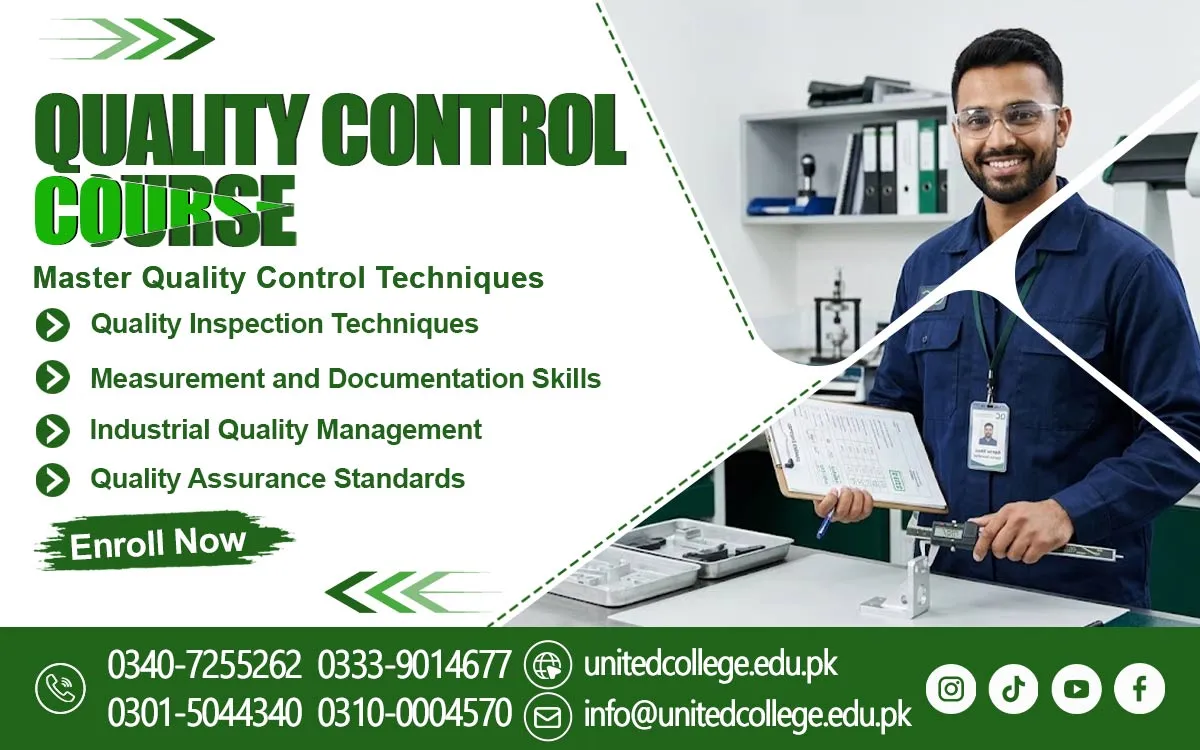

Quality Control Course in Swabi for Production Excellence
Understanding Production Quality Requirements
Production quality requirements are important for ensuring that manufactured products meet customer expectations and industry specifications. The Quality Control Course in Swabi introduces students to the basic principles of production quality and explains how businesses maintain consistent standards throughout manufacturing activities. Learners understand why every product must meet specific requirements before reaching the market.
During the training, students explore different quality factors, including product dimensions, material strength, finishing, functionality, and overall performance. They learn how manufacturers establish inspection criteria and compare finished products with approved specifications. This knowledge helps learners understand the importance of maintaining accuracy during production.
Furthermore, students discover how quality requirements contribute to business performance. They learn why organizations follow established procedures to reduce defective products and improve customer satisfaction. Understanding these principles provides a strong foundation for individuals interested in industrial quality management.
Exploring Manufacturing Process Monitoring
Manufacturing process monitoring helps organizations maintain control over different production activities. Students learn how quality professionals observe manufacturing operations and identify problems that may affect the final product. The Quality Control Course in Swabi explains how regular monitoring supports better production performance and reduces unnecessary errors.
Learners explore how production stages are checked through inspections, measurements, and process evaluations. They understand the importance of monitoring equipment performance, material usage, and working procedures. These activities help identify variations that could lead to manufacturing defects.
The course also highlights the role of communication between production workers and quality inspectors. Students learn how timely reporting and regular process reviews help businesses improve their manufacturing operations. These concepts prepare learners to understand quality monitoring responsibilities in industrial environments.
Learning Statistical Quality Control Basics
Statistical quality control is used by industries to examine production data and identify variations in manufacturing processes. During the Quality Control Course in Swabi, students are introduced to basic statistical concepts that support industrial quality evaluation. They learn how collected information can help organizations understand production performance.
Students explore simple statistical techniques, including averages, measurement variations, frequency distributions, and basic control charts. They understand how these methods help quality professionals recognize unusual changes during manufacturing. This knowledge allows learners to understand how data supports better inspection decisions.
Moreover, students discover how statistical methods contribute to continuous improvement. They learn why production information should be collected and reviewed regularly to identify repeated problems. These basic analytical concepts are useful for individuals interested in quality assurance and production management.
Examining Methods of Product Verification
Product verification is an important process used to confirm whether manufactured items meet established requirements. Students learn how inspectors examine products and compare their characteristics with technical specifications. The Quality Control Course in Swabi introduces different verification methods used in manufacturing and industrial operations.
Learners become familiar with visual inspection, dimensional measurement, functional testing, and document verification. They understand how these procedures help identify differences between actual product results and expected quality standards. This knowledge supports accurate product evaluation.
The training also explains why verification should be performed at appropriate stages of production. Students learn how proper examination can prevent unsuitable products from moving to the next manufacturing stage. These skills help learners understand the responsibilities of industrial quality inspectors.
Identifying Causes of Production Errors
Production errors can affect manufacturing efficiency, product reliability, and business costs. Therefore, identifying the reasons behind these errors is an important part of quality management. Through the Quality Control Course in Swabi, students learn about common production problems such as incorrect measurements, equipment failures, material defects, and improper working procedures.
Learners explore basic problem-solving approaches used to investigate manufacturing errors. They understand how inspections, production records, and workplace observations can help identify possible causes. This knowledge helps them recognize the difference between identifying a defect and understanding why it occurred.
Furthermore, students learn how corrective actions can prevent similar problems in the future. They discover why equipment maintenance, employee awareness, and process improvements are important for reducing production errors. These concepts support better industrial performance and product quality.
Improving Efficiency Through Quality Checks
Regular quality checks help businesses maintain product standards while improving manufacturing efficiency. Students explore how inspection activities can identify problems before they create additional production costs. The Quality Control Course in Swabi explains the relationship between quality checking, productivity, and effective resource management.
During this section, learners understand how routine inspections, material verification, and production monitoring help reduce unnecessary waste. They also study how organizations use inspection schedules and quality checklists to maintain consistent production activities.
In addition, students discover how efficient quality procedures can improve workplace performance. They learn why early problem detection saves time and supports better coordination between departments. These practices help learners understand the value of quality checks in modern manufacturing industries.
Understanding Workplace Quality Responsibilities
Quality responsibilities are shared among different employees working in manufacturing and industrial organizations. Students learn how inspectors, production workers, supervisors, and quality managers contribute to maintaining product standards. The Quality Control Course in Swabi introduces learners to the professional responsibilities involved in industrial quality management.
Learners explore the importance of following standard operating procedures, maintaining accurate records, reporting defects, and cooperating with other departments. They understand how individual performance can influence the overall quality of manufactured products. This knowledge helps students develop awareness of professional workplace expectations.
The course also explains why accountability and effective communication are important in quality-related jobs. Students discover how teamwork helps organizations solve production problems and maintain reliable standards. These responsibilities prepare learners for professional environments where quality management is essential.
Future Scope in Production Quality Management
Production quality management offers different career opportunities in manufacturing, engineering, construction, food processing, and other industrial sectors. After completing the Quality Control Course in Swabi, students can explore employment opportunities according to their technical knowledge, practical abilities, and experience.
Potential career positions include Quality Control Inspector, Production Quality Assistant, Quality Assurance Technician, Manufacturing Inspector, and Quality Management Assistant. Individuals who gain additional experience and advanced knowledge may progress toward supervisory and quality management positions.
United College of Technology provides technical education that helps learners understand important industrial concepts and develop professional knowledge. Students interested in production quality can use this training as a starting point for further learning and career development. With practical experience and continuous improvement, they can prepare themselves for opportunities in the industrial sector.
Frequently Asked Questions (FAQs)
The Quality Control Course in Swabi is a professional training program that introduces students to production monitoring, product verification, statistical quality control, and manufacturing quality management.
Students learn production quality requirements, manufacturing process monitoring, basic statistical methods, product inspection, error identification, and workplace quality responsibilities.
Students, fresh graduates, job seekers, and individuals interested in manufacturing, engineering, production, and industrial inspection can apply according to the institute's admission requirements.
Statistical quality control uses basic statistical techniques to examine production data, identify process variations, and maintain consistent product standards.
Product verification confirms whether manufactured items meet required specifications. It helps identify defects, maintain reliability, and prevent unsuitable products from reaching customers.
Admission Open: Start Your Professional Journey Today!
Join United College of Technology and build a career with practical training, recognized certifications, and Gulf job support. Seats are limited.
Apply Now via WhatsAppContact Information
- Address: Rawalpindi: F-272 Main New Katarian Stop, Old IJP Road | Lahore Campus: Lahore, Pakistan
- Phone/WhatsApp: 0340-7255262 / 0333-9014677 / 0301-5044340 / 0310-0004570 / 051-8770756
- Website: unitedcollege.edu.pk
















Leave a Comment