


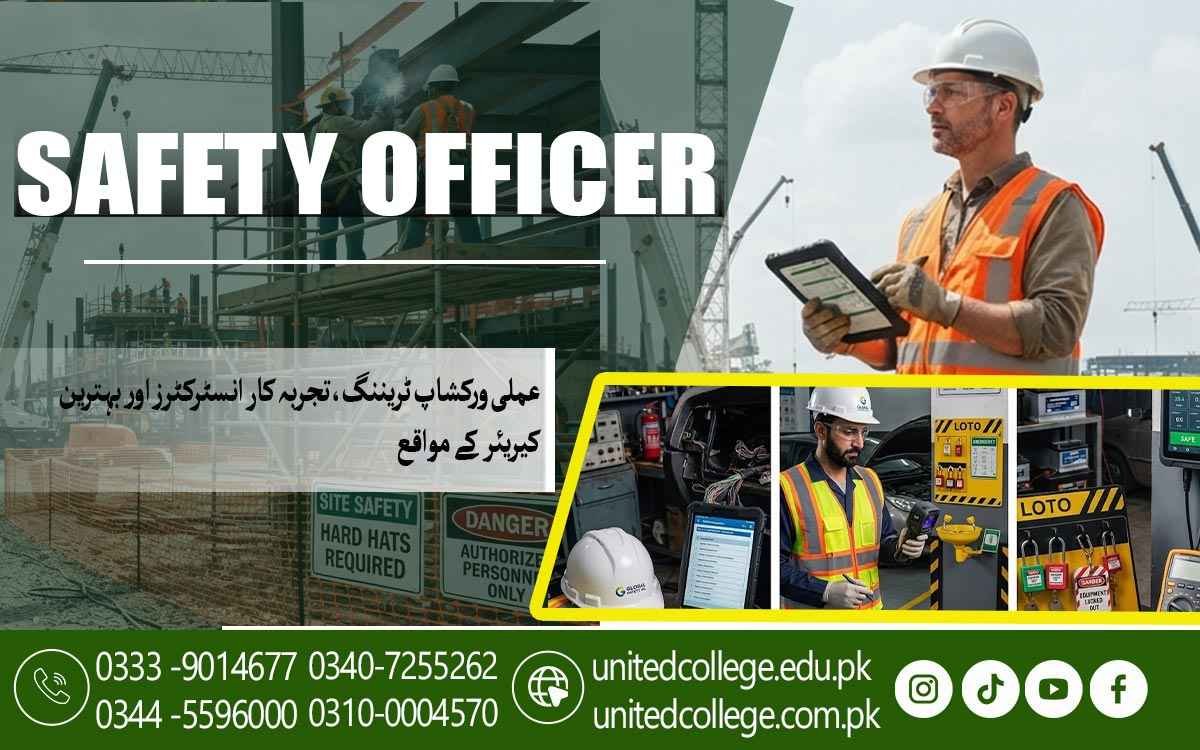

Safety Officer Course in Balakot for Practical Safety Training
How Safety Training Helps Prevent Workplace Accidents
Imagine a worker standing on a construction site when a loose electrical wire lies across a wet floor. Another worker walks nearby without noticing the danger. In just a few seconds, a simple mistake could lead to a serious accident. Situations like this show why workplace safety requires attention, preparation, and proper knowledge. Workers need to understand how to recognize risks, follow safety procedures, and protect themselves and the people around them. The Safety Officer Course in Balakot is a relevant training option for individuals who want to learn about occupational health and safety and understand how accidents can be prevented in different working environments.
Offered by United College of Technology (UCT), this course topic is especially relevant to beginners, students, fresh learners, and job seekers interested in developing safety-related knowledge. Workplace safety is not limited to wearing a helmet or placing warning signs near dangerous areas. It also involves checking equipment, keeping workspaces organized, reporting unsafe conditions, and understanding what to do during an emergency. Whether someone works in construction, manufacturing, a warehouse, or a small workshop, safety awareness can help reduce preventable risks. Learning these principles gives students a clearer understanding of how a safe working environment is maintained.
What Students Learn in a Safety Officer Course in Balakot
A safety officer needs more than general awareness of workplace dangers. The role requires an understanding of how hazards develop, how risks can be controlled, and how workers can follow established safety procedures. A Safety Officer Course in Balakot may cover several learning areas that introduce students to these responsibilities. Common topics in safety training include hazard identification, risk assessment, personal protective equipment, fire prevention, emergency procedures, accident reporting, and workplace inspections. Students can learn why safety rules exist and how they apply to everyday working situations.
A safety officer must recognize these dangers and help ensure that appropriate precautions are followed. Learners may also study safety signs, incident records, and basic documentation used to communicate workplace risks. These subjects help explain how safety information is recorded and shared with supervisors and other workers. Occupational health and safety also includes protecting people from long-term risks, such as excessive noise, dust, and exposure to harmful substances. The exact syllabus, practical activities, and assessment methods depend on the institution and course arrangements, so prospective students should confirm the available details with United College of Technology.
Recognizing Workplace Hazards Before They Cause Harm
A workplace hazard is anything that could cause injury, illness, or damage if it is not properly controlled. Some hazards are easy to notice, while others may remain hidden until someone gets hurt. A wet floor, an uncovered opening, or a heavy object stored incorrectly can create immediate dangers. Electrical wires with damaged insulation may expose workers to electric shock, while poorly maintained machines can cause cuts, crushing injuries, or other serious harm. Chemical substances may also present risks when they are stored incorrectly, handled without suitable protection, or used in areas with poor ventilation. During safety officer training in Balakot, learners can explore how workplace hazard identification helps people recognize these problems before an accident occurs.
The disorganized area increases the chance of trips and falls. A careful inspection can identify the problem and help workers introduce better storage and housekeeping practices. Noise, dust, extreme temperatures, and repetitive physical tasks are other hazards that deserve attention because they can affect workers over time. Students should also understand that hazards can vary between industries. A construction site may present falling-object and work-at-height risks, while a warehouse may involve vehicle movement and heavy lifting. Recognizing these differences helps safety personnel identify relevant precautions, communicate concerns clearly, and encourage workers to report unsafe conditions without delay.
Understanding Risk Assessment and Practical Hazard Control
Finding a hazard is only the first step toward creating a safer workplace. Workers and safety personnel must also understand how likely an incident is to happen and how serious its consequences could be. This process is known as risk assessment. During the Safety Officer Course in Balakot, students may learn to identify a hazard, consider who could be affected, evaluate the level of risk, select suitable control measures, and review whether those measures are working. For example, imagine workers carrying materials through a narrow passage where equipment and supplies have been left on the floor.
A practical control measure could involve clearing the passage, creating designated storage areas, and including walkway checks in routine inspections. More serious hazards may require stronger precautions, such as isolating dangerous equipment or restricting access until the problem has been addressed. Effective risk assessment considers both the chance of an incident and the possible severity of harm. It also recognizes that personal protective equipment alone may not provide sufficient protection when a hazard can be removed or controlled at its source. Safety officers need to communicate their findings so workers understand what action is required and why. Through risk assessment and management, learners can develop a structured approach to workplace problems instead of relying on guesswork.
Using Personal Protective Equipment and Safety Signs Correctly
Even when a workplace has good safety procedures, workers may still face risks that require personal protective equipment, commonly called PPE. PPE includes items designed to reduce exposure to specific hazards. Safety helmets can help protect the head from certain falling-object hazards, while safety shoes provide protection against particular foot injuries. Gloves may protect hands from selected cuts, abrasions, or substances, but the correct type depends on the task. Safety goggles help protect the eyes from dust, splashes, and flying particles, while hearing protection can reduce exposure to hazardous noise when appropriately selected and used. Reflective vests improve visibility in areas where vehicles or moving equipment operate.
Workers need to know how to inspect protective items, recognize damage, follow fitting instructions, and replace equipment when necessary. Safety signs and symbols provide another important layer of protection. Warning signs alert workers to potential dangers, prohibition signs identify activities that are not allowed, and mandatory signs communicate actions that must be followed. Emergency signs may identify exits, first aid points, or other important facilities. For example, a clearly displayed warning sign near a high-voltage area can remind authorized personnel to follow the required precautions and discourage unauthorized access. PPE and signs work best when supported by training, proper maintenance, safe work procedures, and regular supervision.
Fire Prevention, Emergency Procedures, and First Aid Awareness
A small fire can become a major emergency when workers do not know how to respond. Overloaded electrical connections, flammable materials stored incorrectly, and unsafe hot-work activities can all contribute to fire risks. Fire safety training introduces learners to the importance of identifying possible ignition sources, maintaining clear escape routes, following storage requirements, and reporting unsafe conditions. Students studying workplace safety may also learn about fire alarms, evacuation plans, assembly points, and emergency communication. Knowing where an exit is located can make a significant difference when smoke or confusion makes movement difficult.
The correct response depends on the type of fire, the available equipment, the person's training, and the immediate level of danger. If a fire cannot be controlled safely, people should raise the alarm, evacuate, and contact the appropriate emergency services. Emergency response procedures should be clear, communicated to workers, and practised where suitable. First aid awareness is another useful part of workplace safety education. Learners can become familiar with the purpose of first aid supplies, the need to report injuries promptly, and the importance of getting trained assistance when someone is hurt. They should understand that medical emergencies may require professional care rather than improvised treatment. Through fire safety training and emergency planning, beginners can learn why preparation matters before an incident occurs.
Safety Officer Duties on Construction Sites and in Industrial Workplaces
The daily responsibilities of a safety officer can change depending on the industry, the size of the workplace, and the risks involved. On a construction site, safety personnel may pay close attention to scaffolding, ladders, excavation areas, lifting operations, electrical equipment, and falling objects. In a manufacturing facility, their attention may include machine guarding, chemical handling, equipment maintenance, and the safe movement of materials. Warehouses may require particular attention to forklifts, loading areas, storage racks, and pedestrian routes. These examples show why safety officers need to understand the working environment instead of relying on the same checklist for every situation.
They may also learn about toolbox talks, which are short safety discussions held before work begins or when a particular risk needs attention. Accident and near-miss reporting is another important responsibility because it helps organizations understand what happened and identify improvements. Recording these events can reveal problems before a more serious incident occurs. Safety officers may also help workers understand procedures, check whether precautions are being followed, and maintain relevant records. Their work involves observation, communication, organization, and a willingness to address concerns. The Safety Officer Course in Balakot can introduce beginners to these duties and help them understand the knowledge that safety-related roles may require.
How Practical Training Builds Workplace Safety Skills
Reading about workplace hazards is useful, but applying that knowledge to realistic situations helps learners understand how safety procedures work. Imagine being asked to inspect a workshop before its workers begin their shift. The floor has several loose cables, a machine guard appears damaged, and a fire exit is partly blocked. A learner with basic safety knowledge should be able to identify these concerns, explain why they matter, and recognize that appropriate corrective action is needed. Practical learning activities can help develop this kind of thinking. Depending on the course arrangements, safety education may include hazard-identification exercises, sample inspection checklists, risk assessment scenarios, safety sign recognition, and discussions about accident reports.
A safety officer may need to explain a risk to a worker who is busy, report a serious concern to a supervisor, or record an observation in clear language. Practising these tasks can help learners communicate safety information more effectively. Students can also benefit from learning how to distinguish an immediate danger from a problem that requires planned corrective action. The exact practical activities offered by United College of Technology should be confirmed directly with the institution rather than assumed. For anyone considering safety training for beginners, it is sensible to ask how theoretical lessons are supported by examples, demonstrations, exercises, and assessment.
Choosing Safety Officer Training at United College of Technology
Choosing a training course is an important decision, particularly for someone who is new to occupational health and safety. Students should look beyond the course name and examine what they will actually learn. United College of Technology (UCT) offers the Safety Officer Course in Balakot, making it a course option for individuals who want to explore safety-related knowledge and workplace responsibilities. Before enrolling, prospective students should ask about the syllabus, entry requirements, course duration, fee structure, teaching approach, assessment process, and certificate arrangements. It is also useful to ask whether the training covers practical examples from construction sites, workshops, factories, or other relevant workplaces.
. A course certificate and a professional qualification are not automatically the same, and employers may require particular credentials, experience, or additional training for certain positions. Students should therefore verify exactly what certificate is provided, who recognizes it, and whether it meets their intended requirements. The Safety Officer Course in Balakot may be a starting point for learning about hazard control, workplace inspections, emergency preparedness, and accident prevention, but further development can depend on individual goals and industry expectations. By asking clear questions before admission, learners can make a more informed choice and understand what the training includes.
Frequently Asked Questions (FAQs)
The Safety Officer Course in Balakot is designed to introduce learners to workplace health and safety, hazard identification, risk assessment, fire prevention, and accident prevention.
United College of Technology (UCT) offers the Safety Officer Course in Balakot. Students should contact the institute to confirm current admission details and course availability.
Training may cover workplace hazards, personal protective equipment (PPE), fire safety, emergency procedures, safety inspections, risk assessment, and accident reporting.
Students, beginners, fresh learners, and job seekers interested in occupational health and safety can explore this course. Specific eligibility requirements should be confirmed with UCT.
Students can develop knowledge of hazard identification, workplace risk control, safety procedures, emergency preparedness, and effective safety communication.
Admission Open: Start Your Professional Journey Today!
Join United College of Technology and build a career with practical training, recognized certifications, and Gulf job support. Seats are limited.
Apply Now via WhatsAppContact Information
- Address: Rawalpindi: F-272 Main New Katarian Stop, Old IJP Road | Lahore Campus: Lahore, Pakistan
- Phone/WhatsApp: 0340-7255262 / 0333-9014677 / 0301-5044340 / 0310-0004570 / 051-8770756
- Website: unitedcollege.edu.pk
















Leave a Comment