


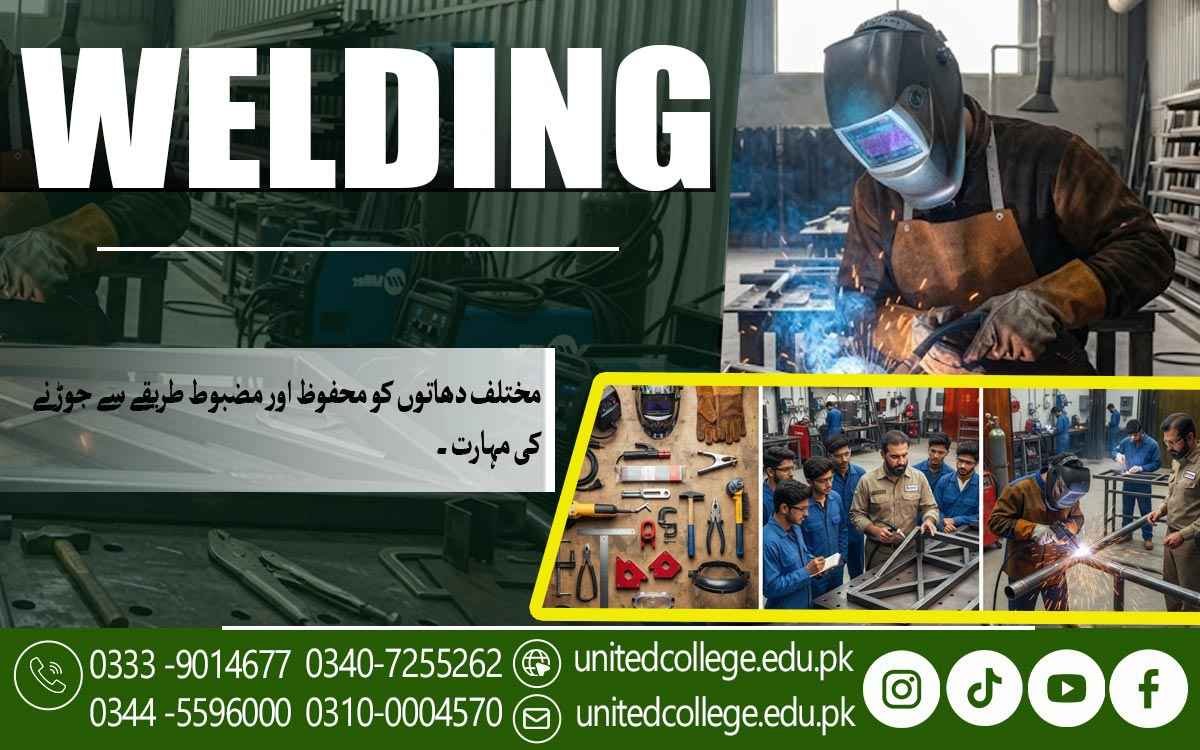

Welding Course in Sadiqabad: Learn Practical Welding Skills
Where Welding Skills Become Useful in Everyday Metalwork
A metal gate needs a strong joint, a machine part needs repair, or a fabricated frame has to be assembled with accurate measurements. In all of these situations, welding can play an important role in turning separate pieces of metal into a useful structure or repairing a damaged component. Welding may look simple from a distance, but good results require more than creating heat and joining two pieces together. A person needs to understand the welding machine, prepare the metal properly, choose suitable materials, control hand movement, follow the correct technique, and inspect the finished joint. In Sadiqabad, learners interested in practical trade training can explore welding as a skill that connects directly with different forms of metalwork.
A Welding Course in Sadiqabad can introduce beginners to the tools, processes, safety practices, and workshop procedures involved in welding without expecting them to know everything from the beginning. Students, fresh learners, and people looking to develop a practical technical skill can gradually learn how metal joining works and how different welding tasks are approached. United College of Technology offers welding training where learners can become familiar with practical concepts and workshop activities while understanding that strong welding ability develops through proper instruction, repeated practice, patience, and attention to detail.
Starting Welding Training with Skills Beginners Can Build Step by Step
For someone who has never held a welding tool before, the first experience can seem confusing because many things need attention at the same time. The learner has to understand how the welding machine works, prepare the workpiece, select the appropriate electrode or welding material, maintain a suitable position, and control the movement of the hand while creating a joint. A structured welding course can make this learning process easier by introducing each part gradually instead of asking beginners to perform complicated work immediately. Learners can first understand how welding uses heat to join metals and why different materials and techniques may require different settings or procedures.
This step-by-step approach is particularly useful because welding is a practical skill that improves through observation and repeated physical practice. A learner may understand the theory behind a weld but still need time to develop hand control and consistency. During a welding practical training program, students can learn to recognize common mistakes and understand how small changes in movement, angle, speed, or preparation can affect the finished joint. For beginners in Sadiqabad, this creates an opportunity to develop a practical foundation before moving toward more advanced welding techniques.
Exploring Welding Techniques from Arc Welding to MIG and TIG
Different welding processes are designed for different working situations, so learners benefit from understanding the basic purpose of each technique. Arc welding is an important process in which an electric arc generates heat to melt and join metal, and it is commonly associated with electrodes that are used to create the weld. Learners can become familiar with controlling the electrode, maintaining a suitable angle, and moving steadily along the joint. MIG welding uses a continuously fed wire electrode and shielding gas, allowing the welder to create a continuous weld when the process and equipment are suitable for the task. TIG welding uses a tungsten electrode and provides greater control over the welding process, which can be useful for work where precision and a clean finish are important.
These processes give students a wider understanding of welding instead of making them think that one method can be used for every type of work. During a Welding Course in Sadiqabad, learners can explore how welding techniques differ according to the material, thickness, joint, equipment, and practical requirement. Understanding these differences also helps beginners recognize why a workshop may use more than one welding process. The purpose of introducing these techniques is not to overwhelm new learners with technical information but to help them understand the wider field of metal joining and gradually become comfortable with the processes included in their practical training.
Getting Comfortable with Welding Machines, Electrodes, and Workshop Tools
A welder needs to understand the equipment surrounding the welding process because safe and accurate work depends on proper tool handling. The welding machine is central to many welding activities, but it works together with other items such as welding cables, electrode holders, earth clamps, electrodes, measuring tools, clamps, hammers, wire brushes, grinders, cutting tools, and other workshop equipment. Each tool has a particular purpose, and beginners can benefit from learning why and when it is used instead of simply memorizing its name. Welding electrodes, for example, are an important part of many arc welding processes and need to be selected, handled, and used according to the requirements of the task.
Learners can be taught to look for obvious problems such as damaged cables, loose connections, unsuitable workpiece positioning, or tools that are not in proper condition. Measuring tools are also important because fabrication work often depends on accurate dimensions and correct alignment. A well-organized welding workshop allows students to see how different tools work together as part of one process. At United College of Technology, learners can become familiar with welding equipment and workshop procedures as part of their practical learning.
Preparing, Cutting, and Fitting Metal Before Welding
A strong welding process starts before the welding arc or flame is applied to the metal. If a surface contains rust, oil, dirt, paint, moisture, or other unwanted material, it may affect the welding process and the appearance or quality of the finished joint. This makes metal preparation an important part of practical welding training in a welding course. Learners can practice measuring material, marking cutting points, cutting pieces to suitable dimensions, cleaning surfaces, removing rough edges, and preparing the joint before welding. Metal cutting also requires care because an incorrectly cut piece can create alignment problems later in the process. After cutting, the pieces may need to be positioned and fitted correctly so that the intended joint can be created.
Each arrangement places the metal pieces in a different relationship, so learners need to understand how the pieces should meet before they begin welding. Clamps may be used to keep components in position, while measurements can help confirm that the pieces are aligned according to the task. These preparation steps are particularly important in metal fabrication, where several pieces may need to come together to form a frame, support, gate, structure, or other component. By learning preparation, cutting, fitting, and joint arrangement together, students begin to see that welding is a complete workflow rather than a single action performed with a machine.
Building Control Through Hands-On Welding Practice
Reading about welding techniques can provide useful information, but practical ability develops when learners actually work with metal and equipment under suitable guidance. During hands-on welding training, students can practice maintaining a steady hand, controlling electrode movement, following the joint line, managing travel speed, and keeping an appropriate angle. These details may sound small, but they can make a noticeable difference in the appearance and consistency of a weld. Learners can also become familiar with different welding positions, such as flat, horizontal, vertical, and overhead positions, depending on the training activities available.
Repeated practice also helps learners understand why rushing can create problems. Moving too quickly may result in an incomplete or uneven weld, while excessive heat or slow movement can affect the surrounding metal and final weld shape. A learner may not produce a consistent weld during the first few attempts, and that is where practice becomes valuable. By examining each result and making small adjustments, students can gradually improve their technique. This is one of the main reasons welding practice is such an important part of a practical course. Instead of only memorizing terms such as arc welding, welding joints, or welding positions, learners can begin to understand how those concepts work when they are applied to real pieces of metal.
Checking Weld Quality and Understanding Common Welding Defects
A welding task does not necessarily end when the machine is switched off. The finished weld should also be examined to determine whether it appears suitable for the intended task. Welding inspection helps learners develop the habit of checking their work instead of assuming that every completed weld is satisfactory. Beginners can be introduced to common welding defects such as cracks, porosity, undercut, excessive spatter, incomplete fusion, poor penetration, and uneven weld appearance. These terms can be explained in simple ways so that learners understand what they are looking for. Porosity, for example, can involve small holes or gas pockets in the weld, while undercut may appear as a groove along the edge of the welded area.
Such problems can be related to factors including poor surface preparation, incorrect movement, unsuitable heat control, electrode angle, or travel speed. Through basic quality checking, learners can visually examine the weld, check the continuity and shape of the joint, look for obvious cracks or gaps, and compare the result with the requirements of the task. This inspection habit is useful in fabrication work, construction welding, repair, and maintenance because it encourages attention to the finished result rather than focusing only on completing the welding operation. Accuracy is especially important when several welded components must fit together, as a small error in one joint can affect the alignment of the entire structure.
Making Welding Safety Part of Every Workshop Activity
Welding involves heat, sparks, intense light, electrical equipment, fumes, and hot metal, so safe working practices should be treated as a basic part of the skill. Welding safety begins with preparing the work area and identifying possible hazards before starting the task. Learners can become familiar with personal protective equipment, commonly called PPE, including a suitable welding helmet, protective gloves, appropriate clothing, safety footwear, and other protective equipment required for specific activities. A welding helmet helps protect the eyes and face from intense welding light and sparks, while gloves and suitable clothing can reduce exposure to heat and hot particles.
Electrical safety also matters, including checking equipment, handling cables carefully, maintaining suitable connections, and avoiding careless contact with electrical components. Learners should also understand why the workshop needs to remain clean and organized, especially around welding areas where cables, tools, metal pieces, and hot materials may create additional hazards. At United College of Technology, safety can be discussed alongside practical welding activities so that learners understand that PPE, ventilation, fire prevention, equipment handling, and clean working practices are not separate from welding; they are part of doing the work responsibly. Building these habits during training can help beginners approach practical tasks with greater awareness and care.
Connecting Welding Skills with Practical Work in Sadiqabad
The usefulness of welding becomes clearer when learners connect the skill with practical activities that involve metal in and around Sadiqabad. Welding knowledge can be relevant to fabrication workshops, construction-related metalwork, machinery maintenance, repair activities, agricultural equipment, gates, frames, supports, and other technical tasks where metal components need to be joined, repaired, or modified. A fabrication task may begin with measuring and cutting raw material before the pieces are fitted, aligned, welded, cleaned, and inspected. A repair job may involve identifying a damaged metal component, preparing the affected area, fitting a suitable replacement or reinforcement piece, and producing an appropriate joint.
A Welding Course in Sadiqabad can give learners a structured opportunity to understand these areas while developing practical familiarity with welding tools and workshop procedures. United College of Technology can introduce learners to the practical side of welding through training that focuses on equipment, techniques, safety, preparation, and hands-on exercises. The exact work a learner may eventually perform depends on their level of skill, experience, and the requirements of a particular workplace, but a sound training foundation can help them understand how welding fits into different forms of technical work.
Developing Reliable Welding Skills Through Patience and Practice
Learning welding is a gradual process, and consistent practice can make a major difference in how comfortable a learner becomes with tools, materials, and techniques. A student may know the names of welding equipment and understand how a particular process works, but practical confidence develops when that knowledge is repeatedly applied through supervised exercises and careful observation. During a Welding Course in Sadiqabad, learners can continue working on electrode control, welding positions, measurements, joint preparation, alignment, equipment handling, inspection, and safe workshop procedures. Every practice attempt provides an opportunity to notice something that could be improved.
For students, beginners, fresh learners, and people interested in practical trade training, welding can therefore be approached as a skill that grows through regular practice rather than instant results. With a structured learning environment, proper safety habits, exposure to welding techniques, and repeated hands-on work, learners can gradually build a stronger understanding of metal joining and workshop procedures. In Sadiqabad, this practical knowledge can provide a useful foundation for further learning in fabrication, construction-related welding, repair, maintenance, and other areas where metalworking skills are required.
Frequently Asked Questions (FAQs)
Yes, beginners can learn welding step by step, starting with equipment handling, safety practices, metal preparation, and basic welding exercises before progressing to more practical techniques.
Students can become familiar with welding machines, electrodes, cables, clamps, electrode holders, measuring tools, grinders, cutting tools, cleaning tools, and other workshop equipment.
Welding involves heat, sparks, bright light, fumes, and electrical equipment. Proper PPE, ventilation, fire prevention, equipment checks, and safe workshop practices help reduce common hazards.
Common techniques include arc welding, MIG welding, TIG welding, and gas welding. Each process has different equipment and applications depending on the welding task.
Welding skills can be useful in metal fabrication, construction-related work, machinery repair, maintenance, workshops, and other activities involving metal joining and repair.
Admission Open: Start Your Professional Journey Today!
Join United College of Technology and build a career with practical training, recognized certifications, and Gulf job support. Seats are limited.
Apply Now via WhatsAppContact Information
- Address: Rawalpindi: F-272 Main New Katarian Stop, Old IJP Road | Lahore Campus: Lahore, Pakistan
- Phone/WhatsApp: 0340-7255262 / 0333-9014677 / 0301-5044340 / 0310-0004570 / 051-8770756
- Website: unitedcollege.edu.pk
















Leave a Comment