


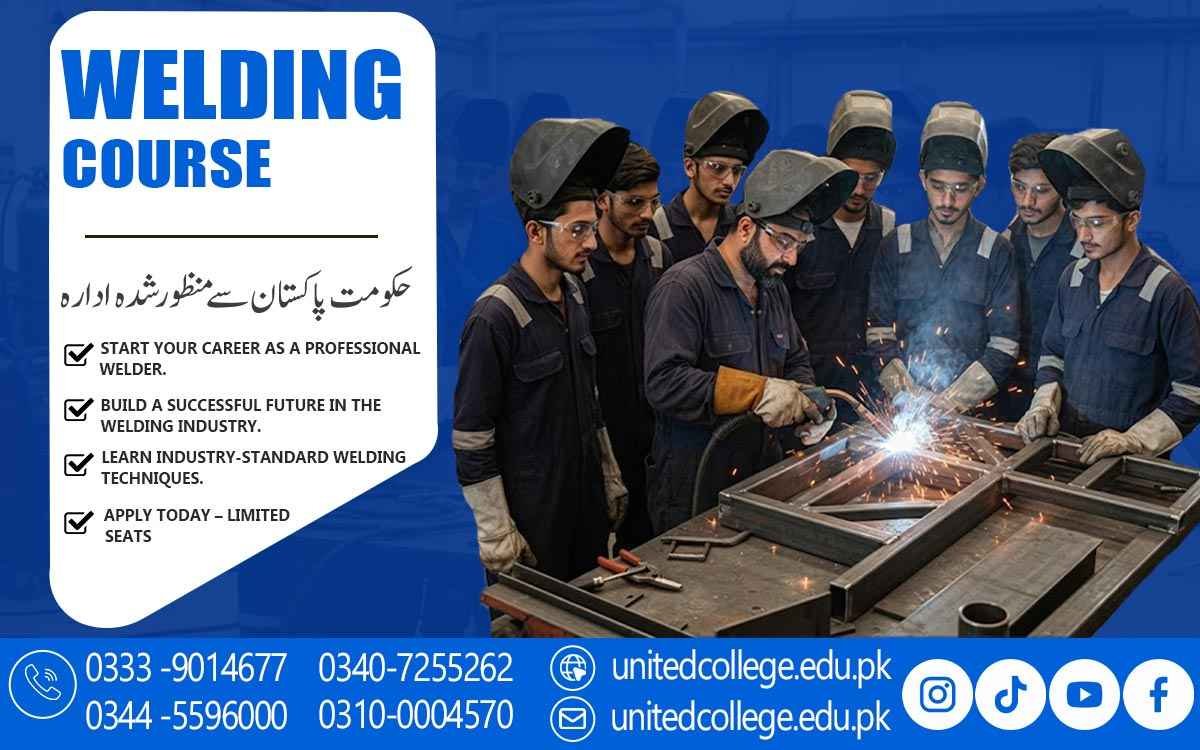

Welding Course in Sukkur for Practical Welding Skills Training
Connecting Welding Skills With Practical Work in Sukkur
A metal gate needs a strong joint, a broken machine part needs careful repair, and a steel frame must be aligned before it can become part of a larger structure. In each of these situations, welding can turn separate pieces of metal into a useful and connected structure. But good welding is not simply about creating sparks or joining two pieces together. It requires control, preparation, the right equipment, correct technique, and attention to safety. For beginners in Sukkur, learning these skills through structured practical training can make workshop work much easier to understand.
A Welding Course in Sukkur can introduce learners to welding machines, electrodes, metal preparation, welding joints, inspection methods, workshop safety, and hands-on practice. Whether someone is completely new to technical work or wants to improve existing workshop knowledge, learning how welding processes work can provide a practical foundation for working with metal in fabrication, construction, repair, and maintenance environments.
Understanding Where Welding Skills Are Used in Sukkur
Welding is closely connected with many types of practical metalwork, which is why it remains an important technical skill for people interested in fabrication and workshop activities. In Sukkur, learners may come across welding applications in metal fabrication, construction-related work, machinery maintenance, repair activities, gates, frames, railings, supports, pipes, and other metal structures. A simple fabrication task can involve measuring a piece of metal, cutting it to the required size, positioning different sections, creating a suitable joint, and checking the finished weld. Machinery repair may require a different approach because the material, joint design, and required strength can vary from one task to another.
This is where proper welding training becomes useful because learners can understand that every welding job should be approached according to the material, equipment, joint, and working conditions. Instead of treating welding as one single technique, students can gradually learn how different processes and tools are selected for different situations. A practical welding course in Sukkur can therefore help beginners understand the connection between classroom explanations and the type of metalwork commonly carried out in workshops, fabrication areas, construction projects, and maintenance settings.
Getting Familiar with Welding Machines and Workshop Tools
Before creating a weld, a learner needs to become comfortable with the equipment used around the welding workplace. A welding machine provides the power needed for particular welding processes, while other tools help with measuring, holding, cutting, cleaning, positioning, and finishing metal. During welding training, beginners can learn the purpose of equipment such as welding machines, electrode holders, welding cables, clamps, measuring tapes, try squares, hammers, wire brushes, grinders, cutting tools, and other workshop equipment. Understanding each tool is important because using the wrong tool or handling equipment carelessly can affect both the quality of the work and the safety of the worker.
Learners can also become familiar with checking cables, connections, machine settings, workpieces, and surrounding areas before beginning a task. The aim is not simply to memorize the names of welding tools but to understand when and why each tool is used. With repeated practice, a beginner can become more comfortable preparing equipment, arranging the work area, holding tools correctly, and following a suitable sequence before welding begins. This practical familiarity can make workshop activities less confusing and help learners develop better control over their work.
Learning Arc, MIG, TIG, and Gas Welding Methods
Different welding methods use different equipment and techniques, so understanding their basic concepts is an important part of welding education. Arc welding uses an electric arc to create enough heat to melt and join metal, and it is widely discussed in beginner welding training because it introduces learners to electrodes, current, arc control, and hand movement. MIG welding uses a continuously fed wire electrode and shielding gas, while TIG welding uses a separate tungsten electrode and offers greater control for certain types of precise welding work. Gas welding uses a flame produced by burning fuel gas with oxygen, and the same general principle of controlled heat is also connected with gas cutting applications.
Beginners do not need to master every process immediately; instead, they can first understand how each method works, what type of equipment it requires, and where it may be suitable. This helps students recognize why one welding technique may be selected instead of another depending on the material, thickness, joint, finish, and practical requirements of a task. Through a structured welding course, learners can gradually compare arc welding, MIG welding, TIG welding, and gas welding while developing an understanding of their equipment, working procedures, limitations, and safety requirements.
Building Control Through Arc Welding and Electrode Handling
Arc welding can be challenging for a beginner because several things need attention at the same time. The learner must hold the electrode correctly, maintain suitable movement, control the arc, observe the molten metal, and keep the hand steady enough to create a consistent weld. Electrode handling is therefore an important part of practical welding training in a welding course. Learners can be introduced to different types of welding electrodes and understand that electrodes are selected according to the welding task and material. They can also learn why electrode condition, machine settings, arc length, travel speed, and working angle can influence the finished weld.
At first, a beginner may produce an uneven bead, create excessive spatter, or struggle to maintain a stable arc, but repeated supervised practice can make these movements more familiar. The purpose of hands-on welding practice is to give learners opportunities to observe what happens when their movement or settings change and then understand how to improve their technique. This kind of practical learning is especially valuable because welding requires coordination that cannot be fully developed by reading instructions alone. Gradually, students can work toward better control, cleaner welds, more consistent movement, and greater confidence while handling welding equipment.
Preparing Metal with Measuring, Cutting, and Joint Fitting
A strong welding process starts before the welding arc or flame is applied to the metal. If a surface contains rust, oil, dirt, paint, moisture, or other unwanted material, it may affect the welding process and the appearance or quality of the finished joint. This makes metal preparation an important part of practical welding training. Learners can practice measuring material, marking cutting points, cutting pieces to suitable dimensions, cleaning surfaces, removing rough edges, and preparing the joint before welding. Metal cutting also requires care because an incorrectly cut piece can create alignment problems later in the process. After cutting, the pieces may need to be positioned and fitted correctly so that the intended joint can be created.
Depending on the task, learners may work with different joint arrangements such as butt joints, lap joints, corner joints, and T-joints. Understanding how these joints are formed helps beginners connect measurements and preparation with the final welding result. During a welding course, this stage can teach learners an important practical lesson: good welding begins with good preparation. When materials are measured accurately, surfaces are cleaned properly, and pieces are aligned carefully, the actual welding process becomes easier to control and inspect.
Practicing Welding Positions, Techniques, and Joint Control
Welding does not always take place on a flat workbench where everything is easy to reach. In practical work, a welder may need to work in different positions depending on the shape and location of the structure being repaired or fabricated. Welding positions can affect visibility, hand movement, gravity, heat control, and the way molten metal behaves during the process. Beginners can first become comfortable with basic flat-position welding before gradually understanding other positions and the challenges they can create. Training may also cover travel speed, electrode angle, arc length, heat control, and movement patterns because these factors can influence weld appearance and penetration.
Penetration refers to how deeply the welding heat and molten metal join the materials, and suitable penetration is important for creating a sound joint. Learners can also practice maintaining a steady movement rather than rushing through the weld. In hands-on welding practice, small changes in technique can produce noticeable differences in the finished bead, giving students a practical way to understand why control matters. This step-by-step approach can help beginners develop patience and coordination while learning how welding techniques are adapted to different joints, positions, materials, and working conditions.
Checking Welds for Defects and Improving Work Quality
Creating a weld is only part of the job; checking the finished joint is also important. A weld may appear acceptable at first glance but still have problems caused by poor preparation, incorrect settings, contamination, unsuitable movement, or improper technique. During welding training, learners can become familiar with common welding defects such as cracks, porosity, undercut, excessive spatter, incomplete fusion, and uneven weld profiles. Porosity, for example, can appear as small holes or gas pockets within the weld, while undercut occurs when the metal near the edge of the weld is eroded and not properly filled. Beginners can learn to inspect welds visually, compare the bead with expected requirements, and identify signs that may indicate a problem.
Basic welding inspection also encourages learners to think about what caused the defect rather than simply noticing that something looks wrong. They may need to consider surface cleanliness, electrode handling, travel speed, heat settings, joint preparation, or hand movement. Understanding these factors can help students develop a more careful approach to fabrication work. Quality does not mean making every weld perfect immediately; it means learning how to observe results, recognize mistakes, understand possible causes, and improve technique through practice.
Making Welding Safety Part of Every Workshop Task
Welding involves heat, sparks, bright light, electrical equipment, fumes, sharp metal edges, and other workplace hazards, so safety needs to be part of every practical activity rather than something considered only after a problem occurs. A welding course can introduce learners to personal protective equipment, commonly called PPE, such as a suitable welding helmet, protective gloves, appropriate clothing, safety footwear, and eye protection for related workshop tasks. Learners can also understand why ventilation is important when welding and why flammable materials should be kept away from sparks and heat. Electrical safety is equally important, particularly when using welding machines, cables, plugs, and connections.
Good workshop discipline also includes keeping tools organized, checking equipment before use, maintaining a clear working area, and following appropriate procedures when handling hot metal. Beginners should understand that protective equipment does not replace safe working habits; both are necessary. Safe welding also means knowing when equipment should not be used because of damaged cables, poor connections, unsuitable surroundings, or other visible problems. By making workshop safety part of regular practice, learners can develop habits that support safer handling of welding equipment and materials during practical training and future technical work.
Developing Practical Welding Skills Through Training in Sukkur
Learning welding is a gradual process in which knowledge becomes more useful when it is connected with repeated practical work. At United College of Technology, learners interested in a welding course can use structured learning opportunities to become familiar with welding equipment, metal preparation, welding techniques, safety procedures, joints, inspection, and workshop practices. For someone starting from zero, the learning process may begin with understanding tools and safety before moving toward machine operation, electrode handling, joint preparation, and controlled welding practice.
The exact work carried out in a workshop can vary, so a useful training approach should focus on building adaptable skills rather than promising one fixed type of work. For learners in Sukkur, practical exposure can make technical concepts easier to understand because they can see how equipment, preparation, technique, inspection, and safety connect within a complete welding task. With patience, regular practice, careful supervision, and attention to workshop discipline, beginners can gradually become more familiar with the tools and processes involved in welding and develop a stronger foundation for practical metalwork.
Frequently Asked Questions (FAQs)
A Welding Course in Sukkur can cover welding machines, tools, electrodes, arc welding, MIG and TIG concepts, gas welding, metal preparation, cutting, joint fitting, welding positions, inspection, defects, and workshop safety.
Yes, beginners can start with basic workshop safety, equipment identification, metal preparation, and simple welding exercises before progressing toward more practical welding techniques.
Training may introduce arc welding, MIG welding, TIG welding, and gas welding, along with their equipment, applications, and basic operating procedures.
Cleaning, measuring, cutting, and properly fitting metal can help create better alignment and support a more controlled welding process.
Common PPE for welding includes a welding helmet, protective gloves, suitable clothing, safety footwear, and appropriate eye protection for related workshop activities.
Admission Open: Start Your Professional Journey Today!
Join United College of Technology and build a career with practical training, recognized certifications, and Gulf job support. Seats are limited.
Apply Now via WhatsAppContact Information
- Address: Rawalpindi: F-272 Main New Katarian Stop, Old IJP Road | Lahore Campus: Lahore, Pakistan
- Phone/WhatsApp: 0340-7255262 / 0333-9014677 / 0301-5044340 / 0310-0004570 / 051-8770756
- Website: unitedcollege.edu.pk
















Leave a Comment