


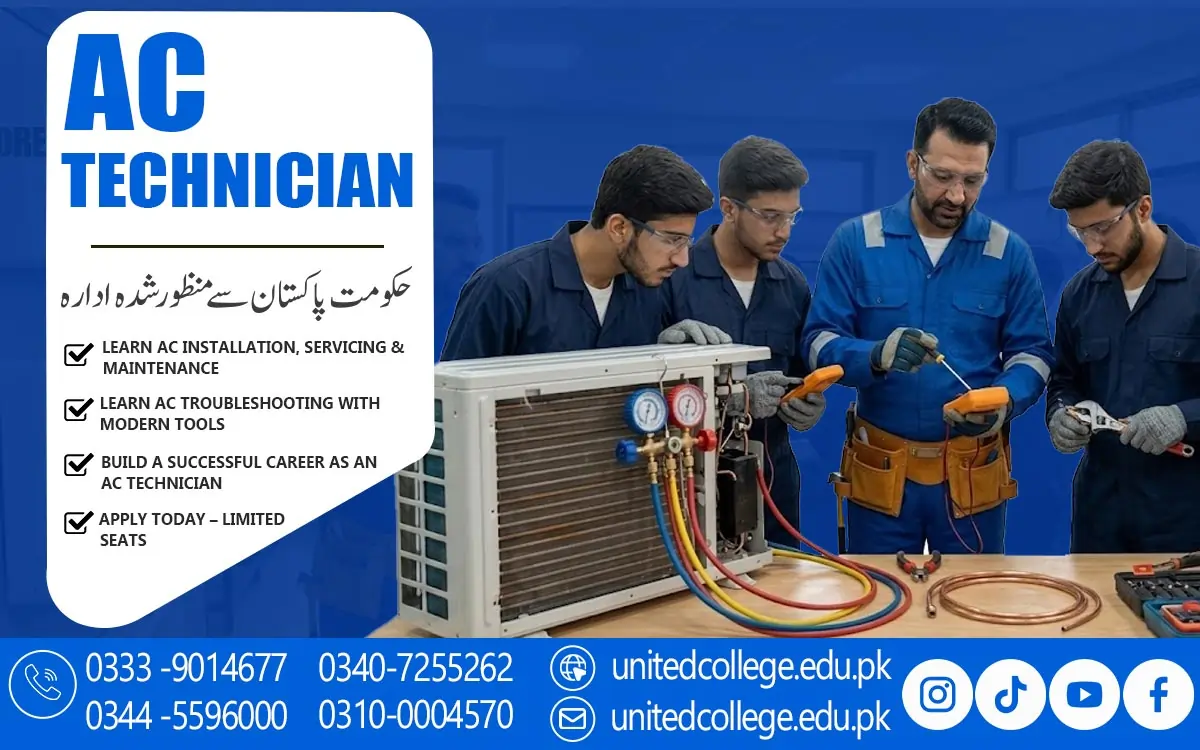

AC Technician Course in Gawadar for Cooling Expertise
AC Technician Course in Gawadar for Mastering Modern Cooling and Repair Skills
Learning a practical technical skill can open the door to new ways of working, solving problems, and gaining experience. The AC Technician Course in Gawadar is a relevant training topic for students, beginners, job seekers, and anyone interested in understanding air conditioning systems. Air conditioners are used in homes, offices, shops, and other buildings, but keeping them in good working condition requires proper knowledge and care.
Learning how these systems operate can help beginners understand common cooling problems and the steps technicians take to solve them. Through AC Technician Training in Gawadar, learners can explore the basic principles of cooling, maintenance methods, installation practices, and fault identification. This knowledge provides a starting point for anyone who wants to develop useful technical abilities instead of relying only on theoretical information.
Understand the Hidden Process That Keeps Every Air Conditioner Cool
An air conditioner does more than blow cold air into a room. It removes heat from indoor air and transfers that heat outside through a cooling process. Several components work together to make this happen. The compressor moves refrigerant through the system, while the condenser helps release heat into the surrounding air. The evaporator absorbs heat from indoor air, and the thermostat helps control the selected temperature.
A beginner-friendly Air Technician Course introduces these components and explains their basic roles. Understanding how each part works makes it easier to spot potential faults and understand why an air conditioner may not cool properly. These HVAC Basic Skills also provide a foundation for learning more advanced repair and maintenance techniques.
Turn Basic Technical Knowledge Into Useful AC Repairing Skills
Studying an AC Repairing Course involves learning how to identify problems instead of guessing what might be wrong. An air conditioner may have weak airflow, unusual sounds, water leakage, poor cooling, or difficulty starting. These symptoms can have different causes, so a technician needs to inspect the system carefully before deciding what action to take. Learners may study how to check air filters, examine visible wiring, inspect drainage arrangements, and recognize signs of restricted airflow.
They can also learn why dirty coils, incorrect thermostat settings, and electrical faults may affect performance. Air Conditioning Repair Skills develop through understanding the relationship between symptoms and possible causes. Good troubleshooting requires patience, observation, and a step-by-step approach. Rather than replacing parts without proper checks, a careful technician gathers information and follows suitable inspection procedures to identify the likely source of a problem.
Explore Installation and Maintenance Techniques That Protect System Performance
Correct installation and regular maintenance play an important role in the operation of an air conditioner. During AC Installation and Maintenance Training, learners can become familiar with installation planning, suitable equipment placement, drainage requirements, airflow, and basic electrical considerations. They can also study routine servicing tasks such as cleaning accessible filters, checking external components, inspecting drain lines, and looking for visible damage. The correct procedure depends on the type of air conditioner and the manufacturer's instructions.
A split AC system, for example, has indoor and outdoor units connected through refrigerant lines and electrical connections. Installing or servicing these parts requires care because poor connections, unsuitable placement, or incorrect handling can affect performance and safety. Beginners should understand which tasks they can practise under supervision and which require a qualified technician. Good maintenance habits help protect equipment and support reliable operation without unnecessary repairs.
Build Confidence Through Careful Tool Use and Real Repair Practice
Practical learning helps turn technical explanations into skills that can be used during actual servicing tasks. In AC Technician Training, learners may become familiar with common service tools, inspection methods, and the correct sequence for checking equipment. Depending on the training arrangements, supervised practice may include examining components, identifying common faults, cleaning accessible parts, and learning how technicians approach basic troubleshooting.
Learners should understand the purpose of each tool before using it and follow the correct procedure rather than relying on guesswork. Practical exercises also teach the importance of recording observations and checking results after a task has been completed. For people with little previous experience, these activities can make technical concepts easier to understand.
Make Electrical Safety and Responsible Refrigerant Handling a Priority
AC servicing requires more than knowing how to repair a component. Safety must guide every inspection, installation, and maintenance task. Before working on electrical parts, technicians must isolate the power supply and verify that the equipment is safe to handle. Capacitors may retain an electrical charge even after power has been disconnected, so they require proper handling by someone with suitable training.
Refrigerant recovery, leak testing, charging, and other related procedures should be performed with suitable equipment and appropriate training. Learners must also understand the correct use of protective equipment and follow manufacturer instructions. A responsible technician never opens a pressurized system or handles unfamiliar electrical components without the required knowledge.
Learn With a Structured Approach Through United College of Technology
People exploring technical education can look into suitable training options before deciding how to begin. The AC Technician Course in Gawadar is a topic for learners who want to understand cooling systems and develop practical repair knowledge. The course is offered by United College of Technology, giving interested learners an institution to consider when exploring AC technician training.
These details matter because the quality and scope of training depend on what is actually included in the program. Learners should look for instruction that explains technical concepts in simple language and connects them with safe working methods. A clear learning structure can help beginners progress from recognizing major components to understanding maintenance procedures and basic fault diagnosis without feeling overwhelmed by unfamiliar terminology.
Apply Your Skills to Everyday Maintenance and Future Technical Development
Knowledge gained through HVAC Technician Training may be useful in several ways, depending on a learner's practice, ability, and further experience. Someone may use basic maintenance knowledge to understand an air conditioner's condition and recognize when professional servicing is necessary. Others may wish to assist an experienced technician, continue learning about refrigeration and cooling systems, or explore work involving air conditioner installation and maintenance.
Building technical ability takes time, supervised practice, and a willingness to keep learning as equipment and service methods change. Good communication, punctuality, careful inspection, and responsible tool handling are also valuable qualities. By developing these habits alongside AC Technician Skills, beginners can create a stronger foundation for further technical learning and practical experience.
Move Forward With Stronger Knowledge of Cooling Systems and Repair Work
A solid understanding of air conditioning begins with learning how cooling systems operate, identifying their main components, and recognizing the reasons behind common performance problems. The AC Technician Course in Gawadar offers a useful subject to explore for anyone interested in practical technical education and air conditioning maintenance. Learners can focus on installation principles, routine servicing, fault identification, tool use, and safe working procedures while gradually improving their understanding through practice.
The most important step is to choose training that matches their learning needs and provides clear information about its actual content. Beginners should remain patient, follow safety instructions, and seek guidance whenever a task goes beyond their current skills. With consistent effort and continued learning, they can develop a better understanding of AC systems and prepare themselves to take on more complex technical tasks as their experience grows.
Frequently Asked Questions (FAQs)
A beginner should understand basic electricity, simple tools, and general safety rules. These basics make it easier to learn how air conditioning equipment works.
Repeated shutdowns, burning smells, unusual noises, or water dripping from unexpected places can indicate a problem that needs proper inspection.
Checking airflow helps technicians identify possible blockages, dirty filters, or other conditions that may reduce cooling performance.
Yes. Knowledge of filter care, temperature settings, airflow, and routine maintenance can help learners understand factors that may cause an AC unit to use more energy.
A split AC has separate indoor and outdoor units, while a window AC combines major components in one unit. Their installation and servicing procedures can differ.
By recording symptoms, checking possible causes in order, following service instructions, and avoiding unnecessary part replacements, learners can develop a more systematic approach.
Admission Open: Start Your Professional Journey Today!
Join United College of Technology and build a career with practical training, recognized certifications, and Gulf job support. Seats are limited.
Apply Now via WhatsAppContact Information
- Address: Rawalpindi: F-272 Main New Katarian Stop, Old IJP Road | Lahore Campus: Lahore, Pakistan
- Phone/WhatsApp: 0340-7255262 / 0333-9014677 / 0301-5044340 / 0310-0004570 / 051-8770756
- Website: unitedcollege.edu.pk
















Leave a Comment