


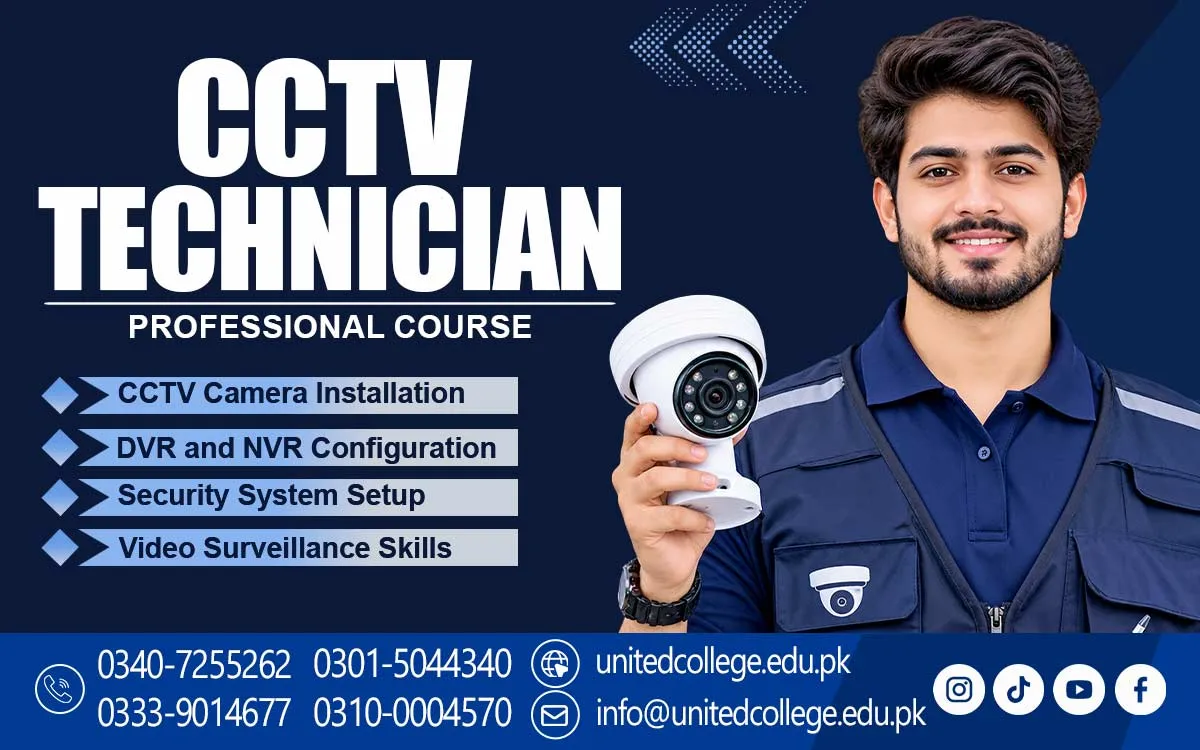

CCTV Technician Course in Nowshehra – Learn CCTV Skills
CCTV Security Systems Used in Modern Homes and Businesses
Security cameras have become an important part of modern security arrangements. From small shops to large factories, different organisations use CCTV monitoring systems to observe activities and maintain recorded footage. In residential areas, homeowners may install cameras near entrance gates, garages, and outdoor spaces to monitor their properties. Shops use security cameras to observe customer activity, monitor cash counters, and review recorded events when necessary. Similarly, schools, hospitals, offices, warehouses, and industrial buildings use surveillance systems for monitoring important areas.
Some systems use traditional analog cameras connected to a Digital Video Recorder (DVR), while modern IP cameras transmit video through a network. Understanding these technologies is an important part of CCTV Technician Training. Students learn that camera placement, clear viewing angles, suitable lighting, and reliable connections all affect recording quality. For example, installing a camera directly toward bright sunlight may produce unclear footage. A technician must consider the surrounding environment before selecting the installation position. These practical details help learners understand the role of CCTV technology in everyday security arrangements.
Practical CCTV Camera Installation and Positioning Techniques
Installing a CCTV camera involves more than simply attaching it to a wall or ceiling. A technician needs to understand the location, viewing angle, mounting height, cable route, and power requirements before starting the installation. During the CCTV Technician Course, students can learn the basic process of preparing an installation area, selecting suitable camera positions, fixing mounting brackets, connecting cables, and testing the final setup. For example, a shop owner may want to monitor the main entrance, cash counter, and storage area. The technician must select camera positions that provide useful coverage without leaving important areas outside the viewing range.
Learners can also understand the difference between indoor and outdoor cameras. Outdoor cameras generally need suitable weather protection, while indoor cameras are selected according to the room layout and lighting conditions. Analog CCTV cameras commonly use coaxial cables, whereas IP cameras can operate through network cables and compatible networking equipment. Students can become familiar with these installation methods through practical exercises. Proper cable management is another important skill because loose or poorly connected wires can cause signal problems and make future maintenance difficult. Learning these techniques helps beginners develop the confidence to approach different CCTV installation tasks carefully and systematically.
Analog Cameras, IP Technology, DVR and NVR Configuration
Different CCTV systems use different technologies, so technicians need to understand their main components and working methods. Analog CCTV cameras generally send video signals to a DVR, which processes and stores the recorded footage. IP cameras work through network connections and commonly use a Network Video Recorder (NVR) for video recording and management. Both systems have their own installation requirements, and the right option depends on the building, security needs, budget, and available equipment. The CCTV Technician Course in Nowshehra introduces learners to these common security technologies and helps them understand the purpose of different devices.
DVR and NVR configuration is another important training area. Students can learn about connecting cameras, selecting recording channels, adjusting video settings, setting the date and time, and checking storage options. For example, if a customer reports that one camera is visible on the screen but its footage is missing from playback, the technician needs to check the recording settings, channel configuration, and storage condition. Learners also become familiar with connectors, power supplies, and network ports used in CCTV systems. Understanding these components makes it easier to identify connection mistakes and recognise the difference between common recording problems.
CCTV Wiring, Networking and Remote Camera Access Skills
Reliable wiring and networking are essential for a CCTV system to work properly. Even a good-quality camera may fail to provide clear footage if its power supply is unstable or its connection is damaged. CCTV wiring involves connecting cameras to recording equipment through suitable cables, connectors, and power arrangements. During training, students can learn about coaxial cables, Ethernet cables, BNC connectors, RJ45 connectors, and basic cable testing methods. IP camera installation also requires an understanding of network connections, internet access, and compatible devices. For example, if a camera disconnects frequently, a technician may need to inspect the Ethernet cable, network port, power source, or router settings.
Remote camera access is another useful feature of modern CCTV monitoring systems. It allows authorised users to view connected cameras through a mobile phone or computer when the system has been configured correctly. Learners can become familiar with the basic steps involved in connecting a recorder to a network and setting up remote viewing through compatible applications. They should also understand the importance of strong passwords and secure access settings. These skills help students recognise the relationship between CCTV equipment and networking technology while preparing them to handle common connection-related problems.
CCTV Maintenance, Camera Troubleshooting and Repair Methods
A CCTV system needs regular inspection to maintain reliable performance. Dust on camera lenses, damaged cables, loose connectors, incorrect settings, and storage problems can affect video quality or recording functions. During the CCTV Technician Course, students learn about CCTV maintenance and repair, helping them understand how to inspect equipment and identify common faults. For example, when a camera displays blurry footage, the technician may need to clean the lens, adjust its focus, or check whether the camera position has changed. If night vision is not working correctly, the problem could involve infrared lights, power supply issues, or incorrect camera settings.
Camera troubleshooting requires patience because the same visible problem can have several possible causes. Students can learn to check connections step by step instead of replacing equipment without proper inspection. Basic maintenance also includes checking camera brackets, reviewing cable conditions, removing dust, and testing video signals. A technician should follow safe working practices and avoid opening electrical equipment without suitable knowledge. Through practical exercises, beginners can develop a systematic approach to identifying faults and understanding the difference between simple maintenance tasks and repairs that require more advanced technical skills.
Essential Tools and Equipment for CCTV Technician Training
Learning to use the correct tools is an important part of becoming familiar with CCTV installation work. Technicians use different equipment to prepare mounting points, connect cables, test signals, and inspect electrical connections. A screwdriver set is useful for tightening camera brackets, opening compatible equipment covers, and securing connectors. Drilling machines help create mounting holes in suitable walls and ceilings, while crimping tools are used to attach compatible connectors to cables. A LAN cable tester helps check Ethernet cable connections and identify wiring faults. Students can also become familiar with BNC connectors, RJ45 plugs, power adapters, cable ties, and basic networking equipment.
A digital multimeter may be used to check electrical values when the technician has the required training and follows safe procedures. During the CCTV Technician Course in Nowshehra, understanding the purpose of these tools can help learners become more comfortable with practical installation tasks. For instance, if an IP camera is not receiving a network connection, a cable tester can help determine whether the Ethernet cable has a wiring problem. Similarly, checking a compatible power supply can help identify a possible power-related fault. Knowing the correct tool for each task saves time, improves installation quality, and reduces the risk of damaging equipment during maintenance or troubleshooting.
Technical Learning Opportunities for Students in Nowshehra
For students and beginners in Nowshehra, enrolling in a CCTV Technician Course can be a useful way to learn practical technical skills, explore an area of interest, and build confidence. CCTV installation is connected with several everyday environments, including residential buildings, retail shops, educational institutions, offices, and industrial workplaces. As more people use security cameras, there is a continuing need for technicians who understand installation methods, basic networking, system configuration, and equipment maintenance. However, learning these skills requires more than memorising the names of cameras and recording devices.
A structured CCTV Installation Course can help beginners develop this knowledge step by step. Learners in Nowshehra can use technical training to become familiar with equipment they may encounter during installation and maintenance work. They can also improve their problem-solving abilities by practising different situations, such as a camera losing its connection or a recorder failing to save footage. Starting with basic tasks and gradually moving toward more complex setups makes technical learning easier to understand. Regular practice, patience, and an interest in security technology can help students build a stronger foundation for further learning and practical experience.
Professional CCTV Technician Training at United College of Technology
United College of Technology (UCT) offers the CCTV Technician Course in Nowshehra for individuals interested in learning about security camera installation and related technical work. The course provides a learning opportunity for beginners who want to understand CCTV equipment, installation methods, wiring, and basic maintenance. During technical training, students can develop familiarity with analog cameras, IP camera systems, DVR and NVR devices, connectors, and networking components. Practical learning is especially important because CCTV installation involves working with real equipment and understanding how different components connect.
Technical guidance can also help students understand common installation mistakes, such as incorrect cable connections, unsuitable camera positions, and poor power arrangements. United College of Technology aims to provide learners with a foundation in practical technical skills that they can continue improving through regular practice. Beginners can gradually become familiar with installation procedures and basic troubleshooting instead of trying to learn every technical concept at once. Developing a clear understanding of equipment and safe working methods can make the learning process more useful and prepare students for further skill development in the security systems field.
Career Development and Practical Work in the CCTV Security Industry
CCTV technician skills can be useful in different areas of the security and technical services industry. After gaining suitable training and practical experience, learners may explore work with CCTV installation companies, security equipment providers, maintenance services, commercial buildings, and residential security projects. Some experienced technicians also choose to provide independent installation and maintenance services, depending on their technical ability, available tools, and customer requirements. However, professional work requires more than completing a training course. A technician needs to understand equipment compatibility, follow safe installation practices, communicate clearly with customers, and diagnose problems accurately.
For example, when installing cameras in a small office, the technician may need to understand the customer's monitoring requirements, identify suitable camera locations, plan cable routes, and test the recording system before completing the work. Knowledge of CCTV Wiring and Networking, remote access, camera troubleshooting, and DVR and NVR configuration can be useful in these situations. The CCTV Technician Course in Nowshehra at United College of Technology provides a starting point for individuals who want to develop these technical abilities. With continued practice, additional learning, and real-world experience, students can strengthen their skills and explore different areas of security surveillance technology.
Frequently Asked Questions (FAQs)
Beginners can learn CCTV camera installation, cable connections, DVR and NVR configuration, IP camera setup, basic networking, and troubleshooting.
Yes, students can learn about IP cameras, network connections, camera configuration, and remote viewing through compatible mobile applications.
Common tools include screwdrivers, drilling machines, crimping tools, LAN cable testers, multimeters, connectors, and networking equipment.
Yes, maintenance is an important skill. It includes checking camera connections, cleaning lenses, inspecting cables, testing recording devices, and identifying common system faults.
After developing practical experience, students can explore CCTV installation, security equipment companies, camera maintenance services, and independent technical projects.
Admission Open: Start Your Professional Journey Today!
Join United College of Technology and build a career with practical training, recognized certifications, and Gulf job support. Seats are limited.
Apply Now via WhatsAppContact Information
- Address: Rawalpindi: F-272 Main New Katarian Stop, Old IJP Road | Lahore Campus: Lahore, Pakistan
- Phone/WhatsApp: 0340-7255262 / 0333-9014677 / 0301-5044340 / 0310-0004570 / 051-8770756
- Website: unitedcollege.edu.pk
















Leave a Comment