


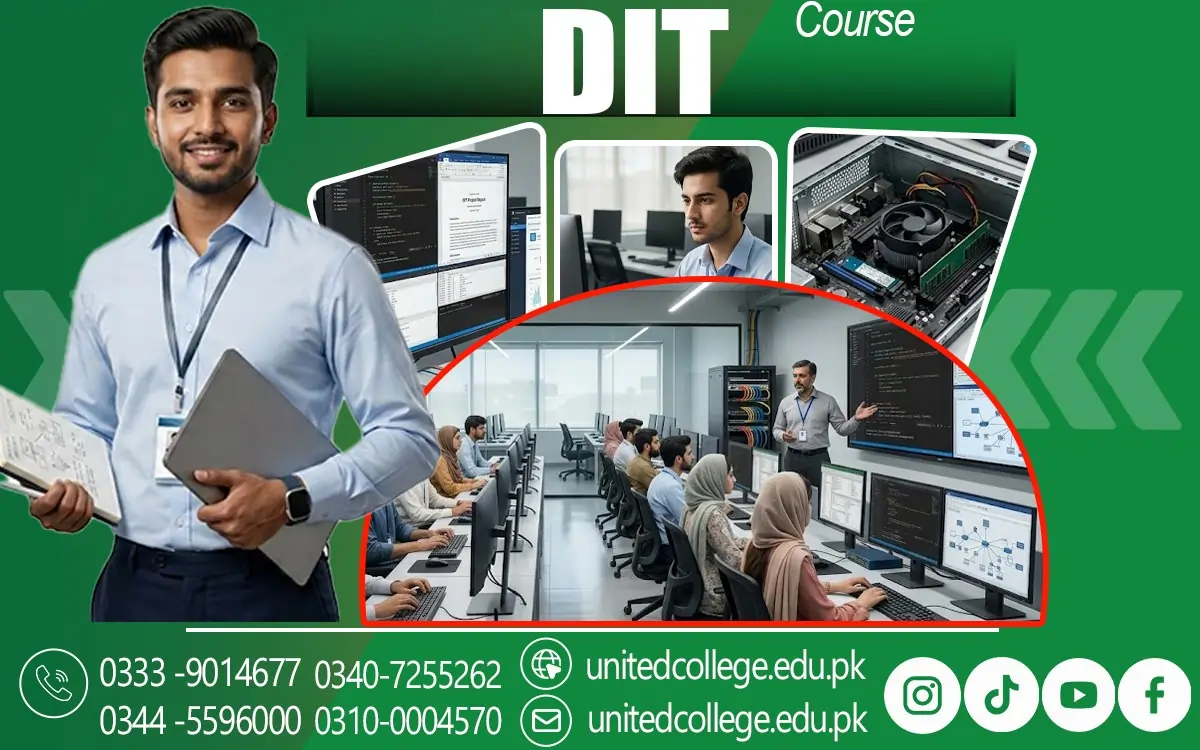

DIT Course in Gilgit Baltistan for IT Education
Exploring the Fundamentals of Digital Technology
The DIT Course in Gilgit Baltistan is a useful option for students who want to develop computer knowledge and understand how digital technology is used in everyday life. Information technology supports many activities, including education, business operations, communication, and office administration. Through this course, learners can explore the basic functions of computers and understand how digital tools help people manage information and complete different tasks efficiently.
Students learn about computer hardware, software, input and output devices, memory, and storage systems. They also become familiar with the basic functions of operating systems and common computer applications. This knowledge helps beginners understand how computers receive information, process data, and produce useful results. Learning these concepts can make students more confident when using technology for academic and professional purposes.
Digital technology is becoming increasingly important across different industries. Schools use computers for educational activities, businesses maintain electronic records, and offices depend on digital communication. By learning the fundamentals of information technology, students can build a foundation for advanced computer training and explore opportunities that require basic technical knowledge.
Understanding Computer Operating Systems
An operating system is essential for managing computer hardware, software, and everyday operations. During the DIT course, students learn about operating systems such as Microsoft Windows and become familiar with their main functions. They explore how an operating system allows users to open applications, manage files, change settings, and interact with different computer components.
Students can practice using the desktop, taskbar, file explorer, and system settings. They learn how to create folders, locate documents, manage installed applications, and organize information. Understanding these functions helps learners perform routine computer tasks more efficiently and solve simple problems that may occur during regular use.
Basic knowledge of operating systems also supports further learning in information technology. Students who understand how computers operate can gradually explore software installation, system maintenance, and troubleshooting. These skills are useful in educational environments, offices, and other workplaces where computers are used for daily activities.
Preparing Documents for Administrative Tasks
Document preparation is an important skill for students who want to work in administrative and office environments. The DIT course introduces learners to word processing applications that help create, edit, and format written information. Students can practice preparing official letters, applications, meeting notices, reports, and other documents commonly used by businesses and educational institutions.
Learners also study formatting techniques that make documents clear and professional. These may include selecting suitable fonts, arranging paragraphs, inserting headings, adjusting margins, and creating tables. They can learn how to add page numbers, correct spelling mistakes, and maintain a consistent layout. These techniques help present information in a structured and readable form.
Another important part of document preparation is managing files correctly. Students learn to save documents, use meaningful filenames, choose suitable file formats, and prepare files for printing or sharing. Regular practice helps them improve accuracy and develop the confidence needed to complete common administrative tasks using computer software.
Using Spreadsheets for Information Handling
Spreadsheet applications help users organize information, perform calculations, and prepare reports. In the DIT Course in Gilgit-Baltistan, students can learn how to use programs such as Microsoft Excel to organize data in rows, columns, and worksheets. These tools are useful for maintaining attendance records, preparing budgets, tracking expenses, and organizing business information.
Students learn to enter data, format cells, and apply formulas for basic calculations. They can practice calculating totals, averages, and percentages while exploring functions that simplify repetitive tasks. Sorting and filtering features help learners arrange information and locate specific records without reviewing every entry manually.
Spreadsheets can also present information through charts and graphs. Students can use these features to compare figures and make reports easier to understand. Developing spreadsheet skills can support future work in data entry, office administration, inventory management, and accounting assistance, depending on an individual's training and qualifications.
Learning Basic Database Techniques
Database techniques help students understand how information can be stored and organized for easy access. Businesses, schools, hospitals, and other organizations use databases to maintain records about customers, employees, students, products, and transactions. The DIT course introduces learners to the importance of accurate digital records and the role databases play in managing large amounts of information.
Students can learn basic concepts such as tables, fields, records, and data organization. Depending on the syllabus, they may also explore introductory database applications and practice entering, updating, searching, and retrieving information. These activities help learners understand how organized records make daily administrative work more manageable.
Maintaining reliable information requires accuracy and responsible handling. Students learn why incorrect entries, duplicated records, and poor organization can cause problems. They should also understand the importance of protecting confidential information and limiting access to sensitive data. These basic techniques provide a useful foundation for further learning in database management and information systems.
Developing Effective Email Communication
Email is an important communication tool used by educational institutions, businesses, and professional organizations. During the DIT course, students learn how email services help users exchange messages, share documents, and communicate across different locations. They can practice writing clear messages and understanding the basic features of commonly used email platforms.
Students learn how to create a suitable subject line, organize the message body, attach files, and review an email before sending it. They can also explore inbox management, searching for messages, organizing emails, and responding professionally. These skills are useful when communicating with teachers, applying for jobs, contacting organizations, or sharing information with colleagues.
Responsible email use is equally important. Learners should understand how to recognize suspicious messages, avoid unsafe attachments, protect account passwords, and keep personal information secure. Developing effective email habits can improve communication and help students use digital services confidently in educational and workplace settings.
Practicing Data Entry and Record Maintenance
Data entry involves entering information into computer systems accurately and organizing it so that it can be used when needed. In the DIT course, students can practice entering text, numbers, dates, and other details into documents, spreadsheets, and digital forms. These activities help learners improve their typing accuracy and understand the importance of careful information handling.
Record maintenance involves reviewing and updating information to keep it accurate and organized. Students learn how to correct errors, update existing details, arrange files, and locate specific records. They can also practice using consistent naming methods and folder structures to make digital information easier to manage. These habits help reduce confusion and support efficient administrative work.
Students should also understand the importance of data privacy and backups. Important records need to be stored carefully, and sensitive information should not be shared with unauthorized people. Regular practice with data entry and record maintenance can help learners prepare for entry-level office tasks and develop useful skills for computer-based employment.
Understanding Career Paths in IT Services
The DIT course can help students develop basic computer knowledge that may support different educational and employment pathways. By learning operating systems, document preparation, spreadsheets, databases, email communication, and data entry, students can build a foundation for working with digital information. The opportunities available to each learner depend on their qualifications, practical abilities, experience, and employer requirements.
Possible entry-level career options include computer operator, data entry operator, office assistant, documentation assistant, and administrative support worker. Students who want to pursue more technical roles can continue studying computer networking, programming, web development, cybersecurity, or database administration. These specialized fields may require additional education, practical experience, or professional certifications.
Building practical experience is an important step toward career development. Students can prepare sample reports, create spreadsheets, organize digital records, and practice common computer operations. They can also improve communication, typing, and problem-solving abilities. With consistent practice and continued learning, students in Gilgit-Baltistan can strengthen their computer knowledge and prepare for further education or suitable IT-related opportunities.
Frequently Asked Questions (FAQs)
The Diploma in Information Technology (DIT) is a computer education program that introduces students to digital technology, operating systems, office applications, spreadsheets, databases, and computer-based tasks.
Common subjects include computer fundamentals, operating systems, word processing, spreadsheet applications, database basics, email communication, data entry, and record maintenance. The exact syllabus depends on the institute.
Students interested in computer education can consider applying if they meet the admission requirements of their selected institute.
Operating system knowledge helps students manage files, use applications, adjust computer settings, and perform routine operations more effectively.
Many DIT programs include spreadsheet applications such as Microsoft Excel, where students learn data entry, formulas, calculations, and basic information management.
Admission Open: Start Your Professional Journey Today!
Join United College of Technology and build a career with practical training, recognized certifications, and Gulf job support. Seats are limited.
Apply Now via WhatsAppContact Information
- Address: Rawalpindi: F-272 Main New Katarian Stop, Old IJP Road | Lahore Campus: Lahore, Pakistan
- Phone/WhatsApp: 0340-7255262 / 0333-9014677 / 0301-5044340 / 0310-0004570 / 051-8770756
- Website: unitedcollege.edu.pk
















Leave a Comment