


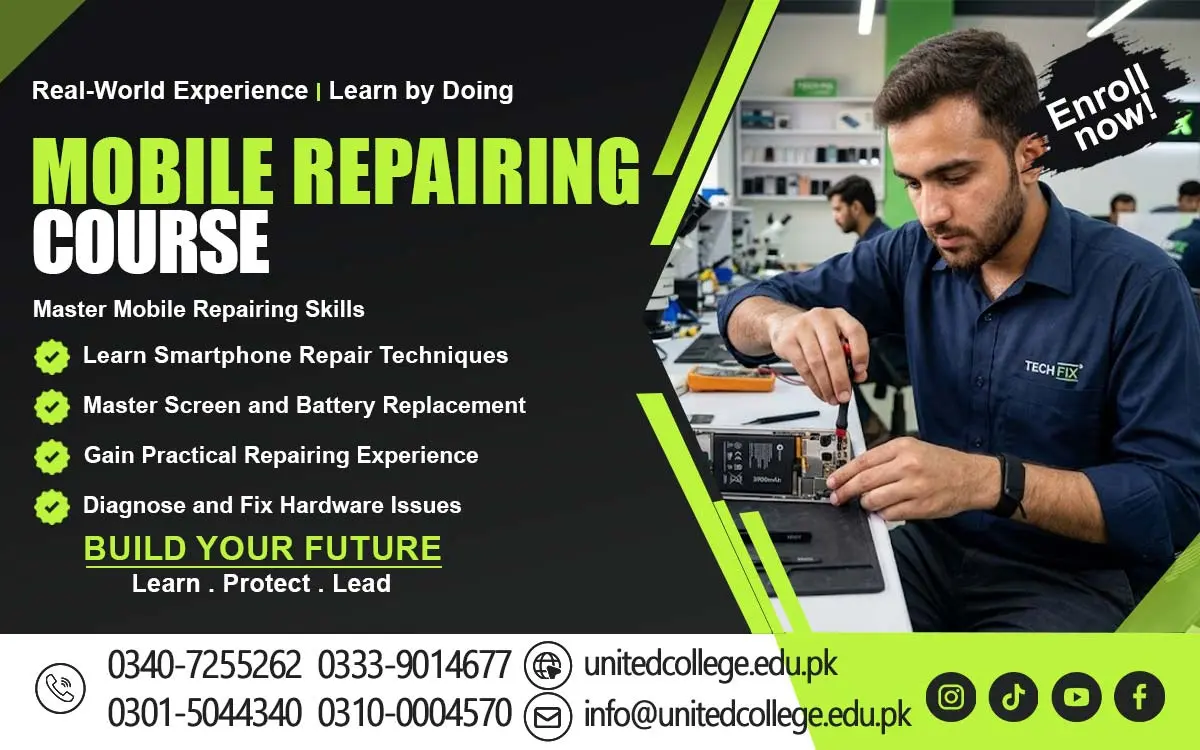

Mobile Repairing Course in Khurram Agency – Master Phone Repair Skills
Common Smartphone Problems That Make Repair Skills Valuable
Modern smartphones are used for communication, education, online shopping, banking, photography, and business, so even a small fault can disrupt someone's daily routine. A phone may stop charging, develop a cracked screen, produce no sound, lose its network connection, or restart unexpectedly. Some devices become slow because of limited storage, outdated software, or applications running in the background, while others experience physical damage after falling onto a hard surface. These problems create a need for people who understand mobile phone diagnostics and can identify possible causes before recommending a repair.
For example, a phone that does not turn on may have a discharged battery, a faulty charging port, damaged internal connections, or a more serious motherboard problem. Guessing the cause and replacing parts without testing can waste money and time. A trained technician learns to observe symptoms, ask questions about the problem, and perform suitable checks before deciding what to do next. For students considering a Mobile Repairing Course in Khurram Agency, these everyday situations provide a useful starting point for understanding the profession.
What Students Can Expect from Mobile Repairing Training
Learning mobile repairing involves understanding the parts of a phone, recognizing common faults, using suitable tools, and following a step-by-step repair process. Beginners first need to understand the basic components of a smartphone, including the battery, display, charging port, camera, speaker, microphone, buttons, and main circuit board. They can then build knowledge of how these components work together and what may happen when one of them develops a fault. Mobile repairing training can also introduce students to safe phone opening methods, screw identification, connector handling, and basic testing procedures.
A mobile phone repair course may cover hardware repair, software troubleshooting, fault detection, and general device maintenance, depending on its curriculum. Students interested in the Mobile Repairing Course in Khurram Agency should understand that practical ability develops through repeated practice rather than memorizing technical terms alone. United College of Technology (UCT) offers this course for people interested in learning mobile repairing, making it relevant to beginners exploring technical education. Before enrolling, learners should confirm the current syllabus, practical training arrangements, course duration, fees, and admission requirements directly with the institution.
Identifying Mobile Hardware Faults and Damaged Components
A smartphone contains many connected parts, and a fault in one component can sometimes appear to be a problem with another. Hardware repair focuses on physical components, including the display, battery, charging connector, speakers, microphones, cameras, buttons, and internal circuits. A cracked screen is an obvious example, but other problems are less visible. A phone may have a loose connector, a damaged charging port, corrosion caused by liquid exposure, or a component that has stopped working correctly. Mobile hardware repair begins with careful inspection rather than immediately removing parts. A technician checks the phone's condition, looks for signs of physical damage, and tests the relevant functions where appropriate.
For example, if a customer reports that the speaker is not working, the technician may first check the volume settings, sound output, and software behaviour before investigating the speaker itself. This approach helps separate simple issues from possible hardware failures. During the Mobile Repairing Course in Khurram Agency, learners can build an understanding of these diagnostic principles and the importance of handling delicate components carefully. They should also learn that motherboard repair is more complex than replacing an external part because the main circuit board contains small electronic components and interconnected circuits. Some faults require advanced equipment and specialist experience.
Learning Mobile Software Troubleshooting and System Recovery
Not every smartphone problem is caused by a broken component. Sometimes the hardware is working properly, but an application, operating system, setting, or corrupted software file causes the device to behave unexpectedly. A phone may freeze, restart repeatedly, become unusually slow, or fail to open certain applications. Mobile software troubleshooting involves checking these symptoms and identifying possible software-related causes before attempting more complicated solutions. Beginners can learn to check available storage, review application behaviour, install legitimate system updates, restart a device, and understand when a settings change may resolve a problem.
A factory reset can erase personal information, so customer permission and a verified backup are important before taking that step. More advanced tasks, such as firmware recovery, require device-specific knowledge and careful attention to the correct software version. Android phone repair may involve different procedures from those used for iPhones, so technicians must follow reliable instructions for the particular device. Learners exploring the Mobile Repairing Course in Khurram Agency can benefit from understanding these differences and practising safe troubleshooting methods. They should never attempt to bypass security protections or access a customer's private information without authorization.
Using Mobile Repairing Tools Safely and Correctly
Repairing a smartphone without the right tools can turn a small fault into a costly problem. Mobile devices contain tiny screws, delicate connectors, flexible cables, and sensitive electronic components that need careful handling. Precision screwdrivers help technicians remove small screws without damaging their heads, while plastic opening tools can help separate phone covers with less risk of scratching or breaking them. Tweezers are useful for handling small parts, and a multimeter can measure electrical values such as voltage and continuity when used correctly.
Battery handling also requires care because puncturing, bending, or overheating a lithium-ion battery can create a fire risk. Technicians should follow suitable safety procedures, disconnect power where appropriate, and use equipment designed for the task. During practical mobile repair training, learners should also develop the habit of keeping screws organized, maintaining a clean workspace, and checking that parts are correctly reconnected before closing a device. The Mobile Repairing Course in Khurram Agency, offered by United College of Technology (UCT), is an option for those interested in developing this technical knowledge.
Diagnosing Charging, Battery, Screen, and Touch Problems
However, each symptom can have several possible causes. If a phone does not charge, the issue might involve the cable, adapter, charging port, battery, software, or internal circuitry. A technician should test safe and suitable possibilities before recommending a component replacement. If a battery drains quickly, the cause may be battery ageing, background applications, poor network conditions, or another fault. Similarly, a black screen does not always mean the entire phone has stopped working; the device may still respond to calls or produce sounds even when its display is damaged.
LCD and touchscreen replacement requires particular care because displays vary by model and may connect to the main board through delicate flexible cables. A technician must also distinguish between display damage and a touch-related fault before selecting a replacement part. Students taking a Mobile Repairing Course in Khurram Agency can benefit from learning a consistent diagnostic process: observe the symptoms, ask the user when the problem began, check basic settings and accessories, test relevant functions, and determine whether specialist inspection is needed. Accurate diagnosis helps prevent unnecessary repairs and improves communication with customers.
Developing Practical Skills Through Hands-On Repair Tasks
Reading about mobile phone repair is useful, but practical experience is essential for understanding how the process works. A beginner may know the names of different phone components yet struggle when faced with a tightly fitted back cover, a delicate connector, or a device containing several small screws. Guided practice helps learners turn theoretical knowledge into practical ability. Suitable beginner activities may include identifying external and internal components, recognizing different screw types, practising safe disassembly on appropriate training devices, and learning how to reconnect parts correctly. Students can also practise basic fault identification using sample devices with known problems, following instructions from an experienced trainer.
Each task should be approached carefully, with attention to the condition of the device before and after the repair. Keeping simple notes about symptoms, tests, findings, and results can help learners understand why a particular solution worked. Practical training also develops patience, concentration, hand control, and problem-solving skills. These abilities are especially important when working with small components that can be damaged by a sudden movement or excessive pressure. People considering the Mobile Repairing Course in Khurram Agency should ask about the practical activities available and how beginners are supervised during repair work. It is sensible to start with basic tasks and gradually progress to more complicated work as knowledge improves.
Understanding Mobile Technician Responsibilities and Career Paths
Mobile phone repair involves more than finding a fault and replacing a damaged component. Technicians also need to understand customer concerns, explain repair options, protect personal information, and communicate honestly about what can and cannot be fixed. When someone brings in a phone with a charging problem, for example, the technician should explain the results of the inspection rather than promise a repair before identifying the cause. Customers may also need clear information about possible costs, replacement parts, repair risks, and the time required for a particular job. These responsibilities make honesty and communication important alongside technical knowledge.
After gaining sufficient practical experience, learners may explore different mobile repair career opportunities, such as assisting an experienced technician, applying for suitable entry-level positions in repair shops, or eventually considering a small repair business. Self-employment, in particular, may require investment in tools, replacement parts, workspace, and customer service. Completing a training course alone does not guarantee a job or a particular income, so students should continue developing their abilities after training. The Mobile Repairing Course in Khurram Agency can be considered by learners who want to begin exploring this technical field through United College of Technology (UCT).
How Beginners in Khurram Agency Can Prepare for Mobile Repairing Training
Starting a technical course becomes easier when learners know what they want to achieve and are prepared to practise regularly. Students in Khurram Agency who are interested in mobile phone repair can begin by learning the names of common smartphone components and observing how charging, sound, display, camera, and network functions work. Basic computer knowledge can also be helpful when learning about device software, file management, and troubleshooting instructions. Beginners do not need to understand every technical detail before starting, but curiosity, patience, and a willingness to follow safety procedures are important.
It is also useful to become familiar with common repair terms, such as motherboard, charging port, connector, firmware, and touchscreen, so that classroom explanations are easier to follow. Before joining the Mobile Repairing Course in Khurram Agency, prospective students should contact United College of Technology (UCT) to confirm the latest course details, eligibility requirements, available practical work, fees, and schedule. They should ask whether the training covers both hardware repair and software troubleshooting, as well as which tools and devices are used for practice. Once training begins, learners can make steady progress by taking notes, asking questions, reviewing difficult topics, and practising each task under suitable supervision.
Frequently Asked Questions (FAQs)
The Mobile Repairing Course in Khurram Agency, offered by United College of Technology (UCT), is designed for learners interested in understanding smartphone repair, fault diagnosis, hardware components, and software troubleshooting.
Yes, beginners can explore mobile repairing training without prior professional experience. Learning basic components, repair tools, and troubleshooting methods can help them develop their skills gradually.
Students can learn about mobile hardware repair, charging problems, battery replacement, screen faults, touchscreen issues, software troubleshooting, and basic mobile phone diagnostics, depending on the course curriculum.
Mobile repairing training may cover both hardware and software topics, including damaged components, charging ports, operating system issues, and common smartphone faults. Students should confirm the current syllabus with UCT.
Common mobile repairing tools include precision screwdrivers, plastic opening tools, tweezers, multimeters, and suitable diagnostic equipment. The tools required depend on the repair task and phone model.
Admission Open: Start Your Professional Journey Today!
Join United College of Technology and build a career with practical training, recognized certifications, and Gulf job support. Seats are limited.
Apply Now via WhatsAppContact Information
- Address: Rawalpindi: F-272 Main New Katarian Stop, Old IJP Road | Lahore Campus: Lahore, Pakistan
- Phone/WhatsApp: 0340-7255262 / 0333-9014677 / 0301-5044340 / 0310-0004570 / 051-8770756
- Website: unitedcollege.edu.pk
















Leave a Comment